Alabama DNP students need more than a general clinical contact. They need a setting prepared to host a scholarly quality-improvement project, a mentor whose role fits that work, and a practice-hour plan their program will approve. Our independent placement desk helps students at any university identify those pieces across Alabama without promising a site or approval.
The DNP is a practice doctorate, so the central placement question is where you can implement and evaluate a meaningful practice change. A suitable Alabama project site might be a hospital unit reducing preventable readmissions, a community clinic improving diabetes follow-up, a county health program increasing vaccination completion, or a long-term care organization strengthening fall prevention. The site must have a real population, an accessible workflow, a leader willing to sponsor the work, and enough data to measure change.
The project mentor also has to match your program's criteria. Depending on the project, that person may be a DNP-prepared nurse, a nurse executive, a physician, a quality leader, or another experienced health-system professional. Before outreach begins, ask your program whether the mentor must hold a doctorate, whether an organizational sponsor and an academic chair are separate roles, and what approvals are required before data collection. Our placement process begins with those written requirements.
Birmingham has the state's deepest concentration of tertiary hospitals, specialty services, children's care, nursing leadership, and formal quality teams. Huntsville Hospital Health System gives north Alabama another broad hospital network, while Montgomery, Mobile, and Tuscaloosa support substantial acute-care, ambulatory, public-health, and executive-practice opportunities. Mobile Infirmary, Baptist Health in central Alabama, East Alabama Health, and Children's of Alabama illustrate the range of non-university systems where a well-scoped project may fit if local leaders and the student's program approve it.
Each setting favors different questions. Large systems may support projects involving care transitions, sepsis processes, workforce well-being, medication safety, or dashboard adoption. County programs and community health centers may be better for screening, chronic-disease outreach, maternal health, or access projects. A good proposal is narrow enough for the host to implement during the student's term and useful enough that a clinical or operational leader can champion it.
The Black Belt, Wiregrass, Appalachian northeast, and western counties have fewer organizations with dedicated nursing-research or improvement offices. They still offer strong practice-doctorate work through critical-access hospitals, small rural hospitals, federally qualified health centers, county health departments, home-health teams, and telehealth programs. Alabama's Office of Primary Care and Rural Health supports this landscape and identifies county departments, rural clinics, community health centers, and small hospitals as core partners.
Rural projects succeed when the design respects staffing and travel. A student might use an existing clinic registry rather than create a new database, hold brief staff education during established meetings, or measure a process already captured in the electronic record. If the nearest appropriate mentor is in a regional hub, confirm whether your program allows remote mentorship while the project work remains anchored at the approved local site.
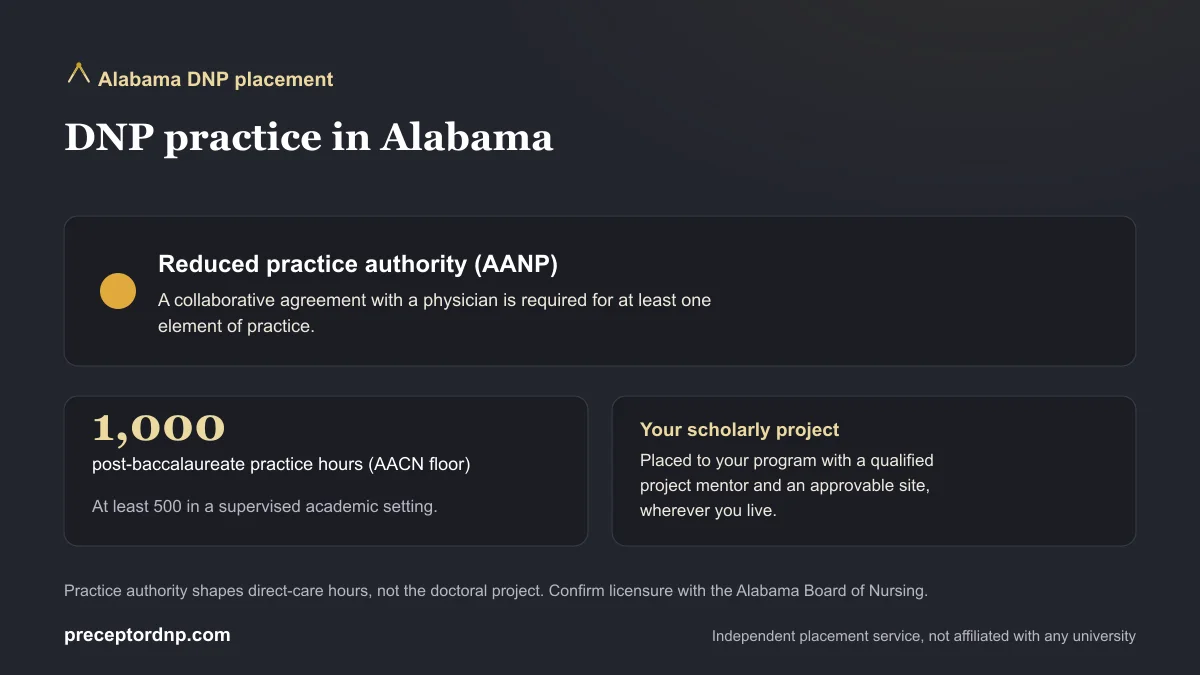
AACN guidance requires at least 1,000 supervised post-baccalaureate practice hours, with at least 500 completed in a supervised academic setting. This is a cumulative minimum, not a promise that every Alabama DNP student starts another 1,000 hours at the doctoral level. A post-master's student may bring qualifying graduate hours that the program evaluates, while a BSN-to-DNP student generally completes population-focus clinical work alongside systems learning and the scholarly project. The remaining number varies by program, so obtain a written hour audit before committing to a site.
Practice experiences can include project planning and implementation, leadership work, population-health assessment, informatics, and approved direct care, but your program decides what counts. Keep a prospective activity log, connect every entry to a course outcome, and ask who must verify it. Review our DNP practice-hour guide and confirm the final calculation with your own program.
AANP currently classifies Alabama as a reduced-practice state. That classification matters when a DNP student's supervised hours include diagnosing, treating, prescribing, or other direct nurse practitioner care because the site and preceptor must operate within Alabama's collaborative-practice structure. A board-certified NP or physician in the student's population focus is the usual direct-care match, subject to program rules and current licensure requirements.
A quality-improvement project that changes a workflow, educates staff, or evaluates an organizational process is generally different from a licensure-gated clinical rotation. Do not treat that distinction as permission to work without site review. Confirm the activity with your program, the host's compliance process, and the Alabama Board of Nursing, especially if the project touches patient care or protected data.
Most online DNP programs expect students to self-source a mentor and site, while some offer coordinator help or a placement-assistance process. Either way, approval stays with the program. A useful Alabama outreach packet states the project aim, target population, expected dates, onsite needs, mentor qualifications, data requirements, and paperwork deadline. It should also say what remains provisional rather than presenting the project as already authorized.
The PreceptorDNP placement desk can help identify and approach plausible organizations, screen mentor fit, and support the paperwork handoff. We are independent, serve students at any university, and cannot guarantee acceptance or program approval. Share your requirements through the match form or contact our desk when you are ready to discuss Alabama options.
Hospitals, health systems, community health centers, county health departments, long-term care organizations, and other approved community settings can all be suitable. The right site has a defined improvement need, usable data, leadership support, and the ability to complete your program's agreement and review process.
Programs commonly accept a DNP-prepared nurse, nurse executive, physician, or qualified system leader whose expertise matches the project. Direct-care hours usually require a board-certified NP or physician in the correct population focus. Your own program sets the final credential and experience rules.
Not necessarily. The requirement is at least 1,000 supervised post-baccalaureate hours cumulatively, and the doctoral-level balance varies by program. Post-master's students may receive credit for qualifying prior graduate hours after an official review. Ask your program for a written audit before planning the remaining experiences.
It controls licensed direct-care practice more directly than a quality-improvement project. Alabama's reduced-practice environment matters for clinical NP hours, but a workflow or outcomes project usually follows organizational and academic approval channels. Confirm both the project scope and any patient-care activity before starting.
No. We can research, approach, and screen possible matches and help with the handoff, but organizations may decline and your program makes the final approval decision. Early, complete requirements give the search its best chance of producing a suitable option.
No cost to request, and nothing is billed until a match is confirmed and your school signs off. We'll reply within one business day.
We do not guarantee placement. Final approval rests with your program.
