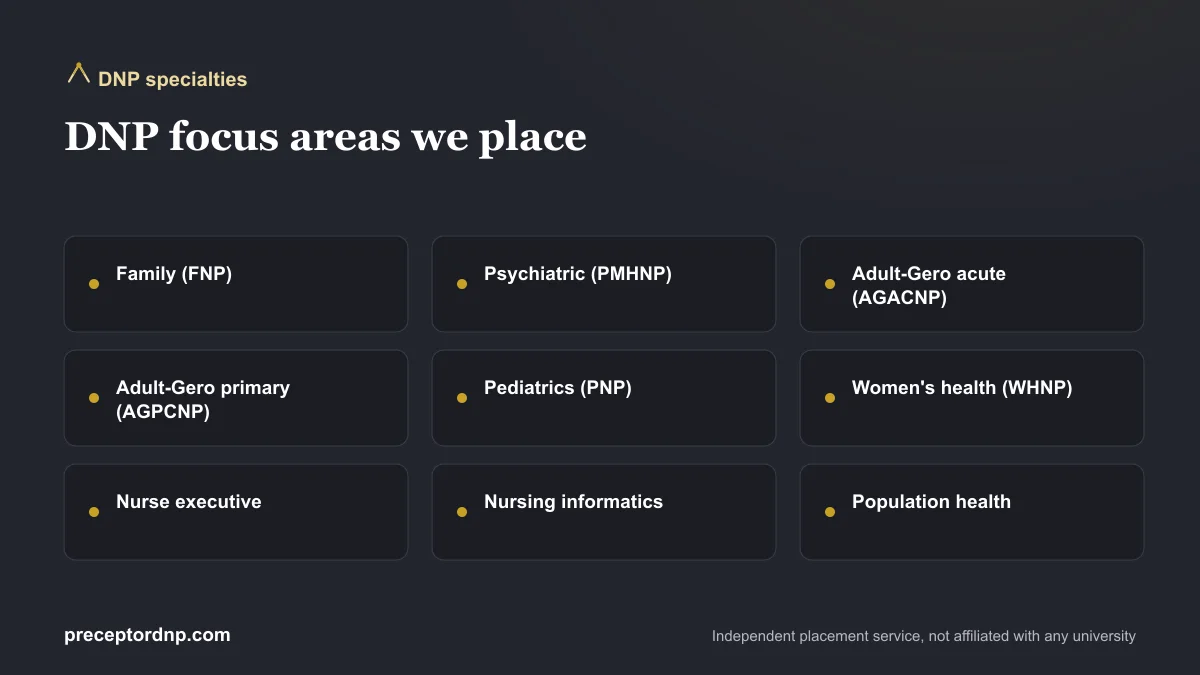
A preceptor who satisfies an FNP practicum won't satisfy a PMHNP one. Doctoral placement is a matching problem, scope, certification, and setting all have to line up with your track. Here is what each specialty needs, and what programs actually check before they approve.
The highest-volume DNP entry track and the heaviest direct-care load. FNP practicum needs primary-care preceptors across the lifespan, a match that has to cover pediatrics through geriatrics, which is why FNP students often need more than one site.
The fastest-growing specialty and the most placement-constrained. PMHNP hours require a psych-certified preceptor for medication management and therapy, a much smaller pool than primary care, and the specialty where a placement service most often makes the difference between starting on time and waiting a term.
Certification dictates setting. AGACNP hours belong in inpatient acute care; AGPCNP hours belong in a primary-care clinic. Matching the wrong setting to the wrong certification is one of the most common reasons a proposed preceptor is rejected on approval.
The narrowest specialty pools. Pediatric and women's-health preceptors are geographically thin outside major metros, which is exactly where a sourcing service earns its keep.
Not every DNP is a nurse practitioner degree. Executive leadership, informatics, and systems-focused DNPs, like Thomas Edison's Systems-Level Leadership track or Grand Canyon's practice/leadership DNP, need a practice mentor and an implementation site for the DNP project rather than a certifying clinical preceptor. Purdue Global's post-master's DNP runs on the same logic: you select a practice site and a Practice Mentor, and the school approves both.
These carry a lighter practicum (often 400 to 1,000 hours) but the match is different: you need an organizational sponsor and a qualified mentor who can supervise a quality-improvement project, and that is still typically on you to arrange.
Programs check credentials, license, experience and conflicts, in writing, before a single hour counts, and the bar is higher than most students expect. Walden's nursing practicum manual is a useful worked example of what NP-track vetting looks like: the preceptor must hold a master's or doctoral degree, carry an active unencumbered license in the specialization, and have at least one year of unsupervised postgraduate experience, supervision must be one-to-one, and students must precept with at least one nurse practitioner across their practicum courses.
Conflict-of-interest screening is just as real. Walden's list excludes your relative, fiance, roommate, significant other, personal friend, primary care provider, supervisor or direct report, and fellow students of the same school, and logging hours under an excluded preceptor can mean rejected hours or worse. Other programs publish their own versions of these rules, so treat your handbook as the authority, but assume every school checks something like this list.
This is why 'a clinician who is willing' is not the same as 'a preceptor who is approvable.' We verify credential, license and conflict fit against your specific program's bar before we ever propose a match, which is the core of how the service works.
The DNP project adds a second matching requirement on top of the specialty: the site has to be able to host an implementation, not just patient care. Doctoral practice hours split between direct-care clinical time and project practice hours, and the project side needs an organization willing to let you measure, change and evaluate something real, with IRB or quality-improvement clearance in the loop before data collection starts.
For NP-entry students this usually means the same site serves both purposes, so we screen for clinical scope and project fit together. For post-master's and leadership students the project is the placement, and the right question is which organization will sponsor it. Either way, a site that cannot sign the agreements a cleared project requires is not a match, however friendly the clinician. The clinical-hours breakdown explains how the two hour types add up to your 1,000.
Sometimes, but often not, especially for FNP, which spans the lifespan, and for split-setting certifications like adult-gerontology. Many DNP students use more than one preceptor across a program. We source for the full footprint your track requires.
Psychiatric-certified preceptors are a much smaller pool than primary-care clinicians, and demand has grown faster than supply. That mismatch is why PMHNP students most often turn to a placement service.
Not in the NP sense. Systems and leadership DNPs need a qualified practice mentor and an organizational site for the DNP project rather than a certifying clinical preceptor, but arranging that is still usually the student's responsibility. Purdue Global's DNP, for example, has you select a practice site and Practice Mentor for school approval.
The common failures are credential mismatch with your specialty, a license issue, too little postgraduate experience against the program's bar, or a conflict of interest, such as precepting under your own supervisor, relative or friend. Programs publish these rules in their practicum handbooks and check them before hours count.
At some programs yes, if one person meets both bars: the clinical credential your specialty requires and the organizational standing to sponsor your project. Other programs separate the roles. Your handbook decides, so confirm before you build a plan around one person.
Sources · last updated July 2026
NCSBN, APRN Consensus Model · AACN, The Essentials: Core Competencies for Professional Nursing Education (2021) · AACN, About the DNP
No cost to request, and nothing is billed until a match is confirmed and your school signs off. We'll reply within one business day.
We do not guarantee placement. Final approval rests with your program.
