The short answer is 1,000, but the number is post-baccalaureate and cumulative, which is where nearly every applicant gets confused. Here is exactly how the total is built, how project hours differ from clinical hours, and what does and doesn't count.
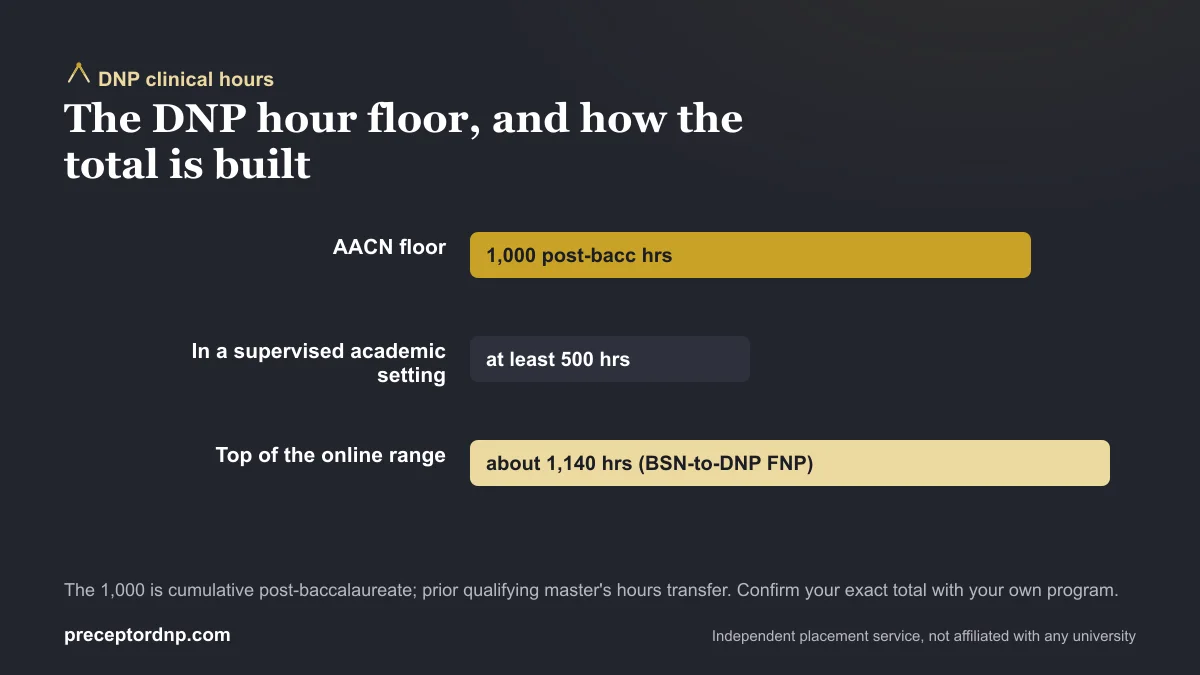
The American Association of Colleges of Nursing (AACN) sets the benchmark every accredited DNP program is built around: a minimum of 1,000 hours of supervised practice post-baccalaureate, with at least 500 of those completed in a supervised academic setting. CCNE, the accreditor for the online DNP programs we place across, holds programs to that floor.
The critical word is post-baccalaureate. The 1,000 hours are counted from your bachelor's degree forward, across your entire graduate journey. They are not 1,000 brand-new hours that must happen inside the DNP course sequence.
That single distinction changes your hour total more than any other factor, so it is worth reading twice: a BSN-to-DNP student logs close to the full total inside the program, while a post-master's student who already completed NP hours transfers them and only adds the remainder.
How many hours you personally complete depends entirely on where you start:
You carry the full load, typically 1,000 to 1,140 hours depending on the program and specialty. South Alabama's BSN-to-DNP FNP sits at the top of that range at 1,140; Arizona State's runs up to 1,125. This is the path where a placement service matters most, because you are sourcing the entire clinical footprint.
If you already hold an NP master's, the 500 to 650 hours you logged there transfer toward the 1,000 post-bacc minimum, and the DNP adds the balance, often a few hundred practice hours tied to your DNP project. Your program's transfer evaluation sets the exact number, and most schools cap it. Purdue Global's online DNP is a concrete example: 1,000 post-baccalaureate practice hours are required to graduate, and a maximum of 500 supervised clinical or practicum hours can be accepted from your prior post-baccalaureate education, so even a heavily precepted NP master's leaves at least 500 hours to complete inside the doctorate.
They count toward the same 1,000-hour total, but they are not interchangeable, and your handbook decides the mix. Broadly, DNP practice hours come in two flavors: direct-care clinical hours under a certifying preceptor, which NP entry tracks require in defined amounts, and project practice hours spent planning, implementing and evaluating your DNP scholarly project under a qualified mentor.
A BSN-to-DNP FNP student needs both: the specialty's direct-care hours to sit for certification, plus project hours to carry the doctoral work. A post-master's student who is already certified usually completes mostly project hours, which is why post-master's totals look lighter. Grand Canyon's post-master's DNP, for instance, is anchored to a practice-improvement project with a 400-hour-plus practicum, while its NP-entry peers at other schools run to 1,000 and beyond.
This split matters for placement because the two kinds of hours need different supervision. A certifying clinical preceptor must match your specialty and setting; a project mentor needs the standing to sponsor an implementation inside a real organization. Some students need one person for both, some need two. When we source, we ask which mix your program enforces before proposing anyone, and the placement process is built around that question.
Totals cluster around the 1,000 floor but vary by track. These are post-baccalaureate figures; confirm the exact number against your own handbook, because programs revise them.
| Program | DNP track | Post-bacc hours |
|---|---|---|
| South Alabama | BSN-to-DNP FNP | 1,140 |
| Arizona State (Edson) | Advanced Nursing Practice DNP | up to 1,125 |
| Chamberlain | DNP (post-master's, APRN) | 1,024+ |
| Walden | DNP (multiple specializations) | 1,000+ |
| Capella | BSN-to-DNP / post-master's | 1,000 (CCNE) |
| Purdue Global | DNP (post-master's) | 1,000 (up to 500 prior accepted) |
| Rasmussen | DNP (post-master's) | 1,000 |
| Aspen | DNP immersion | 1,000 (up to 500 bankable) |
| Thomas Edison (TESU) | DNP Systems-Level Leadership | 1,000+ |
| Herzing | BSN-to-DNP FNP (combined) | 945 |
| Grand Canyon | DNP practice/leadership (DPI) | 400+ practicum |
Because the mix of direct-care versus project hours is set by your specialty and your school, we match you to a preceptor whose scope and setting satisfy the specific split your program enforces, not just any clinician willing to sign. If you are comparing programs, the school-by-school ledger shows who requires what.
Before your project touches data, and usually before project hours begin counting, most programs require an IRB determination, so the clock starts earlier than students expect. The review decides whether your DNP project is human-subjects research or a quality-improvement effort, and programs generally will not let you collect a single data point, or bank the hours around it, until that determination and your site approvals are on file.
Grand Canyon's practice-improvement project (DPI) is an explicit example of a DNP capstone that runs through IRB clearance, and other programs sequence theirs similarly. The details differ school to school, so confirm the exact order of operations in your handbook, but plan on the IRB step taking weeks rather than days.
The practical consequence for placement: your site has to be the kind of organization that will sign the agreements an IRB-cleared project needs, on a timeline that fits your term. That is one of the criteria we screen for before proposing a match, and it is a reason to start sourcing before your practicum term rather than during it.
No. The 1,000 is a post-baccalaureate minimum, so it includes the hours you completed in a qualifying master's. Post-master's students transfer those and add the remainder in the DNP; only BSN-to-DNP students complete close to the full total inside the program. Programs cap the transfer, Purdue Global, for example, accepts a maximum of 500 prior supervised hours toward its 1,000.
Generally no. At the doctoral level, programs expect supervised direct-care and project practice hours; simulation and skills-lab time typically do not substitute. Check your handbook for any narrow exceptions.
1,000 is the floor, not the ceiling. BSN-to-DNP NP tracks add specialty direct-care requirements on top, which is how South Alabama reaches 1,140 and Arizona State reaches up to 1,125.
Usually not. Most programs only credit hours completed after the preceptor, site and required agreements were formally approved, and some treat early logging as a compliance violation. Get written approval first, then start the clock.
They count toward the same post-baccalaureate total, but programs track them separately. Direct-care clinical hours require a certifying preceptor in your specialty; project practice hours cover planning, implementing and evaluating your DNP project under a qualified mentor. Your handbook sets the required mix for your track.
No cost to request, and nothing is billed until a match is confirmed and your school signs off. We'll reply within one business day.
We do not guarantee placement. Final approval rests with your program.
