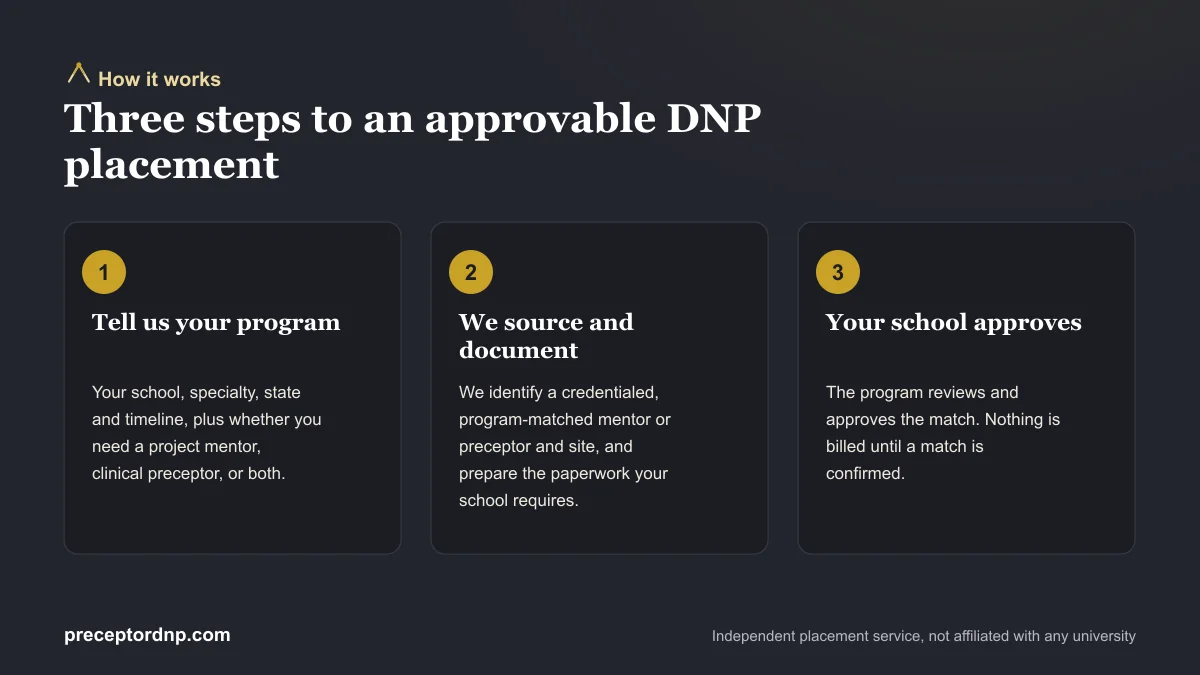
Four steps from admitted to cleared. We do the sourcing and the paperwork; your school does the approving. Nothing is billed until a match is confirmed, and the earlier you start, the more the timeline works in your favor.
We start with the specifics: your school, your specialty track, your state, and the hour total and direct-care split your handbook requires. We map that against what your particular program will and won't approve, a Walden FNP practicum and a Chamberlain post-master's DNP have different requirements, and we source to the right one.
Three numbers from your handbook do most of the work here: your post-baccalaureate hour total, the direct-care share your specialty enforces, and the date your practicum term starts. If you don't know them yet, we will point you at the right handbook sections rather than guess. The clinical-hours guide explains what each number means.
We identify a preceptor in your specialty and state whose credential authorizes supervision in your track, at a site whose setting fits your certification and your required hour split. We verify licensure and credentials before we bring a match to you, an unapprovable preceptor helps no one.
Vetting includes the conflict rules schools actually enforce. Walden's manual, for example, bars precepting under your supervisor, a direct report, a relative, a personal friend or a fellow student, and requires NP preceptors to hold a graduate degree, an active unencumbered license in the specialization and at least a year of unsupervised postgraduate experience. Other programs publish their own versions. We screen against your school's list up front, because a match that fails conflict review costs you a term.
Affiliation agreements, site forms, preceptor CVs and the documentation your program's clinical office requires, we assemble the package and shepherd it through their review. Final approval always rests with your school; our job is to make saying yes easy for them.
Expect the school's own pipeline to have several stages. Walden's runs through an affiliation agreement, a preceptor commitment form, license verification, vetting, onboarding and a degree audit, and Walden states the review can take up to three months or longer once it begins. Many programs also require proof of your own professional liability coverage before approval, Walden's stated minimum is 1 million dollars per incident and 3 million aggregate, covering the entire practicum term. We flag your school's specific document list at the start so nothing surfaces late.
Once approved, you begin logging direct-care hours toward your 1,000+ post-bacc total. We stay on file as a backup: if a site falls through mid-term, which is one of the most disruptive things that can happen in a DNP, we move to re-source rather than leaving you to start over.
Two habits protect your hours from day one. Log them promptly in your program's tracking system, in whatever rhythm your handbook specifies, and never bank time at a site before the written approval is on file, because most programs will not credit it. If your track includes a DNP project, remember the IRB or quality-improvement determination has its own clock; hours tied to project data usually cannot start until that clearance lands.
Start at least a term before your practicum begins, and earlier for thin specialties, because school review time stacks on top of sourcing time. Walden is the clearest published example: applications are due in Meditrek by the first day of the month roughly three months before the term, the office reviews in submission order beginning about three months out, the process can run three months or longer, and an application not approved by the Friday before the term starts is closed. Miss that chain and the term is gone regardless of how good your preceptor was.
Other programs publish softer deadlines but behave the same way in practice: affiliation agreements crawl through legal review, credential checks queue up, and PMHNP or pediatric matches in thin markets take longer to source than metro FNP ones. The math is simple, sourcing time plus paperwork time plus review time has to fit before your term, so the request that starts early is the request that starts on time. Requesting costs nothing, and the pricing structure means you owe nothing until your school approves the match.
It varies by specialty and state. Primary-care FNP matches move faster than PMHNP or pediatrics in thin markets, and your school's own review stacks on top, Walden, for example, states its practicum review can take up to three months or longer. The earlier you start relative to your practicum term, the more room we have to place well; reach out before your clinical term, not during it.
Your school, always. We source and prepare the documentation, but the clinical office at your program makes the final approval decision. We never present placement as guaranteed.
We re-source. A mid-term site loss is exactly the scenario our backup role exists for, so you aren't restarting the search alone.
Commonly an affiliation agreement between the school and the site, a preceptor agreement or commitment form, the preceptor's CV and license details, and often proof of your own professional liability insurance, Walden's stated minimum is 1 million per incident and 3 million aggregate. Your handbook lists the exact set; we assemble it with the match.
No. Most programs refuse credit for hours logged before the preceptor and site were formally approved, and some treat it as a compliance violation. Wait for written approval, then start.
No cost to request, and nothing is billed until a match is confirmed and your school signs off. We'll reply within one business day.
We do not guarantee placement. Final approval rests with your program.
