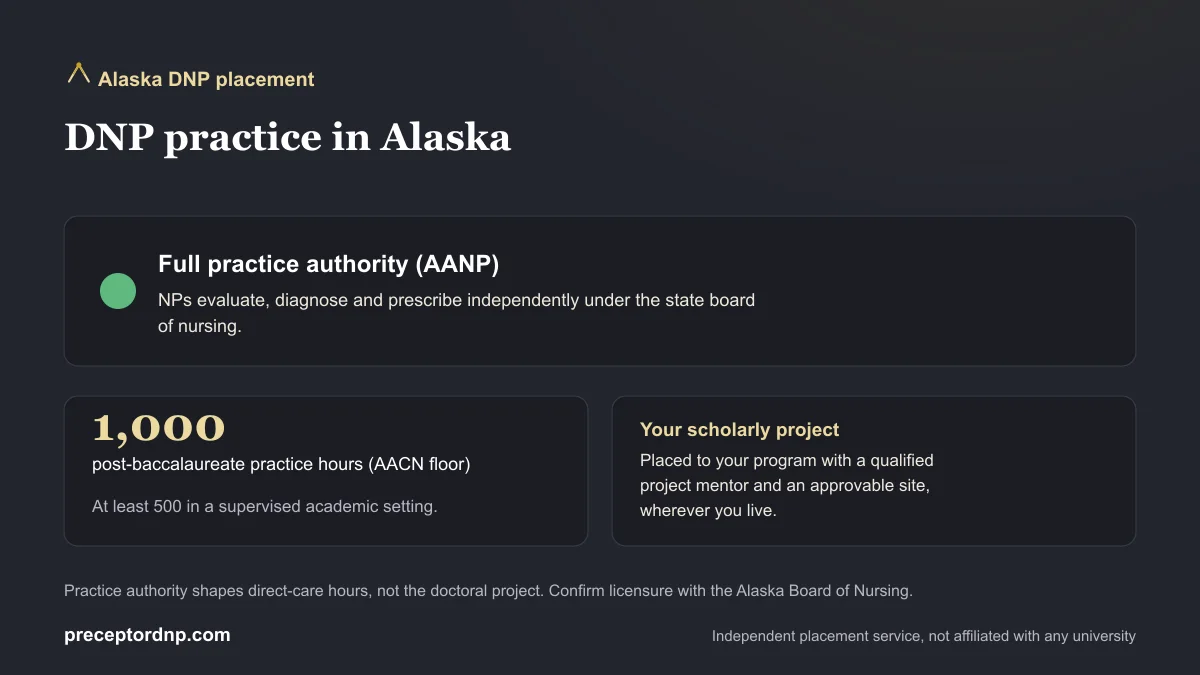
An Alaska DNP placement works best when the project, mentor, and practice-hour plan are designed around distance from the start. Students may find sophisticated improvement infrastructure in Anchorage and regional hubs, while remote communities offer important work in access, prevention, care coordination, and telehealth. Our independent desk helps students at any university pursue appropriate matches, subject to the host's decision and program approval.
The DNP scholarly project is an implemented practice change, not simply a literature review or a list of clinical shifts. In Alaska, a strong project might improve referral completion between a village clinic and a regional center, strengthen follow-up after patient travel, standardize remote blood-pressure monitoring, increase preventive screening, reduce medication discrepancies, or support workforce retention. The site needs a defined population, a process it is willing to change, an accountable sponsor, and data that can show whether the change helped.
Start with the host's priorities rather than arriving with a fully fixed solution. A DNP-prepared nurse, physician, nurse executive, quality specialist, or operational leader may serve as project mentor when that person's expertise and credentials satisfy your program. Ask early whether your program separates the practice-site mentor from academic oversight and whether the organization requires its own evidence review, privacy review, or leadership approval.
Anchorage has the broadest concentration of tertiary care, specialty services, population-health teams, and formal improvement staff. Providence Alaska Medical Center, Alaska Native Tribal Health Consortium, and Southcentral Foundation illustrate the city's mix of hospital and Tribal health infrastructure. Fairbanks and the Mat-Su area support additional hospital, ambulatory, and community work. Juneau and other Southeast communities connect through regional organizations, while Bethel, Nome, Kotzebue, and hub communities across western and northern Alaska coordinate care over enormous service areas.
Regional organizations such as Yukon-Kuskokwim Health Corporation, Southeast Alaska Regional Health Consortium, and Norton Sound Health Corporation can expose a DNP student to care coordination, community health, and system design far beyond a single unit. A named organization is only a possible setting, never a promised site. Tribal health organizations are sovereign partners, and any project must respect the organization's own review, community-engagement, privacy, and data-governance processes.
Alaska's Department of Health reports public health centers in 16 communities supporting more than 250 areas statewide. That scale makes public health nursing, emergency preparedness, maternal and child health, chronic-disease prevention, and rural access credible DNP project settings. It also means travel can be weather dependent, connectivity can vary, and small teams may have little capacity for a complex new workflow. The strongest design uses tools already available to the site and places a light burden on staff.
A project based outside a hub should spell out which work must be onsite, how the student will communicate with the mentor, what happens if travel is interrupted, and how data will be stored. Telehealth may support supervision or implementation, but it does not automatically make every activity count as an approved practice experience. Confirm physical-presence expectations with the program and host before agreeing to a remote or hybrid plan.
AACN guidance calls for at least 1,000 supervised post-baccalaureate practice hours, including at least 500 in a supervised academic setting. The requirement is cumulative. A post-master's DNP student may enter with qualifying graduate clinical hours that the program reviews, while a BSN-to-DNP student usually completes population-focus clinical preparation as well as systems, leadership, and project experiences. The number that remains at the DNP level varies by program, so request an official hour audit before asking an Alaska site for a commitment.
Approved hours may involve needs assessment, stakeholder meetings, project implementation, data interpretation, leadership practice, informatics, population health, or direct patient care. Programs decide which activities count and who may verify them. In Alaska, create a log that separates travel from substantive practice activity and records the outcome addressed by each entry. Our DNP practice-hour overview can help you prepare questions for your program.
AANP currently places Alaska in the full-practice category. For licensed nurse practitioners, that means state practice law authorizes the core elements of NP care under the exclusive licensure authority of the nursing board. For a student completing direct-care hours, the preceptor still must be qualified in the correct population focus, the site must permit the experience, and the student's program must approve the arrangement.
Practice authority is not the main gate for a quality-improvement project that evaluates a workflow or implements a systems change without the student independently providing care. Such projects still require academic and organizational review, especially when patient information or clinical operations are involved. Confirm current scope and licensure details with the Alaska Board of Nursing rather than assuming full practice removes student supervision or site requirements.
Many online DNP programs ask students to self-source a site and mentor, while others provide varying levels of coordinator or placement help. In either model, send a concise packet with your project theme, population, remaining hours, dates, mentor criteria, expected onsite presence, agreement forms, and approval deadlines. Alaska organizations need enough detail to judge staff capacity, travel demands, privacy concerns, and whether the proposal aligns with an existing priority.
The PreceptorDNP placement desk can identify plausible settings, approach potential mentors, and support the paperwork handoff. We are independent, serve students at any university, and do not guarantee that a host will accept a project or that a program will approve it. Review how matching works, then use the match form or contact us with your Alaska requirements.
It may be a suitable setting when the organization welcomes the work, the project serves an identified priority, and your program approves the site and mentor. Treat Tribal review and data governance as central requirements. A placement service cannot promise access or speak for a Tribal organization.
Possibly, if your program and host both allow it and the plan defines communication, onsite accountability, and activity verification. Remote mentorship does not automatically make travel, independent work, or telehealth time count. Obtain written confirmation before relying on a hybrid arrangement.
The national academic minimum is at least 1,000 supervised post-baccalaureate hours cumulatively, not a separate state total. Your program decides how many prior graduate hours qualify and what remains. Ask for an hour audit and confirm which Alaska activities can be logged before the placement begins.
No. Alaska's full-practice environment describes licensed NP authority, not permission for students to practice independently. Direct-care hours still require a program-approved site and qualified preceptor. Scholarly projects also need mentor, organizational, and academic approval even when they are not clinical rotations.
Send your population focus or systems track, project interests, exact remaining hours, dates, mentor qualifications, required forms, travel limits, and any onsite rules. Clear information helps distinguish a feasible Anchorage or regional-hub match from a remote plan that needs more preparation.
No cost to request, and nothing is billed until a match is confirmed and your school signs off. We'll reply within one business day.
We do not guarantee placement. Final approval rests with your program.
