Arizona offers DNP students a wide project landscape, from large Valley health systems to border clinics, Tribal health services, county programs, and rural hospitals. The best placement connects one measurable improvement aim with a mentor who has authority inside the setting and a practice-hour plan accepted by the student's program. We help students at any university pursue that match without guaranteeing site participation or academic approval.
A DNP scholarly project should improve a real process and evaluate the result. Arizona examples could include improving hypertension follow-up at a community clinic, increasing interpreter use, standardizing heat-illness education, reducing emergency-department revisits, strengthening medication reconciliation, or improving prenatal referral completion. The project site must be able to identify the population, support the intervention, and provide suitable measures without creating an unrealistic data burden.
Mentor fit follows the project. A DNP-prepared nurse may guide implementation science, a nurse executive may sponsor a system workflow, a physician may support a clinical quality initiative, and a population-health leader may supervise community work. Your program decides acceptable credentials. Clarify whether a site sponsor and practice mentor may be different people, how often supervision must occur, and what evidence or compliance review is required before implementation.
Maricopa County contains the state's largest concentration of hospitals, specialty programs, analytics teams, and nursing leadership. Banner Health, HonorHealth, Valleywise Health, Dignity Health, and children's services create varied possibilities for care-transition, safety, workforce, population-health, and informatics projects. Tucson and Pima County add major hospital, public-health, behavioral-health, and community-clinic capacity in southern Arizona. These urban organizations may have formal improvement staff, but they also have structured review processes and limited mentor bandwidth.
Flagstaff, Prescott, Yuma, and communities in Pinal, Cochise, Mohave, Navajo, and Apache counties offer a different mix of regional hospitals, federally qualified health centers, county services, and rural clinics. Northern Arizona Healthcare and Yuma Regional Medical Center are examples of non-university regional systems. A statewide search should match the project's population and workflow, not assume the largest hospital is automatically the best doctoral setting.
Arizona's border communities face distinctive access, language, transportation, occupational-health, and public-health needs. Tribal nations and Indian Health Service facilities also sustain complex care networks across large rural areas. These settings can support valuable projects in chronic-disease outreach, maternal health, behavioral health, telehealth, or care coordination when the organization identifies the priority and has capacity to host the work.
Do not treat a community as a convenient project population. Begin with local leadership, define how patients and staff will benefit, and use the organization's approved process for community engagement, privacy, and data stewardship. A project involving a Tribal nation may require review beyond a standard site agreement. Ask the potential host which approvals apply, then confirm that timeline with your program before setting a start date.
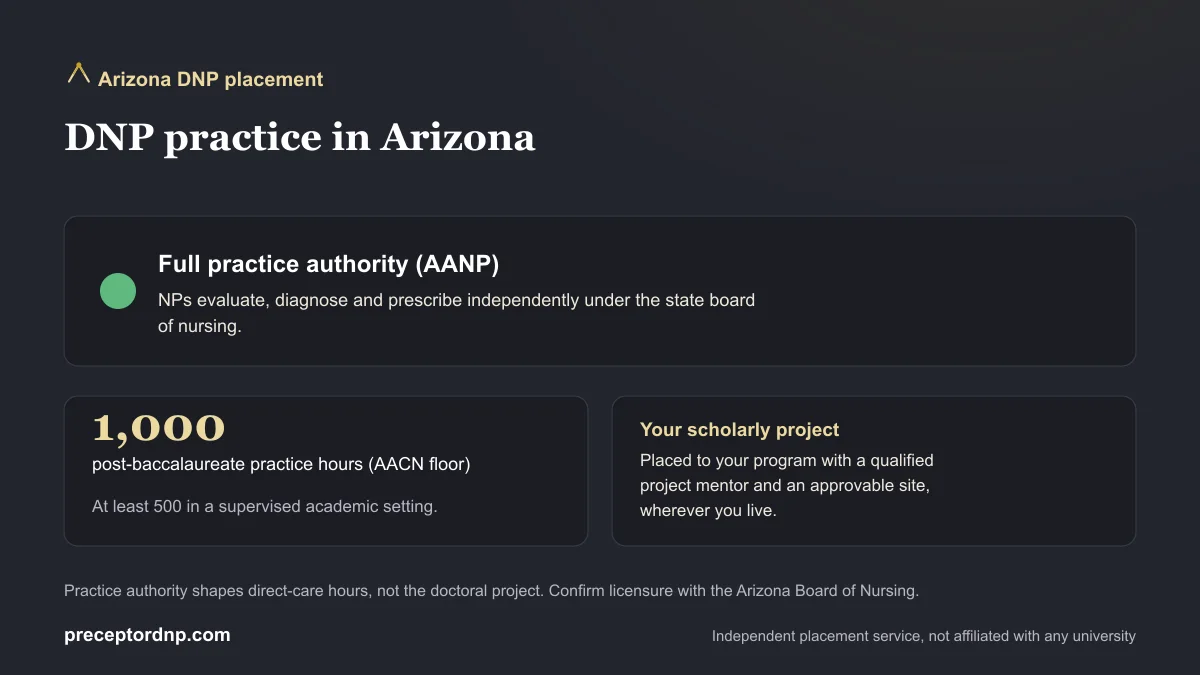
AACN guidance requires at least 1,000 supervised post-baccalaureate practice hours, including at least 500 in a supervised academic setting. That minimum is cumulative rather than 1,000 new hours added automatically at the DNP stage. Post-master's students may bring eligible graduate clinical hours that their program assesses, while BSN-to-DNP students complete population-focus direct care along with systems, leadership, and project experiences. The remaining doctoral hours varies by program, so request a formal audit before contracting with an Arizona site.
A program may count approved needs assessment, implementation, stakeholder work, informatics, leadership practice, outcome evaluation, or population-focused activity. It decides whether travel, preparation, remote meetings, or dissemination count and who signs the log. Ask for those rules in writing. Our DNP practice-hour guide explains the national framework, but your own program must confirm your balance and Arizona placement plan.
AANP currently classifies Arizona as a full-practice state, with NP licensure regulated by the Arizona State Board of Nursing. That environment matters when supervised DNP experiences include diagnosis, treatment, prescribing, or other direct care. A student still needs an approved site and a qualified board-certified NP or physician in the correct population focus. Full practice authority does not turn student hours into independent practice.
A scholarly quality-improvement project usually follows a different pathway because its purpose is to change and evaluate a practice process, not to function as an NP rotation. The project nevertheless remains subject to organizational review, privacy rules, academic supervision, and any clinical safeguards its activities require. Confirm the current scope rules with the board and ask the site to classify each proposed activity before work begins.
Online DNP programs vary. Many expect students to self-source the site and mentor, while some offer coordinator assistance or a defined placement process. A useful Arizona packet includes the project area, intended population, remaining hours, dates, weekly availability, mentor qualifications, data needs, required agreements, and the program's approval deadline. It should invite the organization to refine the project around an existing improvement priority.
The PreceptorDNP placement desk can research possible organizations, approach mentors, and support the paperwork handoff. We are independent and serve students at any university, but a site can decline and the program makes the final approval decision. See how placement works, then use the match form or contact our team with your Arizona requirements.
Hospitals, health systems, county public-health programs, community health centers, rural clinics, Tribal health organizations, long-term care settings, and community agencies may qualify. A specific site must welcome the project, provide an appropriate mentor and data path, and satisfy your program's approval standards.
Yes, when the clinic has a suitable improvement priority, leadership support, an approved mentor, and enough capacity for implementation and measurement. Keep the workflow simple, limit extra documentation, and address travel or remote-supervision details with both the clinic and your program.
Arizona does not replace the program's academic calculation. DNP preparation requires at least 1,000 supervised post-baccalaureate hours cumulatively, and qualifying prior graduate hours may reduce the doctoral-level balance for some post-master's students. Your program must audit the record and approve what remains.
It describes licensed NP authority, not independent student practice. Direct-care experiences still need a qualified preceptor, an approved site, and program oversight. Quality-improvement projects are usually not clinical rotations, but they still require academic and organizational authorization.
No. We can identify and contact plausible mentors, screen their fit against the program's criteria, and assist with documentation. The professional and organization choose whether to participate, and the student's program retains final approval of every mentor and site.
Sources · last updated July 2026
American Association of Nurse Practitioners, Arizona · Arizona State Board of Nursing · Arizona Department of Health Services · Valleywise Health · CCNE DNP practice-hour guidance
No cost to request, and nothing is billed until a match is confirmed and your school signs off. We'll reply within one business day.
We do not guarantee placement. Final approval rests with your program.
