Arkansas DNP students need a site that can support an actual practice change, not merely provide observation hours. Little Rock offers the largest concentration of quality and nursing-leadership infrastructure, while Northwest Arkansas, regional cities, local health units, and rural clinics create distinct project opportunities. Our independent desk helps students at any university connect the project, mentor, and cumulative-hour requirements, with all matches subject to site and program approval.
Little Rock anchors Arkansas's tertiary, pediatric, specialty, public-health, and health-system leadership settings. Baptist Health, Arkansas Children's, CHI St. Vincent, and other central Arkansas organizations may support work in patient safety, care transitions, chronic-disease management, workforce health, informatics, and service access. Northwest Arkansas has expanded hospital and ambulatory infrastructure around Fayetteville, Springdale, Rogers, and Bentonville, including Washington Regional and Mercy services. Fort Smith, Jonesboro, Pine Bluff, Hot Springs, and Texarkana add regional options.
A large system can offer established dashboards and improvement staff, but size alone does not make it an appropriate project site. The organization must identify a manageable priority, grant the student access to the workflow and approved data, and assign someone with authority to guide the work. A smaller clinic with a clear diabetes follow-up gap may be more useful than a major hospital where the proposal competes with enterprise projects.
The Arkansas Department of Health delivers many services through a statewide local-health-unit network, giving public-health DNP students possible settings for immunization, maternal health, communicable-disease, screening, and health-education projects. Its rural-health programs also describe safety-net clinics, federally qualified health centers, rural health clinics, small hospitals, and critical-access hospitals across the state. Those settings can host practical projects when staff capacity and program criteria align.
The Delta, Ozark communities, and southern Arkansas often have fewer dedicated improvement specialists and longer travel distances. Keep the intervention light enough for a small team to sustain. Use an existing registry or reporting process when possible, schedule education within established meetings, and choose measures the site already collects. If mentorship comes from a regional leader, confirm whether your program permits remote supervision while implementation remains at the approved local organization.
The scholarly project's mentor is not automatically the first available clinician. A DNP-prepared nurse can guide evidence translation and implementation, a nurse executive can sponsor a system change, a physician can advise a clinical quality question, and a public-health or operations leader can mentor population or leadership work. Your program decides which credentials and experience qualify, so obtain the mentor form before outreach begins.
Ask whether the mentor has time for regular feedback, authority to help remove operational barriers, and access to the staff and measures the project requires. Also determine whether the host uses a quality-review, evidence-review, privacy, or compliance pathway for student projects. The aim, population, intervention, comparison plan, outcome, and timeline should be provisional until both the organization and program approve them. See common DNP mentor questions before the first conversation.
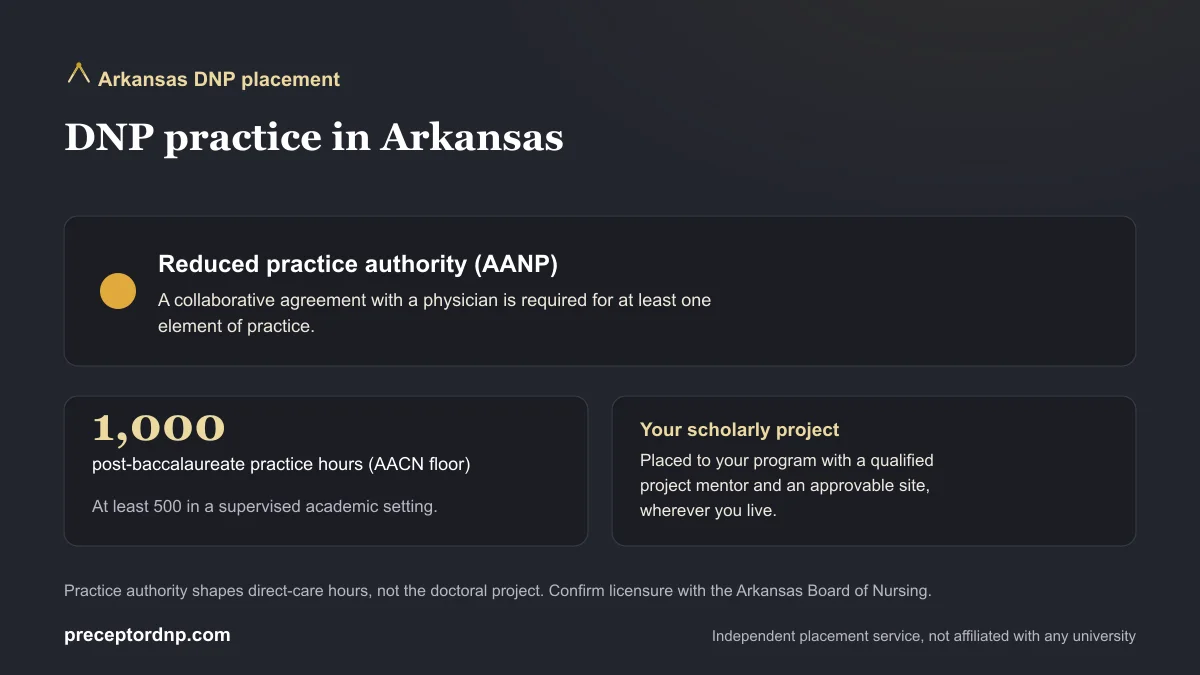
AACN guidance sets at least 1,000 supervised post-baccalaureate practice hours, with at least 500 in a supervised academic setting. This is a cumulative educational minimum. Post-master's DNP students may receive recognition for qualifying prior graduate hours after their program reviews the record, while BSN-to-DNP students commonly complete direct-care preparation alongside systems and project work. The doctoral-level balance varies by program, so do not present an Arkansas organization with an assumed hour total.
Programs may approve hours for assessment, stakeholder engagement, project implementation, data analysis, leadership, population health, informatics, or supervised direct care. They also determine whether preparation, travel, or dissemination counts. Request a written audit and logging rules, then give the site an accurate schedule. Our DNP practice-hour guide explains the cumulative framework, but only your program can confirm the activities and number still required.
AANP currently categorizes Arkansas as a reduced-practice state. For DNP students whose hours involve nurse practitioner diagnosis, treatment, prescribing, or other direct care, the site and preceptor arrangement must fit current Arkansas practice law and program supervision rules. The usual preceptor is a board-certified NP or physician whose population focus matches the student's track, subject to the program's specific requirements.
A DNP quality-improvement project is generally not the same as a clinical rotation. A student changing a reminder process or evaluating a care-transition workflow is working through academic and organizational approvals rather than using practice authority as permission to treat patients. If a project includes any direct-care activity, separate that component clearly and confirm current licensure requirements with the Arkansas State Board of Nursing.
Many online programs use a self-source model, though some provide coordinator support or placement assistance. A complete request should include the student's DNP pathway, project interests, remaining hours, dates, county, travel radius, mentor criteria, agreement documents, data expectations, and approval deadline. Let the Arkansas organization adjust the idea to an active improvement need rather than asking it to host a project designed without local input.
The PreceptorDNP placement desk can research possible settings, contact prospective mentors, and support the document handoff. We serve students at any university and work independently of a school. We cannot guarantee acceptance or program approval. Review how the service works, then send your requirements through the match form or contact our desk.
Potentially. Local health units offer public-health workflows in areas such as immunization, screening, maternal health, and disease prevention. The unit must have capacity, approve the proposal and data plan, and provide a mentor who meets your program's standards.
A narrow aim, a low-burden intervention, locally available measures, leadership support, and a realistic travel and supervision plan are essential. Projects should solve a priority the rural organization recognizes and should not depend on staffing or technology the site cannot sustain.
Not automatically. The minimum is at least 1,000 supervised post-baccalaureate hours cumulatively. Post-master's students may bring qualifying graduate hours, but their program decides what applies and what remains. Obtain a formal audit before agreeing to a placement schedule.
It matters most when you provide supervised direct NP care. A scholarly project focused on workflow or outcomes usually is not a licensure-gated clinical rotation, though it still needs host and program approval. Confirm any patient-care component with the board and your program.
No. We can identify, approach, and screen plausible matches and help organize the handoff. Each professional and organization decides whether to participate, and the student's program makes the final decision about the mentor, site, project, and hours.
No cost to request, and nothing is billed until a match is confirmed and your school signs off. We'll reply within one business day.
We do not guarantee placement. Final approval rests with your program.
