California gives DNP students exceptional variety, but its size and layered organizational processes make a focused search essential. A viable placement connects a host's quality priority, a qualified project mentor, approved access to measures, and the student's remaining post-baccalaureate hours. Our independent placement desk helps students at any university pursue that fit without promising organizational participation or program approval.
The DNP scholarly project is the doctorate's center of gravity. It should implement an evidence-based change in a real California setting and evaluate practice or system outcomes. Possible themes include reducing missed specialty referrals, improving medication reconciliation, standardizing discharge teaching, increasing hypertension follow-up, strengthening interpreter workflows, or improving staff response to patient deterioration. The site needs a defined population, an operational sponsor, feasible measures, and enough time to test the change.
Project scope matters in a complex health system. A statewide idea often becomes one unit, one clinic, one patient group, and a short list of measures. A DNP-prepared nurse, physician, nurse executive, quality leader, or other experienced professional may mentor the project when the person's role and credentials meet program requirements. Ask whether your school requires a doctoral credential, a minimum period of experience, or separate site and project-mentor approvals.
Los Angeles County and the broader Southern California region contain county delivery systems, children's care, large integrated networks, safety-net clinics, specialty hospitals, and extensive public-health infrastructure. Cedars-Sinai, Kaiser Permanente, Dignity Health, and county-operated services illustrate the range. San Diego County adds Sharp HealthCare, Scripps Health, military-connected communities, community health centers, and a binational public-health context. The Inland Empire includes fast-growing Riverside and San Bernardino communities with access and care-coordination needs.
The Bay Area supports major integrated systems, public hospitals, community clinics, and county health programs. Sacramento and the Central Valley offer Sutter Health, Dignity Health, Adventist Health, regional hospitals, agricultural communities, and safety-net services. Far northern counties, the Sierra, and parts of the Central Coast rely more on small hospitals, rural clinics, county departments, and telehealth. Choose geography based on the project's population and required access, not prestige.
California's local public-health structure spans county and some city departments, creating possible practice-doctorate settings for communicable-disease response, maternal and child health, emergency preparedness, environmental health, chronic-disease prevention, and health-equity improvement. Federally qualified health centers and county safety-net organizations can also support projects that measure access, screening completion, no-show reduction, or care coordination. Each jurisdiction has its own leadership and approval route, so start with the local program rather than assuming one statewide process.
Rural sites may have fewer formal improvement staff and limited data support. Design an intervention that works with existing reports, clinic huddles, and staffing. A regional mentor may be practical if the program permits remote supervision, but someone at the implementation site still needs authority to coordinate workflow changes. Resolve travel, privacy, data-access, and meeting expectations before the program sends an affiliation agreement.
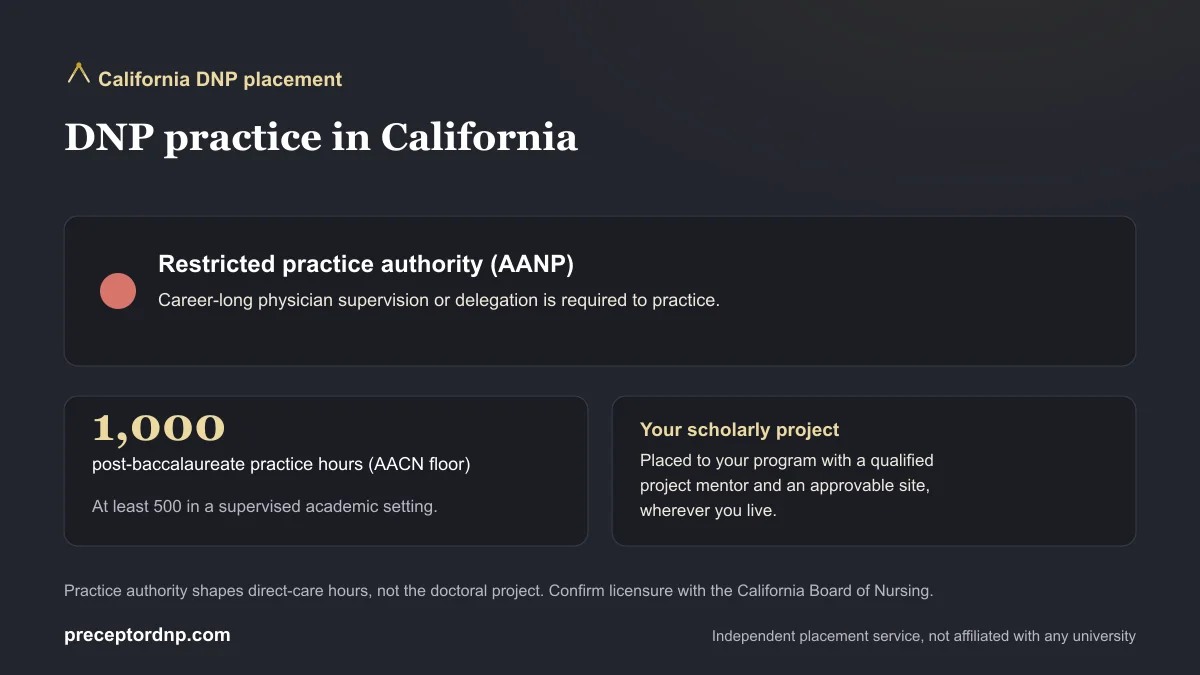
AACN guidance requires at least 1,000 supervised post-baccalaureate practice hours, including at least 500 completed in a supervised academic setting. The minimum is cumulative across qualifying graduate education. A post-master's DNP student may bring eligible prior clinical hours that the program verifies, while a BSN-to-DNP student generally completes population-focus clinical hours with systems, leadership, and scholarly-project experiences. The number completed during the DNP stage varies by program, so secure a written audit before asking a California site to reserve time.
Programs determine which project, leadership, informatics, population-health, and direct-care activities count. They also set documentation rules and decide whether preparation, travel, remote meetings, or dissemination may be logged. Build a prospective calendar that connects each activity to a course outcome and identifies the authorized verifier. Use our DNP practice-hour guide for background, then confirm every assumption with your own program.
AANP currently classifies California as a restricted-practice state, even though state pathways and individual NP authorizations may differ. For a DNP student's direct-care hours, the current license framework, site privileges, preceptor qualifications, and program supervision rules all matter. A board-certified NP or physician must match the student's population focus when the experience involves assessment, diagnosis, treatment, or prescribing.
That classification does not turn a scholarly quality-improvement project into an NP rotation. A project that implements a falls protocol or evaluates referral completion usually proceeds through academic, organizational, privacy, and quality-review channels. If the student will also provide patient care, define and approve that work separately. Confirm current licensure details and any applicable practice pathway with the California Board of Registered Nursing.
Many online DNP programs expect students to self-source a project site and mentor, while others offer coordinator help or a placement-assistance process. California organizations often need long lead times for agreements and internal review. Send a concise packet stating the pathway, project area, population, remaining hours, dates, weekly availability, mentor criteria, data needs, review status, and paperwork deadline. Be prepared to revise the project around an active organizational priority.
The PreceptorDNP placement desk can research plausible hosts, contact potential mentors, and support the paperwork handoff. We are independent, work with students at any university, and cannot guarantee a site or the program's approval. Review our process and service cost information, then submit your California details through the match form.
Potential settings include health systems, hospitals, county health services, federally qualified health centers, long-term care organizations, specialty clinics, and community agencies. The setting must support implementation and measurement, assign a suitable mentor, and complete your program's site-approval process.
Begin as soon as your program gives you project and mentor criteria. Large systems and public agencies may require agreements, compliance review, evidence classification, privacy review, or leadership approval. A clear proposal and complete documents help, but no timeline or acceptance can be guaranteed.
No universal rule requires 1,000 new doctoral-level hours. DNP preparation requires at least 1,000 supervised post-baccalaureate hours cumulatively. Your program assesses qualifying prior graduate work, calculates the remaining balance, and decides which California activities satisfy its outcomes.
It is most relevant to supervised direct NP care. A quality-improvement project focused on a workflow or system outcome is generally not a licensure-gated clinical rotation, though it still needs program and site approval. Confirm any direct-care component with the state board.
No. We can identify possible mentors, approach organizations, screen basic fit, and assist with the handoff. The professional and site decide whether they can participate, and the student's program retains final authority over the mentor, site, project, and practice hours.
No cost to request, and nothing is billed until a match is confirmed and your school signs off. We'll reply within one business day.
We do not guarantee placement. Final approval rests with your program.
