Colorado DNP students can pursue project work in sophisticated Front Range systems or in smaller mountain, plains, and western communities where improvement needs look different. The placement must pair a feasible practice change with a qualified mentor, site permission, and an accurate plan for cumulative post-baccalaureate hours. Our independent desk helps students at any university seek those pieces without guaranteeing a match or academic approval.
The Denver and Aurora region contains Colorado's largest concentration of tertiary hospitals, public safety-net care, children's services, specialty programs, quality teams, and nurse executives. Denver Health, Children's Hospital Colorado, Intermountain Health, CommonSpirit Health, and HealthONE illustrate the range of non-university systems. Colorado Springs adds major hospital and military-connected communities, while Fort Collins, Greeley, and Boulder County support northern Front Range hospital, ambulatory, and population-health work.
Possible scholarly projects include reducing avoidable readmissions, strengthening sepsis or deterioration response, improving behavioral-health follow-up, standardizing discharge education, evaluating a nursing workflow, or improving access to preventive care. Large systems may have analysts and mature dashboards, but they also use formal review channels. A project is viable only when a specific unit or service owns the problem, the measures are accessible, and a leader has time to sponsor implementation.
Pueblo and the San Luis Valley, Grand Junction and the Western Slope, mountain resort counties, and the eastern plains have different access, staffing, transportation, and seasonal-population realities. Critical-access hospitals, rural health clinics, federally qualified health centers, emergency medical services, long-term care organizations, and local public-health agencies can support doctoral work in telehealth, maternal health, care coordination, workforce retention, chronic-disease outreach, or emergency preparedness.
The Colorado Department of Public Health and Environment links local public-health agencies in every county or service area. Those agencies may offer population-level projects that a hospital cannot, especially around maternal and child health, communicable disease, environmental health, and community prevention. Rural settings usually need a narrow intervention using existing staff meetings and data. Plan travel and remote mentorship explicitly, especially when winter conditions or long distances could interrupt onsite work.
A DNP project mentor may be a DNP-prepared nurse, physician, nurse executive, quality specialist, or other experienced system leader when that person's expertise and credentials match program rules. The strongest mentor is not simply willing to sign a log. That person understands the workflow, can introduce the student to stakeholders, helps address barriers, and can verify that the project activities occurred.
Before outreach, obtain the program's mentor criteria, project-site agreement, evidence-review expectations, and hour-verification form. Ask whether the mentor must hold a doctorate, whether a site sponsor may be a separate individual, and how often supervision must be documented. The project question should remain adjustable until the Colorado host confirms its priority, population, data source, privacy path, and implementation window.
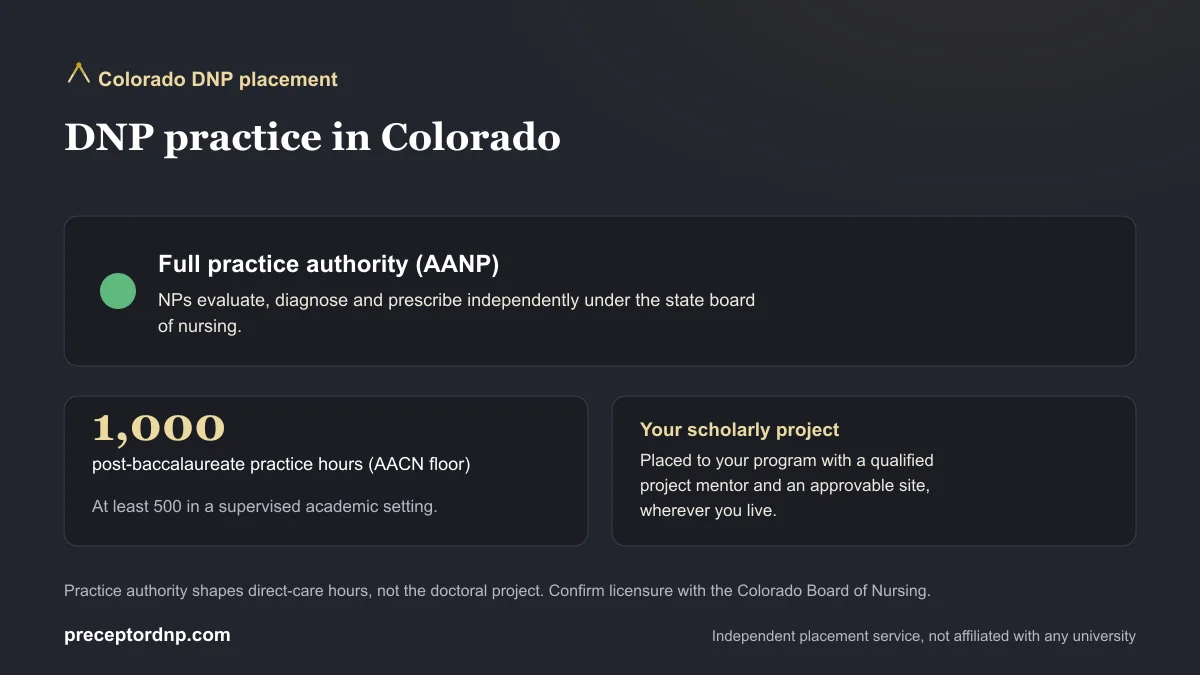
AACN guidance requires at least 1,000 supervised post-baccalaureate practice hours, with at least 500 in a supervised academic setting. This is a cumulative minimum across qualifying graduate preparation, not a fixed block automatically repeated during the doctorate. Post-master's students may enter with eligible clinical hours that their program verifies. BSN-to-DNP students usually complete population-focus direct care alongside systems, leadership, and project practice. The DNP-level remainder varies by program, so request a written audit first.
Programs decide whether project assessment, stakeholder work, implementation, outcome evaluation, informatics, leadership, population health, and direct care meet their outcomes. They also decide whether travel, preparation, or dissemination may be logged. Give a Colorado site only the hours and weekly schedule your program has confirmed. Our DNP practice-hour guide provides context, while your program retains authority over the final calculation.
AANP currently classifies Colorado as a full-practice state, and the Colorado Board of Nursing regulates NP licensure. The category is relevant when a DNP student's supervised experience includes assessment, diagnosis, treatment, prescribing, or other direct care. A qualified board-certified NP or physician should match the student's population focus, and the site and program still must approve the preceptor and activities.
A scholarly quality-improvement project that changes a system process is generally distinct from a clinical NP rotation. Full practice authority neither removes organizational review from the project nor allows a student to deliver care independently. If project tasks touch patient care, identify which are direct-care hours and confirm their supervision separately. Verify current licensure and scope details with the state board before relying on them.
Many online DNP programs ask students to self-source a site and mentor, while some provide coordinator support or placement assistance. A Colorado request should state the DNP pathway, project interests, target population, county, travel radius, remaining hours, dates, weekly availability, mentor qualifications, required agreements, and approval deadline. A concise packet lets a prospective site judge fit and suggest a project aligned with work already underway.
The PreceptorDNP placement desk can research plausible settings, approach mentors, and assist with the paperwork handoff. We are independent, work with students at any university, and cannot guarantee that a person or organization will participate or that a program will approve the match. Read how placement works, then share your Colorado requirements through the match form or contact us.
It can be a strong setting for an approved population-health, maternal-health, preparedness, prevention, or access project. The agency must identify a feasible need, permit implementation and measurement, assign a suitable mentor, and complete the student's program approval process.
Choose a narrow priority, use data the organization already collects, limit added work for small teams, and write a realistic travel and supervision plan. Telehealth can support some mentorship, but both the site and program must approve how onsite and remote activities are counted.
The academic standard is at least 1,000 supervised post-baccalaureate hours cumulatively. There is no separate Colorado total. Your program evaluates prior qualifying graduate hours, sets the remaining balance, and decides which direct-care, project, leadership, and systems activities count.
No. Colorado's full-practice category applies to licensed NP authority. Students still need an approved site and qualified preceptor for direct care. A quality-improvement project follows academic and organizational approval even when it is not a licensure-gated rotation.
No. We can identify and approach plausible professionals, screen fit against supplied program criteria, and support documentation. The mentor and organization choose whether to participate, and the student's program makes the final approval decision.
No cost to request, and nothing is billed until a match is confirmed and your school signs off. We'll reply within one business day.
We do not guarantee placement. Final approval rests with your program.
