Connecticut's compact geography puts major health systems, community clinics, municipal departments, and regional health districts within a relatively connected project market. The challenge is not finding organizations on a map but identifying one that owns the improvement need, can assign a qualified mentor, and can support approved measurement. Our independent desk helps DNP students at any university pursue that fit without guaranteeing participation or program approval.
Connecticut's local public-health system combines municipal departments and regional health districts. The Department of Public Health lists 59 local agencies serving the state, including districts that cover multiple towns. This structure creates credible DNP settings for community needs assessment, vaccination, maternal and child health, emergency preparedness, chronic-disease prevention, environmental health, and access improvement. A regional district may allow a project to compare implementation across communities, but the scope should remain manageable.
A public-health project needs an internal sponsor, an approved population, and a measurement plan using data the agency can lawfully share. Start with an existing priority rather than offering a generic intervention. Clarify which town or district staff will participate, where implementation occurs, how protected information is handled, and whether the agency has its own evidence, privacy, or leadership review before agreeing to a semester timeline.
Hartford and central Connecticut have Hartford HealthCare, Connecticut Children's, Trinity Health of New England, and extensive specialty, ambulatory, and leadership infrastructure. The New Haven area has another dense hospital and community-clinic market. Bridgeport, Stamford, and greater Fairfield County support health systems, safety-net clinics, and population-health work, while Waterbury, Danbury, Norwalk, Middletown, and New London add distinct regional settings. Nuvance Health, Middlesex Health, Griffin Health, and federally qualified health centers broaden the non-university options.
Suitable projects may address care transitions, heart-failure follow-up, language access, infection prevention, medication safety, nursing workflow, behavioral-health integration, or older-adult care. Large systems often have mature quality processes and lengthy review. Smaller clinics may move more quickly but have limited analytics support. Fit the intervention to the site's staffing, available measures, and improvement calendar rather than assuming one design works everywhere.
A DNP-prepared nurse, physician, nurse executive, quality leader, or experienced population-health professional may qualify as a project mentor, depending on program rules. The mentor should understand the practice setting, connect the student with decision makers, help adapt the intervention, and verify activities. A respected clinician without time or authority over the workflow may not be the right doctoral mentor.
Obtain the program's credential standard, mentor form, site agreement, and project-review expectations before outreach. Ask whether academic oversight and practice mentorship are separate, whether the mentor must hold a doctorate, and how frequently meetings must be documented. Keep the project aim provisional until the Connecticut organization confirms its population, operational sponsor, data source, privacy pathway, and implementation dates.
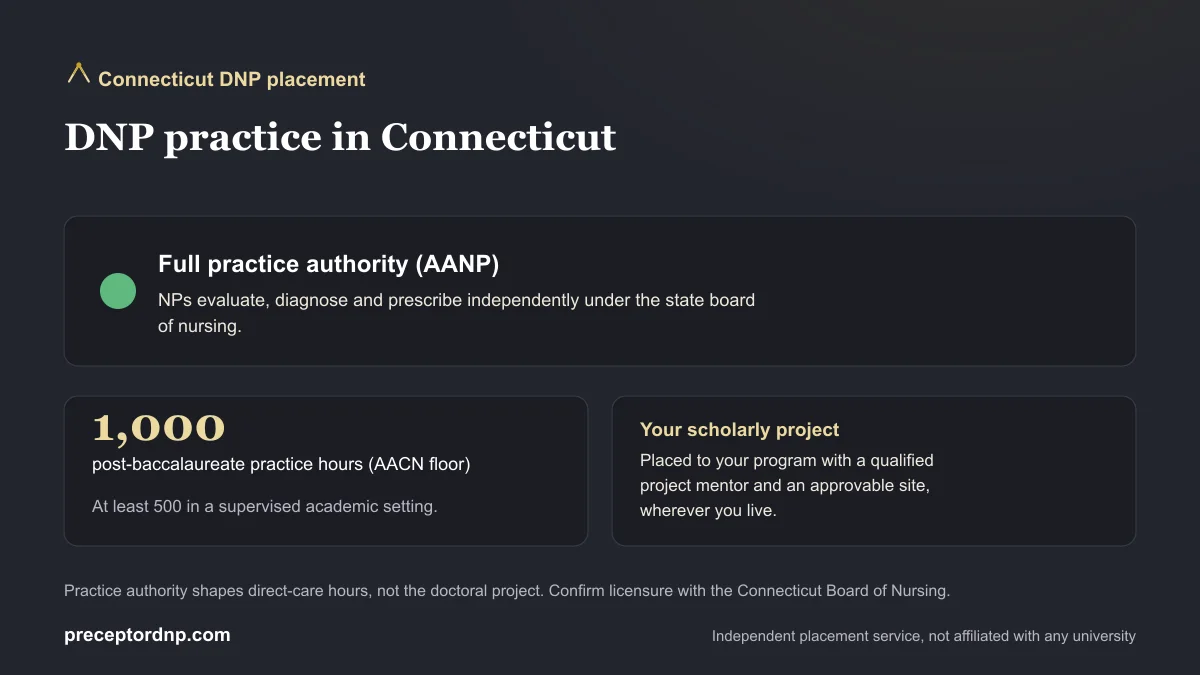
AACN guidance calls for at least 1,000 supervised post-baccalaureate practice hours, including at least 500 in a supervised academic setting. The minimum is cumulative, not a new 1,000-hour block required from every DNP student. Post-master's students may bring qualifying graduate clinical hours that their program verifies, while BSN-to-DNP students commonly complete population-focus clinical preparation along with systems, leadership, and project experiences. The doctoral balance varies by program, so request a written audit before a Connecticut site search.
Programs determine whether needs assessment, stakeholder meetings, project implementation, outcome evaluation, informatics, policy, leadership, population health, and direct care count. They also set logging and verification rules. Build a calendar that identifies onsite, remote, and independent activities and the person authorized to approve each one. Read our DNP practice-hour guide, then confirm the exact remaining requirements with your program.
AANP currently classifies Connecticut as a full-practice state. That category is relevant when a DNP student's supervised experience includes NP assessment, diagnosis, treatment, prescribing, or other direct patient care. The student still needs a qualified board-certified NP or physician in the correct population focus, site permission, and program approval. Full practice authority applies to licensed practice and does not make a student independent.
A quality-improvement project that changes a referral process, introduces an evidence-based checklist, or evaluates a system outcome is generally not a licensure-gated NP rotation. It still must pass the host's quality, privacy, compliance, and leadership processes. If the project includes patient-care tasks, separate and approve those direct-care hours. Confirm current licensure details with the Connecticut Board of Examiners for Nursing.
Many online DNP programs use a self-source model, while others offer coordinator support or placement assistance. A useful Connecticut inquiry states the DNP pathway, project interests, target population, remaining hours, dates, weekly availability, mentor criteria, required agreements, data expectations, and approval deadline. It should invite the organization to connect the student's interests with an active quality priority instead of requesting a signature for a predetermined project.
The PreceptorDNP placement desk can research plausible hosts, approach potential mentors, and assist with the document handoff. We are independent, serve students at any university, and cannot guarantee acceptance or academic approval. See how the placement process works, then use the match form or contact our desk with your Connecticut details.
Yes, when the district identifies a suitable public-health priority, can support implementation and measurement, and assigns a mentor who meets the program's standards. The district and student's program must approve the scope, data use, timeline, and site agreement before work starts.
Programs may approve a DNP-prepared nurse, physician, nurse executive, quality leader, or qualified public-health professional whose expertise matches the project. Direct-care hours usually require a board-certified NP or physician in the correct population focus. Your program sets the final criteria.
Not necessarily. DNP education requires at least 1,000 supervised post-baccalaureate hours cumulatively. A post-master's student's prior qualifying hours may apply after program review. The program calculates the remaining doctoral balance and decides which Connecticut activities count.
It applies most directly to licensed NP care and provides context for supervised direct-care hours. A scholarly quality-improvement project is generally not an NP clinical rotation, but it still needs organizational and academic approval. Students never practice independently because of the state category.
No. We can identify plausible settings, contact prospective mentors, screen fit, and support paperwork. Every organization and professional may decline, and the student's program retains final approval over the mentor, site, project, and practice-hour plan.
No cost to request, and nothing is billed until a match is confirmed and your school signs off. We'll reply within one business day.
We do not guarantee placement. Final approval rests with your program.
