Delaware's small footprint makes statewide project searches practical, yet New Castle, Kent, and Sussex counties have different health-system and community needs. A successful DNP placement joins one measurable practice change with an empowered mentor, site approval, and a verified plan for cumulative practice hours. Our independent desk helps students at any university seek that alignment without guaranteeing a site or program decision.
New Castle County has Delaware's densest hospital, specialty, public-health, and community-clinic infrastructure. ChristianaCare, Nemours Children's Health, Wilmington-area services, and federally qualified health centers can support projects in care transitions, chronic-disease follow-up, patient safety, pediatric care, language access, and nursing workflow. Because large organizations often have formal evidence, privacy, and improvement review, students should allow time for internal approval and affiliation paperwork.
Kent County centers on Dover and Milford, with Bayhealth, state agencies, ambulatory services, and community programs creating options for population health, maternal care, behavioral health, and access work. Sussex County includes Beebe Healthcare, regional services, community health centers, long-term care, and fast-growing coastal communities. Seasonal population changes and rural inland access can shape projects around urgent care use, referral completion, workforce capacity, or older-adult services.
Delaware's Division of Public Health identifies community health centers in every county. Those centers, public-health programs, primary-care clinics, long-term care organizations, home-health teams, and community agencies may be more appropriate than a hospital for projects involving screening, vaccination, maternal support, diabetes management, behavioral-health integration, or care navigation. The right site is the one that owns the problem and can sustain the intervention.
A small organization may have limited analytics and no dedicated quality department. Keep the project focused on a workflow and measures already available. A short staff education plus a revised referral process may be feasible; a new data platform usually is not. Ask who can authorize change, who controls the data, and who will continue the work after the student completes the evaluation.
The DNP project mentor can be a DNP-prepared nurse, physician, nurse executive, quality leader, or another experienced professional whose expertise and credentials meet the student's program rules. For a system-change project, organizational influence and regular availability matter as much as clinical expertise. The mentor should help refine the aim, introduce stakeholders, address operational barriers, and verify the student's practice activities.
Obtain the program's mentor criteria, project guidelines, site agreement, and hour-verification process before contacting Delaware organizations. Confirm whether the mentor must hold a doctorate, whether a separate site sponsor is allowed, and how supervision will be documented. Keep the project proposal adjustable until the host approves the population, intervention, measures, privacy pathway, and implementation dates.
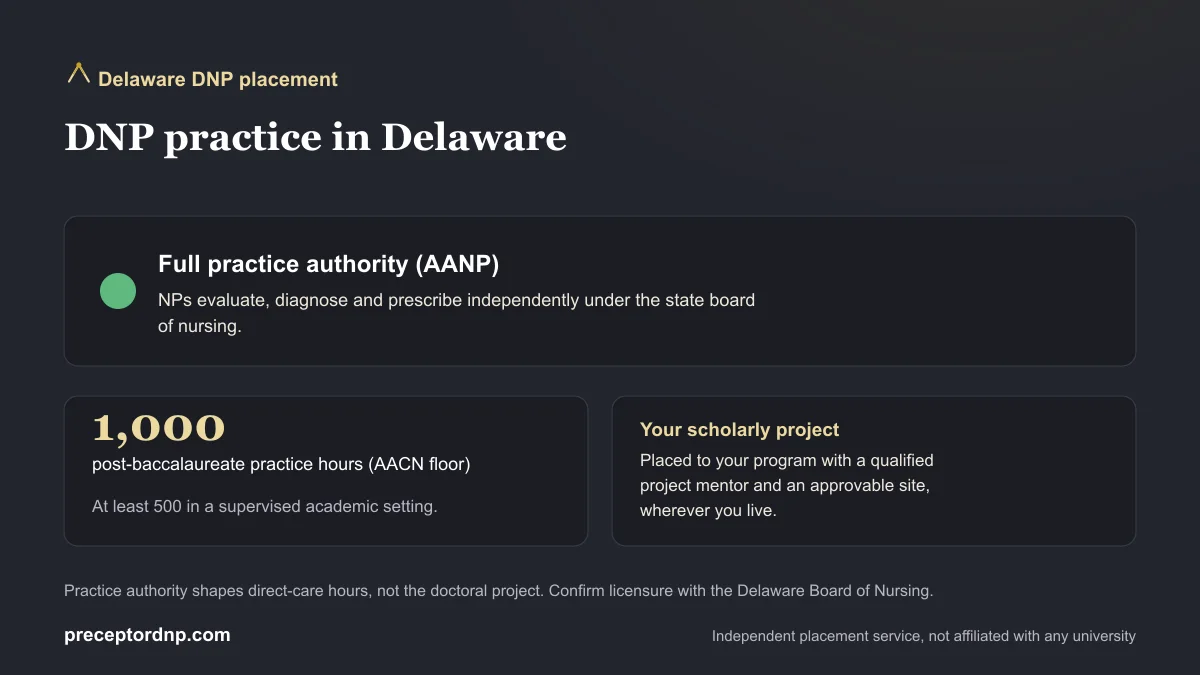
AACN guidance requires at least 1,000 supervised post-baccalaureate practice hours, including at least 500 in a supervised academic setting. This minimum is cumulative across qualifying graduate preparation. Post-master's DNP students may enter with eligible prior clinical hours that their program assesses, while BSN-to-DNP students generally complete population-focus direct care with systems, leadership, and project experiences. The remaining hours at the doctorate varies by program, so ask for a written audit before proposing a Delaware schedule.
Programs decide whether needs assessment, stakeholder engagement, implementation, outcome evaluation, informatics, leadership, public health, and direct care satisfy their outcomes. They also define what the mentor may verify and whether preparation, travel, or dissemination counts. Review our DNP practice-hour overview, create a prospective activity plan, and confirm every category with your own program before beginning work.
AANP currently identifies Delaware as a full-practice state, with NP regulation through the Delaware Board of Nursing. This status provides context for DNP hours involving assessment, diagnosis, treatment, prescribing, or other direct patient care. It does not remove student supervision. The preceptor still must be a qualified board-certified NP or physician in the correct population focus, and both the site and program must approve the experience.
A DNP scholarly project focused on a quality process is generally different from a clinical NP rotation. A project that improves discharge calls or evaluates screening follow-up proceeds through organizational and academic review, even when licensure authority is not its main gate. If the student also provides care, define those hours separately and verify current scope details with the state board.
Many online DNP programs ask students to self-source mentors and sites, while some provide coordinator or placement assistance. A useful Delaware request lists the student's pathway, project area, target population, county preferences, travel range, remaining hours, dates, weekly availability, mentor criteria, required agreements, and approval deadline. Proximity to neighboring states does not make an out-of-state site interchangeable, so confirm location and licensure expectations with the program.
The PreceptorDNP placement desk can research possible hosts, approach mentors, and assist with the paperwork handoff. We are independent, serve students at any university, and cannot promise organizational acceptance or program approval. Review how matching works, then use the match form or contact our desk with your Delaware requirements.
Possible settings include health systems, hospitals, community health centers, public-health programs, long-term care organizations, home-health services, and community agencies. The site must support implementation and measurement, name a qualified mentor, and satisfy the student's program approval requirements.
Yes, if your travel range and program rules allow it. New Castle has the greatest system density, while Kent and Sussex offer regional, public-health, rural, and community opportunities. Match geography to the project's population and workflow, not only to distance.
Not automatically. The requirement is at least 1,000 supervised post-baccalaureate hours cumulatively. A post-master's student may have qualifying prior hours after program review. Your program calculates the remaining balance and decides which Delaware project or clinical activities count.
No. Full practice describes licensed NP authority, not student independence. Direct-care hours still require a program-approved site and qualified preceptor. Scholarly projects also require a suitable mentor and organizational approval even when they are not clinical rotations.
No. We can identify and approach plausible settings, screen potential mentor fit, and assist with the paperwork handoff. Each organization decides whether it can host the work, and the student's program makes every final approval decision.
No cost to request, and nothing is billed until a match is confirmed and your school signs off. We'll reply within one business day.
We do not guarantee placement. Final approval rests with your program.
