Georgia DNP students can find project opportunities across major Atlanta systems, regional hospitals, 18 public-health districts, community clinics, and rural facilities. The doctoral placement works when a host owns the improvement priority, a qualified mentor can guide implementation, and the practice-hour plan matches program rules. Our independent desk helps students at any university pursue that combination without promising acceptance or approval.
Metro Atlanta has the state's deepest concentration of tertiary care, safety-net services, specialty programs, analytics teams, and nursing leadership. Piedmont Healthcare, Wellstar Health System, Grady Health System, and Children's Healthcare of Atlanta illustrate the non-university options for projects in patient safety, transitions, chronic disease, workforce well-being, emergency care, and access. Northeast Georgia Health System adds a substantial hub around Gainesville and surrounding counties.
Augusta, Savannah, Macon, Columbus, and Albany each anchor regional hospital and community networks. Atrium Health Navicent, Memorial Health, and Phoebe Putney Health System are examples of organizations serving different parts of the state. Rome, Dalton, Valdosta, and Waycross add northwestern, southern, and southeastern options. Choose a region based on the population and workflow the project needs, then verify that a specific service line can support implementation and measurement.
The Georgia Department of Public Health funds and works with 18 districts that include the state's county health departments. Those districts create possible sites for maternal and child health, vaccination, infectious-disease response, emergency preparedness, chronic-disease prevention, and community access projects. A district project should focus on an identified local priority, define which counties and staff participate, and use a data plan the organization approves.
Georgia's State Office of Rural Health supports small rural, critical-access, and rural emergency hospitals with quality and performance work. That landscape can support DNP projects involving care transitions, emergency services, health equity, telehealth, medication safety, or population health. Rural teams may lack dedicated improvement staff, so use existing measures, keep education brief, and avoid interventions that depend on new technology or extra staffing the site cannot sustain.
A DNP scholarly project needs more than a clinician willing to sign forms. Depending on the topic and program rules, the mentor may be a DNP-prepared nurse, physician, nurse executive, quality leader, or experienced public-health professional. The right person understands the workflow, can engage stakeholders, has enough authority to help implement change, and can verify the student's work.
Before contacting a Georgia organization, obtain the program's mentor criteria, site agreement, project-review instructions, and hour-verification form. Ask whether a doctoral credential is required, whether the site sponsor and practice mentor may be different people, and how often supervision must be documented. Keep the intervention adjustable until the host confirms the population, aim, measures, privacy pathway, leadership support, and implementation window.
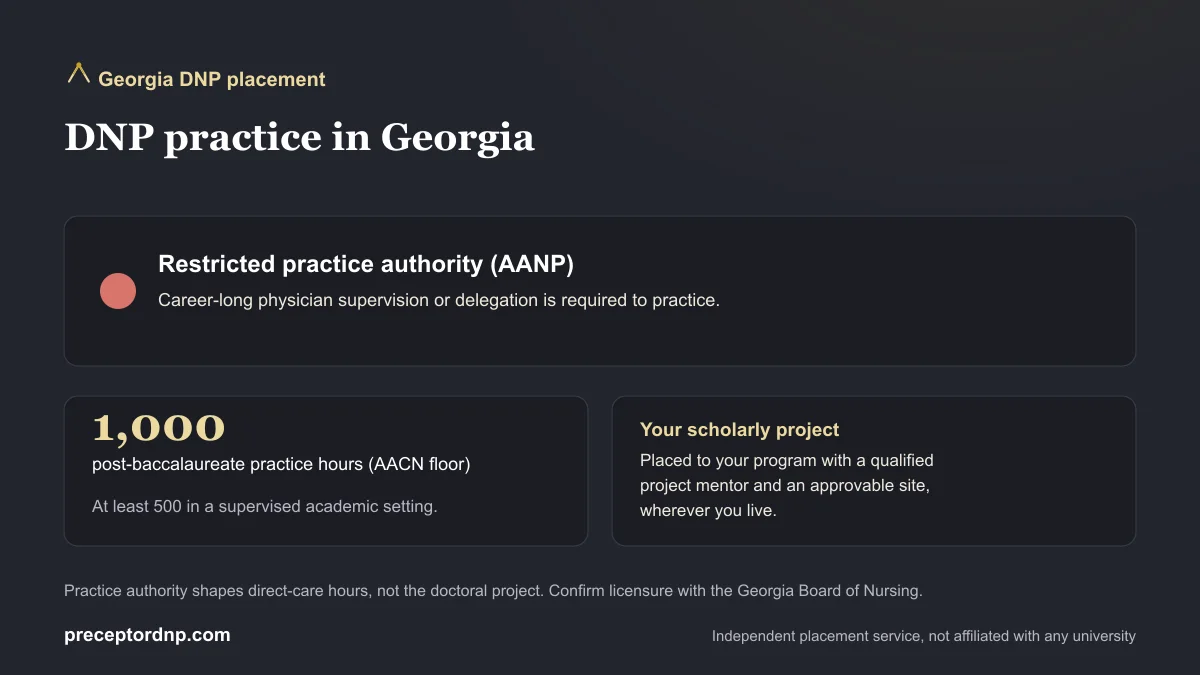
AACN guidance requires at least 1,000 supervised post-baccalaureate practice hours, including at least 500 in a supervised academic setting. The minimum is cumulative, not a fixed set of 1,000 new doctoral hours for every student. Post-master's DNP students may bring qualifying graduate clinical hours that the program verifies, while BSN-to-DNP students commonly complete population-focus care with systems, leadership, and scholarly-project practice. The remaining DNP hours varies by program, so request a formal audit before asking a Georgia site for time.
Programs decide which assessment, stakeholder, implementation, evaluation, informatics, policy, leadership, population-health, and direct-care activities count. They also define whether preparation, travel, remote meetings, or dissemination may be logged and who signs the record. Use our DNP practice-hour guide to understand the framework, then give the prospective site only the schedule and activity categories your own program has confirmed.
AANP currently classifies Georgia as a restricted-practice state. This status matters when a DNP student's supervised experience involves NP assessment, diagnosis, treatment, prescribing, or other direct patient care. The site and preceptor must operate within current Georgia licensure requirements and the program's supervision rules. A board-certified NP or physician should match the student's population focus and meet program criteria.
A DNP quality-improvement project is generally not a master's-level NP rotation. A student improving a discharge process, testing a screening workflow, or evaluating a nursing protocol follows organizational and academic review even when practice authority is not the project's main gate. If the project includes direct care, identify and approve those hours separately. Confirm current licensure details with the Georgia Board of Nursing before starting.
Many online DNP programs ask students to self-source the project mentor and site, while some offer coordinator support or placement assistance. A useful Georgia packet states the DNP pathway, project interests, target population, county, travel range, remaining hours, dates, weekly availability, mentor qualifications, required agreements, data needs, and approval deadline. It should invite the host to align the proposal with an active quality priority.
The PreceptorDNP placement desk can research plausible settings, approach mentors, and assist with the paperwork handoff. We are independent, serve students at any university, and cannot guarantee participation or the student's program approval. Read how placement works, then share your Georgia details through the match form or contact our desk.
Potentially. Districts can support approved population-health and community projects, but the local team must identify a feasible priority, permit implementation and data use, assign a qualified mentor, and complete the student's organizational and program approval processes.
A narrow aim, leadership support, an intervention that fits current staffing, and measures the site already collects are essential. Plan travel and supervision carefully, limit added documentation, and confirm whether any remote mentorship or activity will count before work begins.
Not automatically. DNP education requires at least 1,000 supervised post-baccalaureate hours cumulatively. A program may recognize qualifying prior graduate hours for a post-master's student, then calculates what remains and approves the Georgia activities used to complete it.
It applies most directly to licensed direct-care activity and supervised NP clinical hours. A scholarly quality-improvement project is generally not a licensure-gated rotation, but it still requires organizational and academic approval. Confirm any patient-care tasks under current board rules.
No. We can identify and contact possible mentors, screen fit against supplied criteria, and support the paperwork handoff. Each professional and organization decides whether to participate, and the student's program retains final approval over every element.
No cost to request, and nothing is billed until a match is confirmed and your school signs off. We'll reply within one business day.
We do not guarantee placement. Final approval rests with your program.
