A strong Hawaii DNP placement starts with a practice setting that owns a real improvement need and a mentor who can help move the work from proposal to measured change. PreceptorDNP helps students at any university look for project sites, project mentors, and population-focus practice experiences across Oahu and the neighbor islands. We are independent, and every mentor, site, activity, and hour remains subject to the student's program approval.
The DNP scholarly project is the center of this search, not an extra assignment added to an ordinary clinical rotation. A useful Hawaii site can define a measurable gap, provide an operational sponsor, permit appropriate data access, and support a small practice change. Hospitals and multisite systems in Honolulu and Aiea may have formal quality, safety, or population-health teams. Community clinics, public-health programs, long-term care organizations, and home-health agencies may offer a focused question, such as improving follow-up after discharge or standardizing a screening workflow.
Before asking for a signature, turn the idea into a short project brief. State the population, current process, proposed intervention, measures, data source, timeline, and staff burden. Ask the site how it distinguishes quality improvement from human-subjects research and what internal review is required. A DNP student should not promise publication, access to protected records, or a particular outcome. The site and program decide whether the proposal is feasible and whether separate compliance or ethics review is necessary.
Honolulu has the largest concentration of hospitals, specialty services, and administrative leaders, so it often supports projects involving transitions of care, inpatient quality, workforce processes, or service-line data. Hawaii Pacific Health lists medical centers and clinics on Oahu, Kauai, and Lanai, which illustrates how one system can connect urban operations with island communities. Hilo, Kona, Wailuku, Kahului, and Lihue add regional hospitals, ambulatory programs, and community partners. State Department of Health district and neighbor-island offices also make prevention, emergency preparedness, public-health nursing, and chronic-disease work visible outside Honolulu.
Distance changes the design. A student on Hawaii Island, Maui, Kauai, Molokai, or Lanai may find fewer formal improvement departments and DNP-prepared mentors. It may favor a tightly scoped project with one clinic, critical-access service, community organization, or telehealth workflow. Confirm how often the program requires in-person work, whether virtual supervision is acceptable, and who can cover the project when weather or staffing interrupts the schedule.
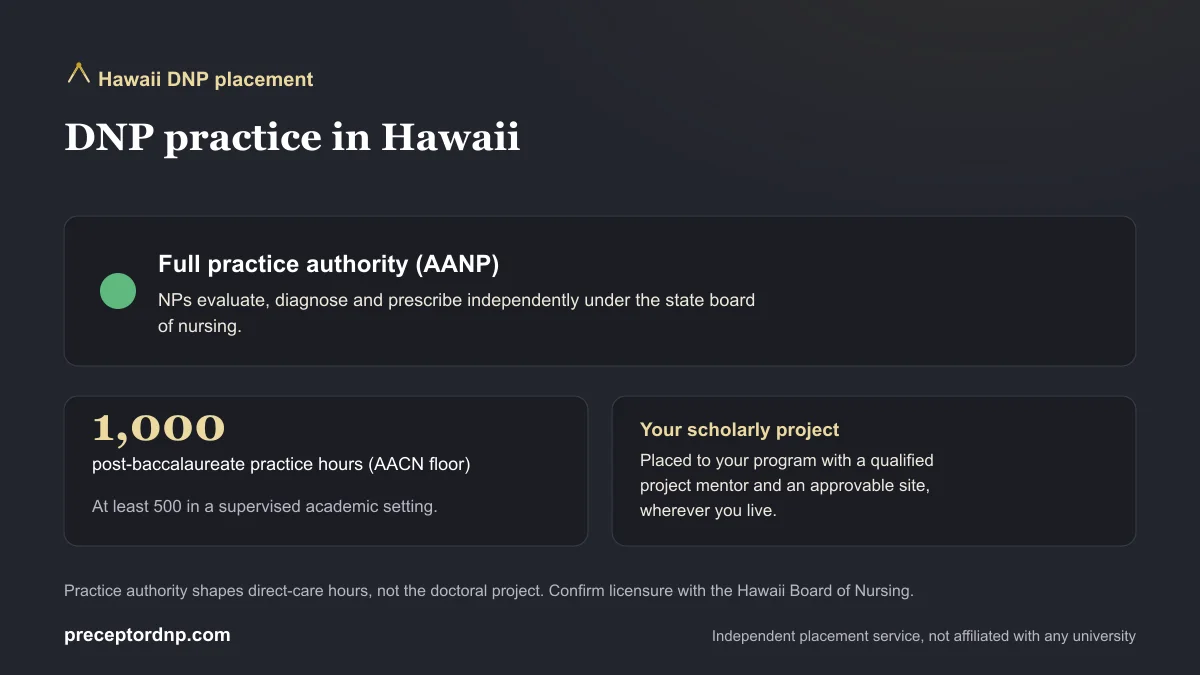
The cumulative DNP total is at least 1,000 supervised post-baccalaureate hours, varies by program, and includes at least 500 hours in a supervised academic setting. This is not a claim that every student must add 1,000 new hours during the final project. A post-master's student may receive credit for qualifying prior graduate hours after the program reviews documentation and identifies gaps. A BSN-to-DNP student commonly completes population-focus direct-care experiences alongside systems, leadership, and project work. Confirm the accepted prior hours, remaining categories, supervision rules, and logging method with your own program before a Hawaii site commits resources.
Separate the hour plan into activities the program can evaluate. Project work may include stakeholder meetings, workflow observation, staff education, implementation, data review, and sustainability planning. Direct-care hours must match the student's population focus and require an appropriately qualified clinical preceptor. Some programs permit one person to supervise both types of work, while others require a project mentor and a clinical preceptor with different credentials. A clear hour grid prevents a promising project from being asked to fill a clinical gap it was never designed to cover.
The AANP State Practice Environment currently classifies Hawaii as a full-practice state for nurse practitioners. That category matters when a DNP student's approved hours include assessment, diagnosis, treatment, or prescribing. Licensure, certification, facility privilege, supervision, and student-status rules still apply, so confirm current requirements with the Hawaii Board of Nursing and the program. Full practice does not turn a student into an independently practicing clinician.
A scholarly quality-improvement project is generally not a licensure-gated clinical rotation when the student is analyzing a process, teaching staff, or testing an approved workflow rather than independently treating patients. Keep that distinction explicit in the site agreement. If the implementation includes patient-specific clinical decisions, medication management, or other direct care, the program and site must define the qualified preceptor, scope, documentation access, and level of supervision before those activities begin.
For the scholarly project, the strongest mentor may be a DNP-prepared nurse, nurse executive, physician, quality leader, or health-system administrator who understands the setting and can convene the people affected by the change. The mentor should have enough authority to help clarify data access, staff participation, and implementation timing. For direct-care hours, programs typically look for a board-certified nurse practitioner or physician whose population and practice align with the student's track. Credentials alone are not enough; the program decides the required experience, licensure, and evaluation role.
Ask prospective mentors about capacity rather than requesting a vague preceptor commitment. Share the estimated meeting cadence, project dates, approval forms, evaluation duties, and whether the student needs clinical encounters as well as project supervision. Many online programs expect students to self-source, while some provide coordinator assistance or placement support. Either model still requires the school to approve the individual and setting. A courteous, specific request is easier for a busy Hawaii leader to assess.
A ready packet should include the program's site and mentor criteria, your resume, license and certification details when relevant, learning objectives, remaining-hour summary, proposed project brief, dates, and required affiliation documents. Add a backup plan for a delayed agreement or unavailable data set. Do not collect patient information, begin implementation, or count hours before the program and site authorize the activity. Keep a contemporaneous log tied to competencies and obtain mentor verification on the schedule your program specifies.
If the geography, mentor role, and project purpose fit, PreceptorDNP can help organize a focused search and approach potential Hawaii settings. Review how the matching process works, then use the matching form to share your population focus, island, project topic, timeline, and hour gap. We assist with outreach and fit assessment, but we do not guarantee a placement or any program's approval.
Yes. Hospitals, clinics, public-health programs, long-term care settings, and community organizations on the neighbor islands can support strong projects when the question is feasible and the site can provide a qualified mentor, data access, and program-required oversight. Confirm travel and virtual-supervision rules before committing.
No. Full practice describes state nurse practitioner regulation, not student independence. Direct-care hours still require the supervision, credentials, agreements, and approvals set by the program and site. Check current licensure information with the Hawaii Board of Nursing.
Possibly, if that person's credentials and role satisfy both sets of requirements. A project mentor needs operational access and project expertise, while direct-care supervision must align with the student's population focus. Your program must approve the arrangement before hours begin.
Qualifying supervised graduate hours may count for a post-master's student after the program verifies them and completes its gap review. The cumulative requirement is at least 1,000 supervised post-baccalaureate hours, varies by program, so confirm the accepted documentation and remaining hours directly with your program.
No. We help identify and approach possible mentors and sites, but availability, fit, affiliation terms, compliance review, and final approval remain with the mentor, organization, and student's program.
No cost to request, and nothing is billed until a match is confirmed and your school signs off. We'll reply within one business day.
We do not guarantee placement. Final approval rests with your program.
