Idaho DNP students need more than a clinician willing to sign a form. The best placement pairs a site with a defined improvement priority, a mentor who can support implementation, and approved experiences that address the student's remaining post-baccalaureate practice hours. PreceptorDNP helps students at any university search statewide, while the program and host organization retain final approval.
The Treasure Valley, including Boise, Meridian, and Nampa, has the state's deepest concentration of hospital services, specialty practices, administrative teams, and ambulatory networks. These settings can suit projects on transitions, safety, patient education, access, or workforce processes. Twin Falls anchors care in the Magic Valley, while Pocatello and Idaho Falls support southeastern and eastern communities. Coeur d'Alene and Lewiston provide northern options. A student should still search by operational fit, not city size alone. A smaller clinic with an engaged sponsor can be more workable than a large organization without time or data for the project.
Idaho's distance and terrain make rural planning central. The Idaho Department of Health and Welfare reports a network of critical-access hospitals and supports rural health clinics, free clinics, and other safety-net providers. Those settings may have limited formal research staffing, yet they often conduct practical improvement work involving emergency transfer communication, antimicrobial stewardship, chronic-disease follow-up, telehealth, and care coordination. Keep the intervention narrow enough for local staffing and technology. Confirm travel, in-person attendance, connectivity, and backup supervision before relying on a remote site.
A DNP scholarly project should address a problem the Idaho organization recognizes and wants to improve. Suitable hosts include hospitals with quality teams, multisite clinics, federally qualified health centers, public-health programs, long-term care settings, home-health services, and community organizations. The student brings evidence appraisal and a structured change method, but the site supplies operational context. Early conversations should identify an accountable sponsor, baseline measure, feasible intervention, staff affected, data owner, and decision process for quality improvement or research review.
Write a one-page concept before requesting placement. Describe the population and setting, current-state gap, proposed change, outcome and process measures, implementation window, and expected burden on staff. Do not assume that access to an electronic record, patient list, or internal dashboard will be available. Ask what privacy training, data agreement, information-security review, or project determination is required. A mentor's interest is not permission to begin. The student's program and the Idaho organization must approve the project and any data use first.
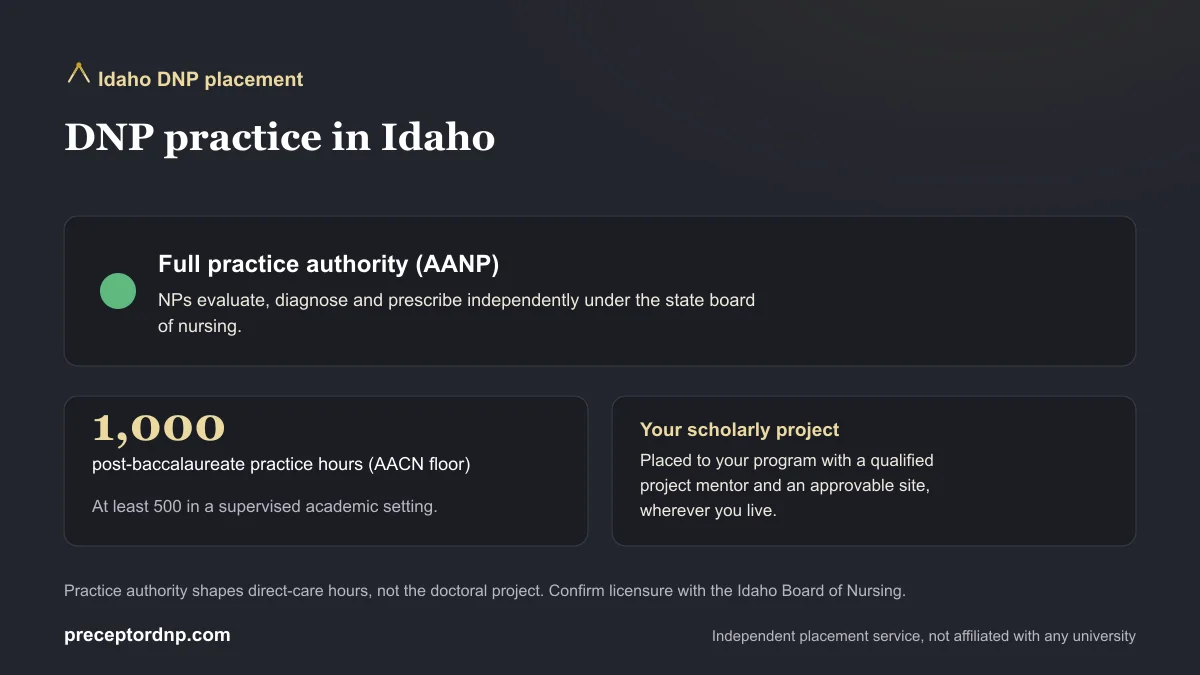
The cumulative DNP total is at least 1,000 supervised post-baccalaureate hours, varies by program, and includes at least 500 hours in a supervised academic setting. A post-master's student may enter with prior supervised hours that the program accepts after reviewing transcripts, verification, and competency gaps. A BSN-to-DNP student usually completes population-focus clinical practice while developing systems, leadership, and project competencies. Never presume that every project activity counts or that a prior master's total will transfer. Confirm the accepted hours, remaining categories, and documentation method with your own program in writing.
Create separate columns for project practice and direct-care practice. Stakeholder assessment, workflow mapping, staff education, implementation, outcome review, and sustainability planning may support the scholarly project when the program authorizes them. Patient assessment, diagnosis, treatment, and population-focus encounters belong in the direct-care plan and require a qualified clinical preceptor. If the student needs both, state that during outreach. An Idaho quality leader may be an excellent project mentor without practicing in the student's clinical specialty, and a specialty clinician may not control project data or implementation.
A project mentor might be a DNP-prepared nurse, physician, nurse executive, quality professional, population-health leader, or administrator with authority in the chosen setting. Look for someone who can help refine scope, introduce stakeholders, interpret local workflow, and maintain access through implementation. Programs set credential and experience requirements, so send those criteria at the first serious conversation. Also disclose meeting frequency, evaluation forms, expected project duration, and whether the mentor must attend a presentation or sign periodic logs.
For direct-care hours, the typical match is a board-certified nurse practitioner or physician whose patient population and practice align with the student's focus. Facility credentialing, liability documentation, affiliation agreements, and student onboarding may add lead time. One person can fill both roles only if the program finds the credentials and duties sufficient for each. Many online programs ask students to self-source, while some offer coordinator assistance. In either case, site availability does not replace formal program approval.
AANP currently classifies Idaho as a full-practice state for nurse practitioners. The category is relevant to approved direct-care experiences because state licensure governs NP evaluation, diagnosis, treatment, and prescribing. It does not give a student independent authority or override supervision, certification, facility policy, or program rules. Verify current licensure and scope details with the Idaho Board of Nursing before finalizing a direct-care placement.
A DNP quality-improvement project is generally different from a licensure-gated clinical rotation. A student may be assessing a workflow, educating staff, implementing an approved process, or evaluating aggregate outcomes rather than independently delivering care. Define that boundary in the project plan. If any activity involves patient-specific clinical judgment, orders, prescribing, or treatment, the site and program should identify the responsible licensed clinician and required supervision before it is included.
Prepare the program's mentor criteria, site form, objectives, resume, proposed schedule, remaining-hour summary, project concept, and any license or certification documents relevant to the role. Show how the project can fit the organization's current workflow and identify a smaller alternative if the first outcome or data source is unavailable. Do not start implementation or count hours while an affiliation agreement, compliance review, or mentor approval is pending. Keep logs tied to competencies and seek signatures at the intervals your program specifies.
PreceptorDNP can help organize the search across Idaho and approach settings that appear aligned with the project and hour plan. Read how matching works, then use the placement form with your city range, project topic, population focus, dates, and remaining practice categories. We help with outreach and fit assessment, but no placement or program approval is guaranteed.
Yes. A rural clinic, critical-access hospital, public-health program, or community organization may work when it has a meaningful improvement need, an approved mentor, feasible data, and enough operational capacity. The program must approve the site and decide which activities count.
No. Full practice describes regulation of licensed nurse practitioners. A student must follow the program's supervision rules, the site's policies, and applicable licensure and credentialing requirements. Confirm current details with the Idaho Board of Nursing.
Depending on program rules, the mentor may be a DNP-prepared nurse, physician, nurse executive, quality leader, or administrator who understands the setting and can support implementation. Direct-care hours may require a different board-certified clinician aligned with the student's population focus.
There is no single new-hour figure that applies to every student. The program reviews qualifying prior graduate hours and competencies, then defines the remaining plan toward at least 1,000 supervised post-baccalaureate hours. The exact amount varies by program, so confirm it before contacting sites.
No. We can assist with identifying and approaching potential sites and mentors. Availability, project feasibility, affiliation terms, compliance review, and final approval belong to the organization and the student's program.
Sources · last updated July 2026
AACN CCNE DNP Programs and Accreditation FAQs · AANP Idaho practice information · Idaho Board of Nursing · Idaho rural health and underserved areas · Saint Alphonsus hospital quality reports
No cost to request, and nothing is billed until a match is confirmed and your school signs off. We'll reply within one business day.
We do not guarantee placement. Final approval rests with your program.
