Illinois offers DNP students a wide range of project environments, but the right placement is the setting that can sponsor a real change and evaluate its result. PreceptorDNP helps students at any university search for scholarly-project mentors, implementation sites, and population-focus practice opportunities. The service is independent, and the student's program and host site make every approval decision.
The doctoral difference is the scholarly project. A suitable Illinois organization needs a defined practice gap, an internal sponsor, a workable data source, and authority to test an approved change. Large hospitals may offer nursing excellence, quality, patient-safety, population-health, or clinical analytics teams. Federally qualified health centers, county health departments, community mental-health programs, long-term care organizations, home-health services, and correctional health settings can support projects closer to a specific population. The strongest site is not necessarily the largest. It is the one where staff see value in the question and can support the student's timeline.
Bring a short concept document to the first substantive meeting. Name the population, current workflow, evidence-based intervention, measures, data owner, participants, and expected staff effort. Ask how the organization decides whether work is quality improvement, evidence-based practice, or human-subjects research. Also ask about privacy training, record access, reporting, and dissemination limits. Mentor interest alone is not authorization to use data or begin implementation. Site review and program approval must be complete before the student starts or counts project hours.
Chicago and its suburbs have dense hospital, specialty, ambulatory, and public-health infrastructure. Advocate Health Care, for example, lists hospitals in Chicago, Oak Lawn, Park Ridge, Downers Grove, Libertyville, Barrington, Elgin, and Hazel Crest. Those environments may support projects involving transitions, clinical quality, equity, staff practice, or high-volume service lines. Rockford, Peoria, Bloomington-Normal, Springfield, the Quad Cities, and the Metro East area add regional systems and community programs, often with a more accessible chain of decision-makers.
Central and southern Illinois require a different search strategy. The Illinois Department of Public Health recognizes critical-access hospitals and rural health clinics, and its Center for Rural Health supports access in rural and underserved areas. A small hospital or county program may welcome a focused project on emergency transfer, infection prevention, chronic-disease follow-up, maternal health, behavioral-health referral, or telehealth. Limit the intervention to what local staffing and data systems can sustain. Confirm travel radius, weather plans, virtual meeting rules, and backup mentorship before selecting a distant site.
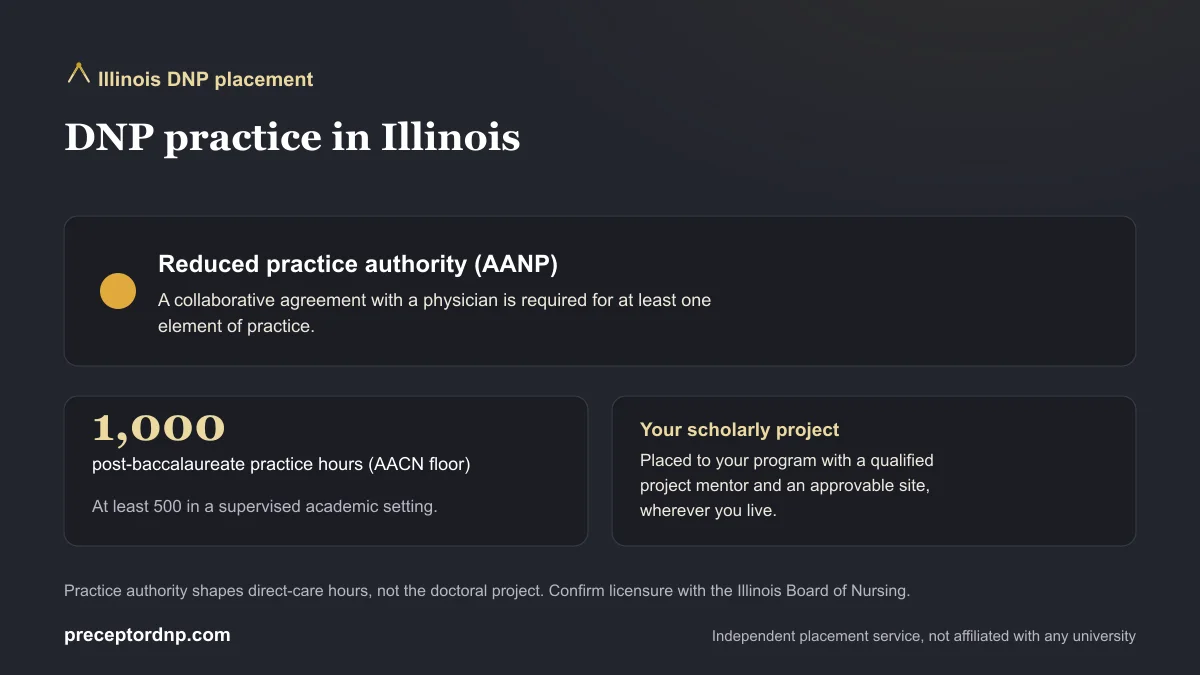
The cumulative DNP total is at least 1,000 supervised post-baccalaureate hours, varies by program, and includes at least 500 hours in a supervised academic setting. A post-master's student may bring qualifying graduate clinical hours, but the program decides what documentation is acceptable and which competency gaps remain. A BSN-to-DNP student usually completes population-focus direct-care hours together with systems, leadership, and project practice. Do not ask an Illinois project site to promise a fixed total before the program completes its review. Confirm accepted prior hours, remaining categories, required credentials, and logging rules first.
Project practice can include stakeholder assessment, workflow mapping, implementation planning, staff education, outcome review, and sustainability work when the program authorizes those activities. Direct-care practice includes patient-specific assessment and management aligned with the student's population focus. Those two plans may share a setting but need different supervision. A quality director might be ideal for a readmission project but unable to validate specialty clinical encounters. A clinical preceptor may supervise patient care without controlling the data or staff needed for organization-wide change.
AANP currently categorizes Illinois as a reduced-practice state. Illinois also licenses advanced practice registered nurses with full practice authority under state requirements, so a student's direct-care plan should not rely on the category alone. The Illinois Board of Nursing and professional licensing department provide current applications, rules, and guidance. Confirm the preceptor's license status, prescribing authority when relevant, facility privileges, and any required practice relationship with the program and site before clinical hours begin.
A DNP quality-improvement project is generally not a licensure-gated clinical rotation when the student is assessing a process, educating staff, implementing an approved workflow, or evaluating aggregate results. Reduced practice does not prevent doctoral systems work, but it governs patient-care activities that fall within NP practice. If the project includes patient-specific decisions, orders, medication management, or treatment, define the responsible licensed clinician and supervision structure in advance. Never treat project approval as permission for independent clinical practice.
For the scholarly project, programs may approve a DNP-prepared nurse, physician, nurse executive, quality leader, public-health leader, or administrator who understands the local operation and can support change. The person should be able to introduce stakeholders, clarify data access, and keep the work aligned with organizational priorities. Send the program's credential criteria, expected meeting cadence, evaluation duties, dates, and presentation requirements before requesting a commitment. A willing mentor whose role cannot open the project pathway may not be enough.
For population-focus direct care, programs commonly require a board-certified nurse practitioner or physician whose practice matches the student's track. Illinois sites may also require affiliation agreements, background checks, immunization records, liability documents, privacy modules, or local onboarding. One mentor can cover both roles only if the program approves the qualifications and activities. Many online programs expect self-sourcing, while some offer coordinators or placement assistance. Either approach ends with formal site and program review.
Assemble one packet with the program's site and mentor standards, resume, objectives, hour-gap summary, proposed schedule, project concept, and relevant licensure or certification documents. Explain what the student will do, what the organization must provide, and what will not be requested. Include a smaller backup intervention if staffing or data access changes. Do not imply that placement, a specific outcome, or program approval is assured. Keep activity logs tied to competencies and obtain signatures on the program's schedule.
PreceptorDNP can help organize an Illinois search around geography, mentor qualifications, and project readiness. Review the matching steps, then share the project topic, target population, travel range, dates, and remaining-hour categories through the matching form. We assist with outreach and fit, but availability, compliance, affiliation, and academic approval remain outside our control.
Yes. County and local public-health settings can fit population-health, prevention, emergency-preparedness, access, and workflow projects when they can provide a qualified mentor, appropriate data, and implementation support. The student's program must approve the site and activities.
No. The category is most relevant to direct patient care within nurse practitioner practice. A quality-improvement project that changes a process or evaluates aggregate outcomes is generally different, though site review, privacy rules, and program oversight still apply.
Possibly. The mentor must satisfy the program's project requirements and, for direct care, hold the required credentials in the student's population focus. Programs may prefer separate people when operational authority and clinical specialty do not overlap.
The state does not set an individual student's DNP hour gap. The program reviews qualifying prior supervised graduate hours and determines what remains toward at least 1,000 supervised post-baccalaureate hours. The final plan varies by program and should be confirmed before outreach.
No. We help identify and approach possible mentors and settings. The organization decides whether it has capacity, and the student's program decides whether the mentor, site, project, and hours meet its standards.
No cost to request, and nothing is billed until a match is confirmed and your school signs off. We'll reply within one business day.
We do not guarantee placement. Final approval rests with your program.
