An Indiana DNP placement works when the host organization has a change it wants to make and a mentor who can guide the student through implementation. PreceptorDNP helps students at any university look for scholarly-project sites, practice mentors, and population-focus experiences without turning the page into a master's clinical-rotation guide. The student's program and the Indiana site must approve every role, activity, and hour.
A DNP scholarly project should solve an operational problem that matters to the host. Indiana hospitals with nursing quality, safety, professional practice, or population-health teams can support projects involving discharge, infection prevention, screening, patient education, staff workflow, or care coordination. Community health centers, county health departments, behavioral-health programs, long-term care organizations, home-health agencies, and community groups may offer a smaller implementation field with clearer access to the affected team. Choose a site for its ownership of the question, not simply for its name or size.
Translate the initial idea into a concise project brief. Include the population, current gap, proposed intervention, process and outcome measures, data source, implementation dates, and staff effort. Ask who can authorize the work, who owns the data, and how the site distinguishes quality improvement from research. Record access, privacy review, information-security training, and local committee review can take time. A verbal yes from a mentor does not permit the student to collect information, change practice, or count hours before formal approval.
Indianapolis has the broadest mix of tertiary hospitals, ambulatory networks, public health, specialty care, and system leadership. Community Health Network lists hospitals and outpatient locations across Indianapolis, Anderson, and Kokomo, while other statewide systems extend toward Lafayette, Crown Point, and southern communities. Fort Wayne anchors northeastern care, South Bend and Michigan City serve the north, and Evansville connects southwestern Indiana. Terre Haute, Bloomington, Muncie, and Columbus add regional hospitals, clinics, and county programs that may offer practical project access.
Rural Indiana should be part of the plan, not an afterthought. The Indiana State Office of Rural Health supports critical-access hospital quality and performance work, and the state maintains a county-by-county local health department map. A rural project may focus on emergency transfer, medication reconciliation, chronic-disease monitoring, maternal support, referral completion, or telehealth adoption. Formal quality departments and DNP-prepared mentors may be less common, so scope the change to one service or workflow. Confirm driving time, virtual supervision, connectivity, and a backup contact before accepting the site.
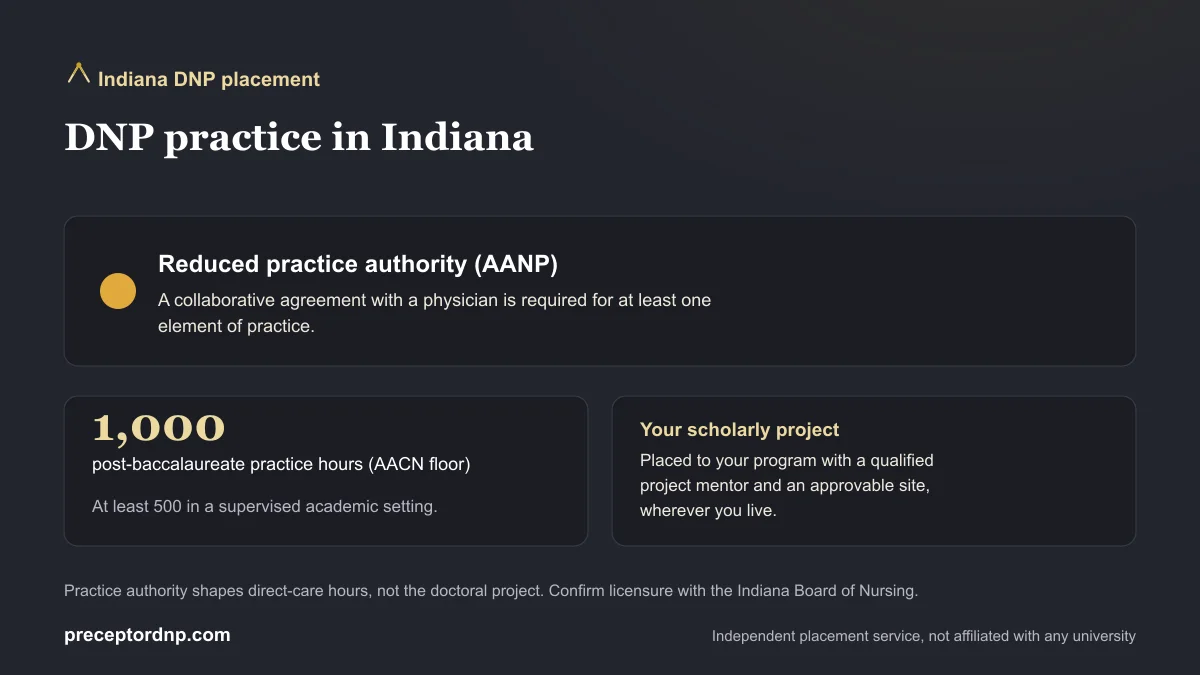
The cumulative DNP total is at least 1,000 supervised post-baccalaureate hours, varies by program, and includes at least 500 hours in a supervised academic setting. It is not an automatic block of new project hours. A post-master's student may apply qualifying prior graduate hours after the program verifies them and completes a competency-gap review. A BSN-to-DNP student generally develops direct-care expertise alongside project, leadership, and systems work. Confirm what prior documentation is accepted, how many hours remain, which competency categories are open, and how Indiana experiences must be logged before site outreach begins.
Keep project and clinical practice visible as separate lines. Project hours can involve stakeholder analysis, workflow observation, evidence translation, staff education, implementation, measurement, and sustainability planning when the program accepts them. Direct-care hours involve patient-specific assessment and management within the student's population focus. An Indiana project mentor may not hold the specialty credentials needed for clinical encounters, and a clinical preceptor may not have access to organization-wide data. Tell prospective sites exactly which type of supervision is needed.
AANP currently lists Indiana as a reduced-practice state. The category matters when approved DNP hours include nurse practitioner assessment, diagnosis, treatment, or prescribing. Indiana licensing information addresses prescriptive authority and collaborative-practice documentation, but requirements depend on the activity and license. Confirm current rules, the preceptor's standing, facility privileges, and any necessary agreements with the Indiana State Board of Nursing, the site, and the student's program before direct-care hours start.
A doctoral quality-improvement project is generally not a licensure-gated clinical rotation when the student is mapping a process, teaching staff, implementing an approved workflow, or reviewing aggregate results. The project still needs organizational oversight, privacy safeguards, and academic approval. If the intervention includes patient-specific clinical judgment, orders, medication changes, or treatment, identify the responsible licensed clinician and required supervision. Reduced practice should not be used to block nonclinical systems work or to justify unsupervised patient care.
Programs may approve a DNP-prepared nurse, physician, nurse executive, quality leader, public-health leader, or administrator as a scholarly-project mentor. The best candidate understands the local workflow, can convene affected staff, and has enough authority to help with data and implementation. Give the person the program's credential standards, project dates, meeting expectations, evaluation forms, and presentation duties before asking for a commitment. A helpful clinician outside the project process may be a useful advisor but not the operational mentor the project needs.
For population-focus direct care, the usual preceptor is a board-certified nurse practitioner or physician practicing with the relevant patient group. Site onboarding may include an affiliation agreement, background check, immunization records, liability documents, and privacy or record training. One person may cover both project and clinical supervision if the program approves all credentials and functions. Many online programs ask students to self-source; others offer placement or coordinator assistance. Neither approach bypasses final academic and site approval.
Organize the resume, objectives, site and mentor criteria, remaining-hour summary, proposed calendar, project brief, and relevant license or certification documents in one packet. Explain the student's responsibilities, the mentor's expected time, data needs, and program contacts. Include a smaller fallback measure or workflow in case the preferred data set is unavailable. Do not start work during affiliation or compliance review, and do not represent a possible mentor as program-approved. Keep a dated competency log and request signatures before memories become stale.
PreceptorDNP is independent and can help focus the Indiana search by region, mentor role, project readiness, and population focus. See how the process works, then share the project topic, travel range, dates, and practice-hour gap through the matching form. We assist with identifying and approaching possible settings, but placement availability and program approval are never guaranteed.
Yes. A critical-access hospital can be a strong site for a focused quality project when it has an identified need, a qualified mentor, usable measures, and enough staff capacity. The program and hospital must approve the scope, data plan, and supervision.
Depending on program criteria, a DNP-prepared nurse, physician, executive, quality professional, public-health leader, or administrator may qualify. The person should understand the practice setting and be able to support implementation, not merely sign the final evaluation.
Usually not in the same way it controls nurse practitioner patient care. Process assessment, staff education, and aggregate outcome evaluation are generally systems activities. Patient-specific clinical decisions still require the licensure, preceptor, and supervision structure set by law, site, and program.
No. The total is cumulative. A post-master's student may receive credit for qualifying prior supervised graduate hours after program review. The student must reach at least 1,000 supervised post-baccalaureate hours, and the remaining amount varies by program. Confirm the gap in writing.
No. We support the search and outreach process. Mentor availability, project feasibility, affiliation terms, onboarding, and final academic approval remain with the individuals, organization, and student's program.
No cost to request, and nothing is billed until a match is confirmed and your school signs off. We'll reply within one business day.
We do not guarantee placement. Final approval rests with your program.
