A Louisiana DNP placement should give the scholarly project a real operational home and a mentor who can help move evidence into practice. PreceptorDNP helps students at any university search for project sites, practice mentors, and population-focus experiences across metro and rural communities. We are independent, and the student's program and host organization retain final approval of every placement element.
The DNP project is a practice-change effort, not a paper attached to an ordinary clinical rotation. Louisiana hospitals with quality, nursing-practice, safety, or population-health teams may support work on transitions, infection prevention, clinical pathways, patient education, or workforce processes. Federally qualified health centers, parish health units, behavioral-health providers, rural clinics, long-term care settings, home-health agencies, and community organizations may offer clearer access to one population or workflow. The essential test is whether the organization recognizes the gap and can sponsor an intervention during the academic timeline.
Develop a one-page concept after listening to the site. Define the population, current process, evidence-based intervention, measures, data source, schedule, and staff burden. Ask who authorizes quality-improvement work, how the organization makes a research determination, and what privacy, data, or information-security review applies. Emergency preparedness and continuity planning may also affect implementation dates in coastal communities. Do not assume access to records, dashboards, or identifiable lists. Mentor interest does not authorize data collection or a change in practice.
New Orleans has the state's densest group of major hospitals, specialty services, public-health partners, and health-system leaders. Baton Rouge adds statewide administration and large hospital networks. Shreveport and Monroe anchor northern Louisiana, Lafayette serves Acadiana, Lake Charles supports the southwest, Alexandria sits near the center, and Houma serves bayou communities. Ochsner Health describes regions across New Orleans, Baton Rouge, Acadiana, the Northshore, north Louisiana, the West Bank, and southwest Louisiana, while LCMC Health operates a large New Orleans-area network.
Rural parishes call for a focused design. The Louisiana Department of Health's rural transformation work identifies rural hospitals, critical-access hospitals, rural health clinics, federally qualified health centers, community mental-health centers, and telehealth infrastructure as parts of the care ecosystem. These settings can support projects on chronic-disease follow-up, maternal support, behavioral-health referral, emergency transfer, food access, remote monitoring, or care coordination. Confirm driving distance, storm plans, connectivity, staff capacity, and backup supervision so an interruption does not make the project impossible to complete.
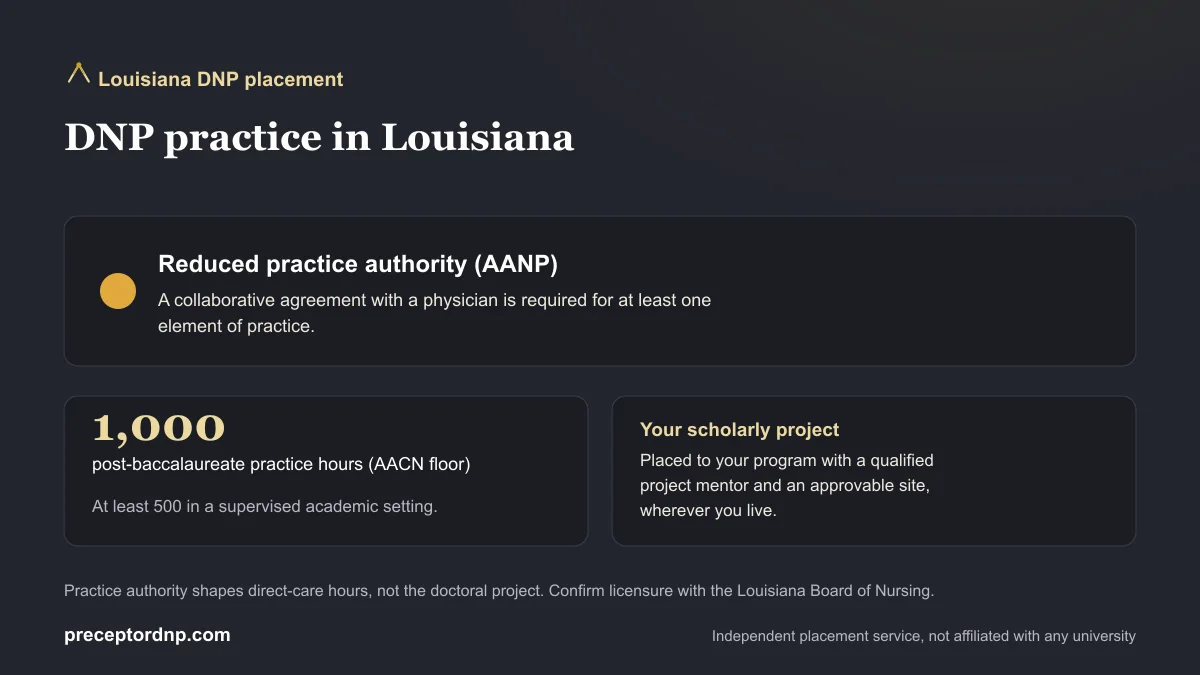
The cumulative DNP total is at least 1,000 supervised post-baccalaureate hours, varies by program, and includes at least 500 hours in a supervised academic setting. A post-master's student may have qualifying prior supervised hours accepted after the program verifies documentation and evaluates competency gaps. A BSN-to-DNP student commonly completes population-focus direct-care experiences while building project, systems, and leadership competence. Do not ask a Louisiana site to promise a fixed number of new hours before the program identifies the student's actual gap and required categories.
Map project practice separately from direct care. Stakeholder assessment, workflow observation, staff education, implementation, outcome evaluation, and sustainability planning may count toward project competencies when the program authorizes them. Patient-specific assessment, diagnosis, treatment, and management belong to the clinical plan and must align with the student's population focus. A project mentor may have strong operational authority without the specialty credentials required for clinical encounters. A clinical preceptor may not control the data or staff needed for a system change.
AANP currently classifies Louisiana as a reduced-practice state for nurse practitioners. The category matters when approved DNP hours involve evaluation, diagnosis, treatment, or prescribing. It does not replace a review of the preceptor's license, collaborative-practice requirements, prescriptive authority, facility privileges, or site policy. Confirm current rules with the Louisiana State Board of Nursing, the host organization, and the student's program before any direct-care activity begins.
A scholarly quality-improvement project is generally not a licensure-gated clinical rotation when the student is assessing a process, educating staff, implementing an approved workflow, or evaluating aggregate outcomes. Reduced practice does not block systems work, but it remains relevant if the student participates in patient-specific decisions. If the intervention includes an order, medication change, treatment, or independent clinical assessment, identify the responsible licensed clinician and supervision structure first. Project approval never authorizes practice outside student scope.
Depending on program rules, a project mentor may be a DNP-prepared nurse, physician, nurse executive, quality leader, public-health professional, or administrator with relevant experience and access. The person should be able to convene stakeholders, clarify data permissions, and protect the project's feasibility. Send the program's mentor criteria, dates, meeting cadence, evaluation forms, hour-verification duties, and presentation expectations before requesting a commitment. A clinician who supports the topic but cannot open the operational pathway may be an advisor rather than the primary mentor.
For population-focus direct care, programs commonly require a board-certified nurse practitioner or physician whose practice matches the student's focus. Louisiana organizations may require affiliation agreements, liability records, background checks, health documentation, and local onboarding. One person can cover both project and clinical roles only if the program approves every credential and responsibility. Many online programs ask students to self-source, while some provide coordinators or placement assistance. Either route ends with school and site approval.
Prepare the resume, objectives, program site standards, mentor qualifications, hour-gap summary, proposed schedule, project concept, and relevant license or certification details. Explain what the student will do, how much mentor time is expected, and what staff or data access may be requested. Include a smaller backup scope and a continuity plan for severe weather or staffing disruption. Do not begin work, access data, or count hours while academic, site, compliance, or affiliation review is pending. Keep a dated competency log and seek verification promptly.
PreceptorDNP can help organize a Louisiana search by region, project readiness, mentor role, and population focus. Review how the matching process works, then share the parish range, project topic, dates, and remaining-hour categories through the matching form. We assist with identification and outreach, but mentor availability, organizational acceptance, and program approval are not guaranteed.
Yes. A parish health unit or community program may fit prevention, population-health, emergency-preparedness, maternal, or access projects when it has a qualified mentor, usable measures, and capacity for implementation. The organization and program must approve the work.
No. It primarily affects nurse practitioner direct care. Process assessment, staff education, and aggregate evaluation are generally systems activities, though they still require site and program oversight. Patient-specific clinical decisions require the appropriate licensed preceptor and supervision.
Possibly, if that person meets the program's requirements for both roles and has access to support implementation. When operational authority and population-focus clinical expertise do not overlap, separate mentors may be required.
There is no single new-hour number. The program reviews qualifying prior supervised graduate hours and defines what remains toward at least 1,000 supervised post-baccalaureate hours. The exact plan varies by program, so confirm it in writing before site outreach.
No. We help identify and approach potential mentors and sites. Capacity, data access, affiliation terms, compliance review, storm disruptions, and final academic approval remain outside our control.
No cost to request, and nothing is billed until a match is confirmed and your school signs off. We'll reply within one business day.
We do not guarantee placement. Final approval rests with your program.
