Maryland gives DNP students many possible settings, but a strong placement is the site that owns a measurable problem and can support implementation. PreceptorDNP helps students at any university search for scholarly-project mentors, practice sites, and population-focus experiences throughout the state. The student's program and Maryland organization retain final approval of the mentor, work, and hours.
The DNP scholarly project should translate evidence into a change the host can use. Maryland hospitals with quality, safety, nursing-practice, population-health, or care-management teams may support projects on transitions, infection prevention, patient education, clinical pathways, equity, or workforce processes. Federally qualified health centers, local health departments, behavioral-health providers, long-term care settings, home-health agencies, and community organizations may provide a tighter focus on one population or workflow. A recognizable name is less important than an accountable sponsor, feasible measure, and staff willing to implement.
Begin with listening and a one-page concept. Define the population, current-state gap, proposed intervention, process and outcome measures, data source, timeline, and staff burden. Ask how the organization distinguishes quality improvement from research and what privacy, data-governance, information-security, or committee review applies. Do not assume that electronic records, internal dashboards, or identifiable lists will be available. The site should also decide how results may be shared outside the organization. A mentor's interest is not permission to start.
Baltimore and its surrounding counties have the greatest concentration of tertiary hospitals, specialty services, public-health infrastructure, and system leadership. MedStar Health, LifeBridge Health, and other major systems operate hospitals and ambulatory sites in the central corridor. Annapolis, Columbia, Towson, and Frederick add regional options. Southern Maryland includes Prince Frederick, Waldorf, and Leonardtown, while Hagerstown and Cumberland support western communities. These settings can offer very different approval timelines, mentor pools, and data environments even when they are close on a map.
The Eastern Shore, western mountains, and southern counties deserve their own search strategy. Salisbury and Easton anchor larger Shore services, while Cambridge and smaller communities rely on local hospitals, clinics, and health departments. The Maryland State Office of Rural Health recognizes 18 of the state's 24 jurisdictions as rural and supports access, coordination, and technical assistance. Rural projects may focus on telehealth, emergency transfer, chronic-disease follow-up, behavioral-health referral, maternal support, or transportation barriers. Confirm travel, connectivity, and backup supervision early.
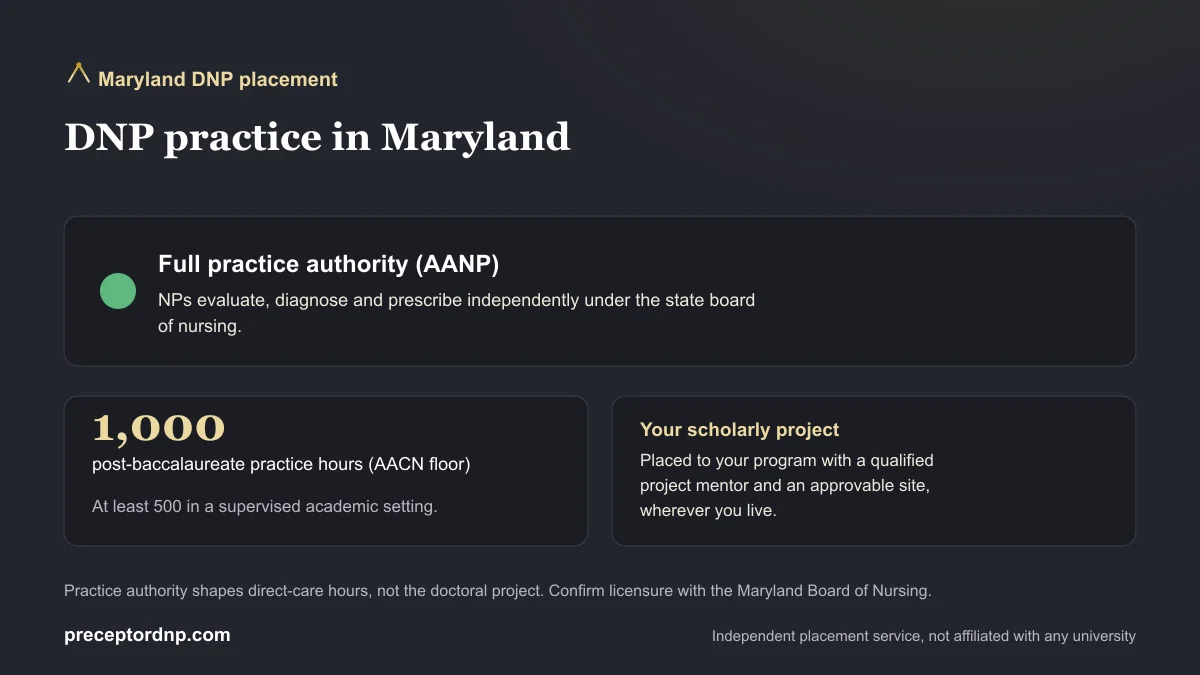
The cumulative DNP total is at least 1,000 supervised post-baccalaureate hours, varies by program, and includes at least 500 hours in a supervised academic setting. A post-master's student may have prior supervised hours accepted after the program verifies documentation and evaluates competency gaps. A BSN-to-DNP student generally develops population-focus clinical skills while also completing project, leadership, and systems practice. Do not present another student's hour plan as a Maryland requirement. Confirm accepted prior hours, remaining categories, mentor qualifications, and documentation rules with your own program first.
Keep project and direct-care practice separate in the planning grid. Stakeholder analysis, workflow observation, staff education, implementation, outcome evaluation, and sustainability planning may support scholarly-project competencies when approved. Patient-specific assessment, diagnosis, treatment, and management belong to the population-focus clinical plan. A system quality leader can be a strong project mentor without meeting specialty clinical-preceptor criteria. A board-certified clinician may supervise encounters but lack authority over the staff or data needed for an organization-wide change.
AANP currently classifies Maryland as a full-practice state for nurse practitioners. That category is relevant when DNP hours include evaluation, diagnosis, treatment, or prescribing. It does not make a student an independent practitioner or remove certification, facility privilege, supervision, and program requirements. Confirm the preceptor's current status and applicable licensure information with the Maryland Board of Nursing before direct-care hours begin.
A scholarly quality-improvement project is generally not a licensure-gated clinical rotation when the student is evaluating a process, teaching staff, implementing an approved workflow, or reviewing aggregate outcomes. Define that boundary in the project plan and site agreement. If the intervention includes patient-specific clinical judgment, orders, medication management, or treatment, identify the responsible licensed clinician and required supervision in advance. Full practice describes licensed NP regulation, not automatic student autonomy or site acceptance.
A scholarly-project mentor may be a DNP-prepared nurse, physician, nurse executive, quality leader, public-health professional, or administrator if program requirements permit. The person should understand the setting, introduce affected stakeholders, clarify data access, and help protect the project's feasibility. Send the program's credential criteria, project dates, meeting cadence, evaluation forms, hour-verification duties, and presentation expectations before requesting a commitment. An enthusiastic advisor without operational access may not be able to sponsor implementation.
Direct-care practice commonly requires a board-certified nurse practitioner or physician whose patient population and practice match the student's focus. Maryland sites may require affiliation agreements, liability documentation, background screening, health records, and local privacy training. One person can fill project and clinical roles only if the program approves all qualifications and activities. Many online programs ask students to self-source, while some provide placement or coordinator assistance. In either model, formal academic and site approval is still required.
Combine the resume, objectives, mentor standards, site criteria, remaining-hour summary, proposed schedule, project concept, and relevant license or certification details. Explain what the student will do, how much mentor time is expected, and what staff or data access may be requested. Include a smaller fallback scope if the preferred measure becomes unavailable. Do not begin implementation, access records, or count hours while academic, site, compliance, or affiliation review is pending. Keep a dated competency log and obtain verification on the required schedule.
PreceptorDNP can help focus a Maryland search by region, project readiness, mentor role, and population focus. Review the matching process, then share the project topic, travel range, dates, and remaining-hour categories through the matching form. We assist with identification and outreach, but mentor capacity, organizational acceptance, and program approval are not guaranteed.
Yes. Local health departments can fit prevention, population-health, access, emergency-preparedness, and care-coordination projects when they have a qualified mentor, feasible measures, and capacity to support implementation. Program and site approval are required.
Yes. Hospitals, clinics, health departments, and community organizations on the Shore may support project or population-focus practice when the setting, mentor, activities, travel plan, and supervision meet the student's program requirements.
No. Full practice concerns licensed nurse practitioner regulation. DNP students remain subject to program oversight, site policy, credentialing, and their own license status. Confirm current details with the Maryland Board of Nursing.
The program verifies qualifying supervised graduate hours and identifies remaining competencies toward at least 1,000 supervised post-baccalaureate hours. There is no fixed statewide amount of new hours, and the gap varies by program. Confirm the result before Maryland outreach.
No. We help identify and approach possible mentors and sites. Availability, data access, affiliation terms, compliance review, site authorization, and final academic approval remain outside our control.
Sources · last updated July 2026
AACN CCNE DNP Programs and Accreditation FAQs · AANP Maryland practice information · Maryland Board of Nursing · Maryland State Office of Rural Health · MedStar Health locations
No cost to request, and nothing is billed until a match is confirmed and your school signs off. We'll reply within one business day.
We do not guarantee placement. Final approval rests with your program.
