A Massachusetts DNP placement should begin with a workable scholarly project question and a site that owns the outcome you want to improve. The state offers dense quality infrastructure in Greater Boston, strong regional systems in Worcester and Springfield, and community settings from the Merrimack Valley to the Berkshires where a prepared mentor can help turn evidence into measured practice change.
The doctoral distinction is the scholarly project, not another collection of master's NP rotations. Massachusetts hospitals operate formal patient care assessment, quality assurance, risk management, peer review, and credentialing systems. Hospital quality departments, nursing professional practice teams, infection prevention groups, and ambulatory improvement teams are natural places to ask a focused question. The site must own the problem and permit access to the relevant workflow and data.
Greater Boston has the largest concentration of complex systems, including Mass General Brigham, Beth Israel Lahey Health, and Boston Medical Center. Baystate Health anchors Springfield, Berkshire Health Systems serves the far west, and Cape Cod Healthcare supports the peninsula. Each location controls agreements, privacy review, onboarding, and mentor capacity. A community hospital or multisite clinic may offer a clearer path to a defined population than a flagship campus.
The Massachusetts Department of Public Health runs prevention, infectious disease, safety, and quality functions, while local boards of health carry community priorities. FQHCs and community organizations can support projects on chronic disease outreach, vaccination, maternal health, behavioral health connection, or language access. Match the intervention to a locally owned metric.
A project mentor should understand the setting, reach the people who control the workflow, and be able to supervise doctoral practice. Depending on program rules, that person may be a DNP-prepared nurse, nurse executive, physician, quality leader, or another qualified health-system leader. A unit director or clinical quality specialist may have better access to weekly data than an executive sponsor.
Ask who owns the data, whether the change fits current priorities, and which review pathway applies. Clarify meeting frequency, onsite expectations, deliverables, and who can sign hour logs. Your program makes the final determination about mentor credentials and site suitability. A verbal welcome is not permission to start collecting information.
For direct-care hours, a board-certified NP or physician should practice in the student's population focus and meet program standards. Systems and leadership hours also need clear alignment and supervision. Review the DNP specialty pathways before asking one mentor to cover work outside that person's scope.
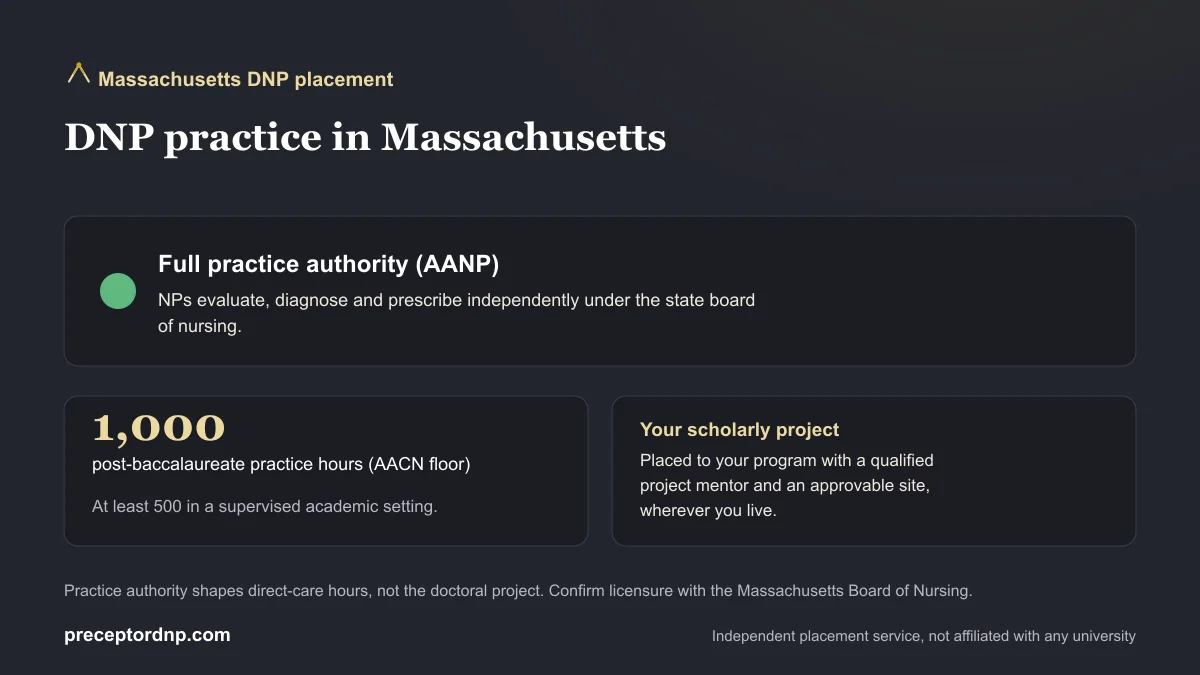
The DNP calls for at least 1,000 supervised post-baccalaureate practice hours, varies by program, with at least 500 hours completed in a supervised academic setting. This is a cumulative post-baccalaureate total, not a promise that every student completes 1,000 new hours after entering the doctoral phase. A post-master's student may be able to apply qualifying prior supervised hours after the program verifies them. A BSN-to-DNP student generally builds direct-care and systems practice alongside the scholarly project.
Request a written gap analysis before contracting with a site. Separate accepted hours, hours still needed, project implementation, direct patient care, systems work, and excluded activities. Transfer decisions differ, so confirm the exact requirement with your program. Our DNP clinical hours guide can help organize the questions, but the program controls what counts.
Massachusetts sites may require an agreement, background checks, immunization records, privacy training, record access, and project review. Those steps can outlast the mentor search. Do not log hours before written authorization, and keep notes showing the objective, supervised activity, outcome, and mentor verification.
Boston, Cambridge, and the inner suburbs offer deep analytics and nursing quality resources but receive heavy student demand. The North Shore, Merrimack Valley, MetroWest, Worcester, and Springfield provide large populations with different access questions. Brockton, New Bedford, and Fall River can support community-facing work. On the Cape and Islands, seasonal volume, ferry logistics, and workforce constraints shape feasibility.
Pittsfield, Greenfield, North Adams, and smaller western communities have hospitals, primary care, public health, long-term care, and community agencies where a bounded improvement can matter. Quality teams may be small, so mentors often carry operational duties too. Build a modest data plan and budget real travel time. Telehealth supervision requires both site and program approval.
AANP currently classifies Massachusetts as a full practice state. That category matters when supervised hours involve evaluating, diagnosing, treating, or prescribing, because the preceptor's authority and the student's approved role must fit the encounter. The Massachusetts Board of Registration in Nursing is the official source for licensure and advanced practice requirements, and rules can change. Confirm the preceptor's active status and your program's documentation before direct care begins.
A DNP quality-improvement project is generally not a licensure-gated clinical rotation. Reviewing an approved workflow, educating staff, testing a process, and evaluating aggregate outcomes are different from independently providing patient care. Even so, site policy, privacy protections, project review, and the student's existing license still matter. Never describe full practice authority as automatic permission to enter a facility, access records, or implement a change.
Before outreach, prepare a one-page summary with the problem, population, proposed evidence-based change, measures, expected timeline, onsite needs, and mentor qualifications. State clearly that the program must approve the arrangement and that the site retains control over operations and data. Offer two possible scopes, one for a single unit or clinic and one for a broader service line. A contained first cycle is usually more credible than a statewide ambition that cannot be completed during one term.
PreceptorDNP is independent and works with DNP students at any university. We assist with identifying possible Massachusetts project sites and mentors, but we never guarantee a placement or a program's approval. When your gap analysis and project direction are ready, share them through the matching form or contact our placement desk. Review placement cost information before deciding whether support fits your plan.
Hospitals, ambulatory networks, FQHCs, long-term care organizations, public health departments, and community agencies may qualify when they own the problem, support measurement, and complete the required agreement. Your program must approve both site and mentor.
Not necessarily. The total is cumulative after the baccalaureate. Post-master's students may receive credit for qualifying prior supervised hours, while BSN-to-DNP students typically accumulate hours across direct care, systems work, and the project. Ask for a written gap analysis.
Only if the mentor meets both sets of requirements. A DNP-prepared nurse, physician, nurse executive, or system leader may fit a project, while direct-care hours usually require a board-certified NP or physician in the student's population focus. Your program decides.
It can reduce a regulatory barrier for NP-led direct care, but it does not replace school approval, a site agreement, privacy review, onboarding, or the site's project process. Quality-improvement work is usually distinct from a clinical rotation. Confirm direct-care licensure details with the Massachusetts Board of Registration in Nursing.
Begin after your program confirms the project stage, mentor criteria, and hour gap. Several months of lead time is sensible where affiliation agreements or health-system review are required. Bring a concise project brief and remain open to Worcester, Springfield, the South Coast, the Cape, and western communities as well as Boston.
No cost to request, and nothing is billed until a match is confirmed and your school signs off. We'll reply within one business day.
We do not guarantee placement. Final approval rests with your program.
