Michigan gives DNP students several distinct project environments: large integrated systems in the southeast, regional networks across the Lower Peninsula, and small hospitals and community programs in the north and Upper Peninsula. The best placement is the setting that owns your proposed outcome, can support a qualified project mentor, and has a realistic path from approval to measurement.
Detroit and its suburbs hold the state's deepest concentration of hospital quality, nursing practice, analytics, and population health teams. Henry Ford Health, Corewell Health, McLaren Health Care, and Detroit Medical Center operate across this market. Integrated systems support work on transitions, safety, infection prevention, or chronic disease follow-up, but access is centralized. An interested clinician cannot bypass project review, privacy, or data governance.
Grand Rapids and Lansing offer sizable regional operations, while Flint, Saginaw, Bay City, and Midland connect urban and surrounding rural populations. Traverse City and Munson Healthcare anchor much of northern Lower Michigan. In the Upper Peninsula, Marquette is a referral center, and smaller hospitals and clinics serve communities separated by long drives and winter travel. These settings may favor a tightly bounded project on transfer communication, telehealth follow-up, workforce readiness, or reliable screening rather than a data-heavy intervention spanning many sites.
County and district health departments, tribal health programs, FQHCs, long-term care, home health, and community behavioral health services can host work on immunization, maternal support, substance use connection, rural access, or utilization. A project is more feasible when its measure fits an existing reporting cycle.
The DNP scholarly project is a supervised practice-change effort, not a generic clinical rotation. Begin with a local gap and propose a change small enough to test during the approved timeline. Examples include discharge follow-up, a safety checklist, or outreach for an overdue service. The site should identify the population, workflow owner, and data available before and after implementation.
Do not promise research or outcomes that the design cannot support. Many projects use quality-improvement or evidence-based practice review rather than human-subject research, but the site and program decide. Clarify record access, data extraction, storage, and dissemination. Site authorization remains separate from program approval.
In a small Michigan hospital or clinic, a project may need simpler measures and fewer meetings because leaders cover multiple roles. That can be an advantage. A single unit, one care transition, or one clinic panel often produces a more credible implementation than a statewide plan. Rural relevance should arise from the site's actual priority, not from assuming every northern community has the same need.
For the scholarly project, programs may accept a DNP-prepared nurse, physician, nurse executive, quality specialist, or other qualified health-system leader. Credentials alone are not enough. The mentor needs access to the workflow, time for regular supervision, and authority to connect you with staff and data owners. A local champion and a separate executive sponsor can be a useful combination when one person cannot provide both daily guidance and organizational approval.
Ask who can sign practice logs, how often you will meet, which work must occur onsite, and what happens if the mentor changes roles. Confirm the mentor's qualifications with your program before treating the match as final. For direct-care hours, use a board-certified NP or physician practicing in the student's population focus and meeting Michigan licensure plus program standards. The mentor for a leadership project may not qualify for clinical encounters, and the clinical preceptor may not control a system-change project.
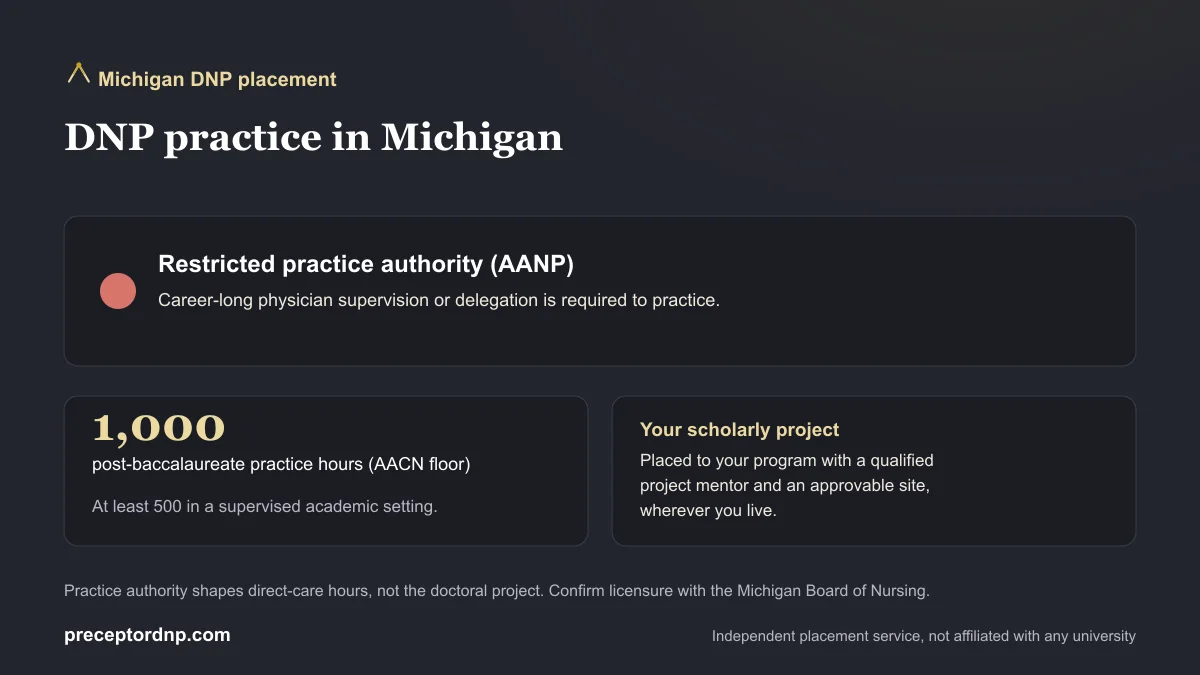
The DNP standard calls for at least 1,000 supervised post-baccalaureate practice hours, varies by program, and includes at least 500 hours in a supervised academic setting. The number is cumulative after the baccalaureate. Post-master's students may apply qualifying prior supervised hours after their program audits the documentation. BSN-to-DNP students usually build population-focus clinical practice and systems work across the curriculum while developing and implementing the project.
Obtain a written gap calculation before seeking a Michigan placement. Separate accepted hours, remaining direct care, project work, systems objectives, and excluded activities. Planning, commuting, class assignments, or unsupervised work may not qualify. Use the DNP clinical hours guide as a planning aid and confirm decisions with your coordinator.
Build approval time into the term. Health systems may require an affiliation agreement, background screening, immunization records, privacy training, and internal project review. Rural sites may have fewer administrative layers but less spare staff time. Keep a dated activity record linked to objectives and secure mentor verification while the work is fresh. Never begin logging hours merely because an introduction went well.
AANP currently places Michigan in the restricted practice category. Michigan law restricts at least one element of NP practice, including physician delegation connected to controlled-substance prescribing. This matters when a student's supervised work includes direct patient care, diagnosis, treatment, or prescribing. Check the preceptor's active license, role, population focus, and any required delegation with the Michigan Board of Nursing resources before the rotation begins.
Practice authority does not turn a quality-improvement project into a clinical rotation. Mapping an approved process, educating staff, testing a workflow, and reviewing authorized aggregate outcomes generally follow organizational project and privacy rules rather than NP prescribing law. Students still must work within their own license and approved role. Restricted practice is not a reason to ignore Michigan as a project market, and it is not permission to blur direct care with systems work.
Prepare a concise packet with the problem, setting, population, evidence-based change, proposed measures, schedule, onsite needs, and mentor criteria. Add the program contact and state that both program and site approval are required. For northern or Upper Peninsula options, explain travel plans and any request for remote supervision. If a site cannot release data, offer a process measure that its team can report without transferring protected information.
PreceptorDNP is an independent placement service for DNP students at any university. We help identify possible Michigan mentors and project sites, but we cannot guarantee a placement or school approval. Once you have the hour gap and project direction, use the placement request form or contact the placement desk. Our process overview explains what to prepare.
Possible settings include health systems, critical access hospitals, FQHCs, health departments, tribal programs, long-term care, and community organizations. Suitability depends on problem ownership, measures, mentor capacity, and both site and program approval.
No. It matters for patient care within NP scope, especially where physician delegation applies. Quality-improvement work usually follows site review, privacy, and operational rules. Confirm direct-care requirements with Michigan licensing resources.
Qualifying supervised post-baccalaureate hours may count after your program verifies them. Programs differ in documentation, recency, and category rules. Ask for a written gap analysis before arranging a site, and do not convert the cumulative standard into a fixed number of new DNP hours.
Depending on program rules, a DNP-prepared nurse, physician, nurse executive, quality leader, or other qualified system leader may serve. The person should understand the workflow, have access to decision makers and data, and provide documented supervision. Direct-care preceptors need separate population-focus and licensure alignment.
Yes, especially for focused work on transitions, telehealth, chronic disease, access, or safety. Expect long travel, smaller teams, and limited analytics. Confirm onsite requirements, winter travel, remote meeting rules, and data access first.
No cost to request, and nothing is billed until a match is confirmed and your school signs off. We'll reply within one business day.
We do not guarantee placement. Final approval rests with your program.
