Minnesota supports DNP projects across large Twin Cities systems, regional referral centers, county public health, and a broad critical access hospital network. A workable placement joins one local improvement priority with a mentor who can supervise doctoral practice, open the right operational doors, and help measure change within the academic calendar.
Minneapolis, St. Paul, and the surrounding metro contain Allina Health, HealthPartners, Hennepin Healthcare, and other complex delivery networks with quality, nursing practice, informatics, population health, and care management teams. These settings can support projects on safety, transitions, chronic disease, behavioral health connection, or access. They also use formal review and affiliation processes, so mentor interest is only the beginning of approval.
Rochester has a deep specialty and improvement environment through Mayo Clinic. CentraCare anchors St. Cloud, Essentia Health serves Duluth and northern communities, and Sanford Health has a major presence around Bemidji and western Minnesota. Mankato and regional centers in the south add hospital and ambulatory options. Use system names to understand geography, not to assume availability. A smaller service line or affiliated clinic may be a better project site than a main hospital.
County and tribal public health, FQHCs, long-term care, rural clinics, and community organizations widen the field. Minnesota's local infrastructure supports projects tied to vaccination, maternal and child health, aging, mental health connection, chronic disease prevention, or rural access. Ask whether the setting already tracks a relevant measure and has staff capacity to participate.
The scholarly project is the center of DNP placement. It should translate evidence into a defined practice change, not repeat master's-level NP clinical rotations. Start with the site's problem statement and baseline, then choose an intervention that can be introduced, observed, and refined during the approved period. Examples include standardizing a discharge step, improving an evidence-based screening workflow, increasing reliable referral follow-through, or reducing a documented process variation.
Clarify the review pathway before writing a final protocol. A quality-improvement or evidence-based practice project may not be human-subject research, but the site and program determine that status. Ask who approves the project, whether protected data are involved, who performs data extraction, and what may be shared in a presentation. The organization retains authority over its patients, staff, records, and operations.
Minnesota's rural settings can produce strong projects when scope matches capacity. The state Flex Program explicitly supports quality improvement in critical access hospitals. A rural project might use a small number of practical measures and an existing reporting process. It should not import a metro workflow without listening to local staff, nor assume telehealth removes travel or supervision requirements.
A DNP-prepared nurse, physician, nurse executive, quality leader, public health leader, or another program-approved professional may mentor a scholarly project. Look for control over the workflow, access to data owners, and time for regular feedback. In a large system, an executive sponsor may authorize the work while a unit or clinic leader provides weekly supervision. Put both roles in writing so signatures and decisions do not become last-minute problems.
Direct-care hours require different alignment. A board-certified NP or physician should be actively practicing in the student's population focus, licensed for the work, and accepted by the program. One person may qualify for both roles, but do not assume it. Leadership, informatics, public health, and clinical objectives should each be paired with supervision that can be documented. See DNP specialty and role options when separating the hour plan.
Before accepting a mentor, ask about meeting cadence, onsite expectations, data access, project review, and planned absences. Confirm who can validate logs and whether a backup is available. Schools approve credentials and sites, while organizations decide who may supervise work inside their operations.
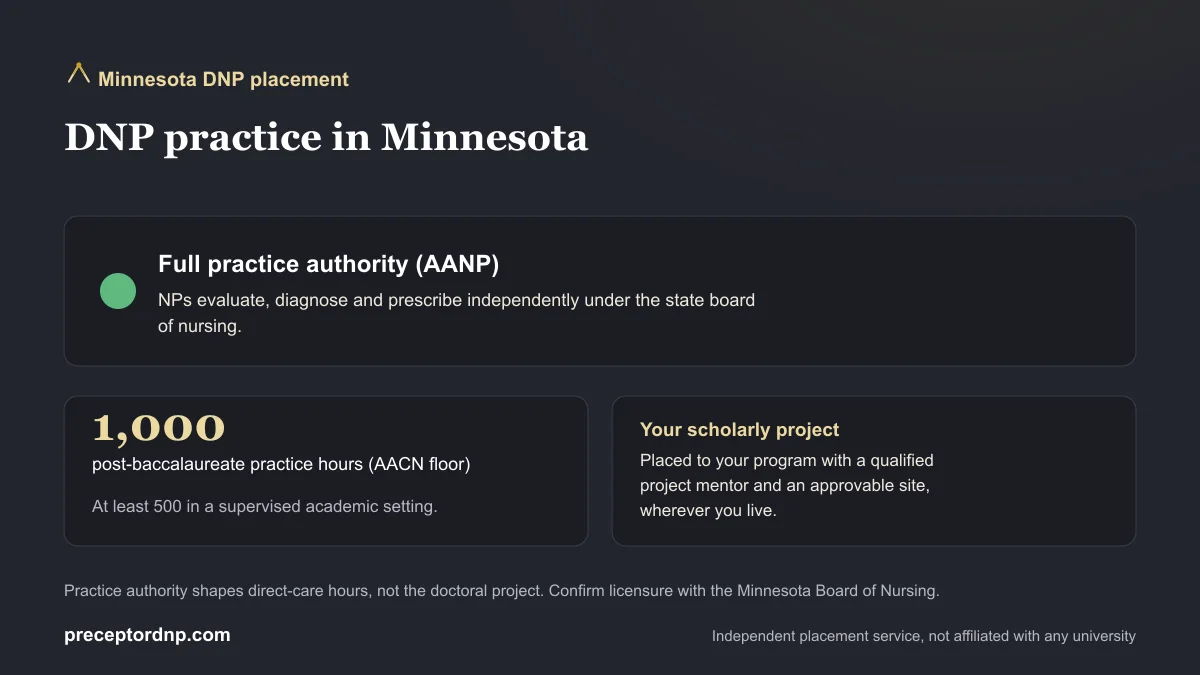
The DNP requires at least 1,000 supervised post-baccalaureate practice hours, varies by program, with at least 500 hours in a supervised academic setting. This is a cumulative post-baccalaureate expectation. Post-master's students may apply prior supervised graduate hours only after their program verifies the documentation and fit. BSN-to-DNP students commonly accumulate population-focus direct care, systems practice, and project work across the curriculum.
Request a written gap analysis showing accepted prior hours, remaining categories, direct-care requirements, project hours, and excluded activities. Published program designs differ, and no statewide Minnesota number replaces your program's rules. Use our DNP hours planning page to prepare questions, then confirm the answer with your program before paying, traveling, or onboarding.
Log only approved, supervised practice. Keep dates, objectives, activities, outcomes, and mentor verification together. Metro systems may require lengthy affiliation and privacy steps. Rural sites may move through fewer offices but have limited onboarding staff. Either way, an interested mentor does not authorize early hour logging.
AANP currently classifies Minnesota as a full practice state. That category concerns NP patient-care authority and is relevant when a DNP student's supervised hours include assessment, diagnosis, treatment, or prescribing. Minnesota also has requirements that can affect NPs early in practice, so verify the preceptor's active status, experience, and any current transition provisions with the Minnesota Board of Nursing. Program rules may be stricter than state minimums.
Full practice authority does not approve a scholarly project. A quality-improvement student who maps a process, trains staff, or evaluates authorized aggregate results is usually working under site project, privacy, and operational rules, not independently treating patients. Keep direct care and project activities distinct in the proposal and log. Neither AANP classification nor a nursing license replaces a site agreement.
Send a one-page brief that states the local problem, population, proposed change, measures, timeline, mentor qualifications, and program contact. Include what must happen onsite and whether travel to rural communities is realistic. Offer a smaller alternative scope if approvals or data access narrow the project. This demonstrates respect for a site that is already balancing patient care and improvement work.
PreceptorDNP independently assists DNP students at any university with possible project sites and mentors. We do not guarantee placement or program approval. After your program confirms the project stage and hour gap, submit the matching request or contact our placement desk. Read how placement support works before outreach.
Yes, if the hospital owns the improvement need, can provide an approved mentor and supervision, and completes site and program review. The state Flex Program supports quality-improvement activity in critical access hospitals, but that does not create automatic student access. Keep measures and workload realistic for a small team.
Program rules may allow a DNP-prepared nurse, physician, nurse executive, quality leader, public health leader, or another qualified professional. The mentor should understand the workflow, reach data and decision makers, meet regularly, and verify hours. Direct-care preceptors require population-focus and licensure alignment.
They may. A post-master's program can accept qualifying supervised post-baccalaureate hours after reviewing documentation and fit. Ask for the decision in writing. BSN-to-DNP students usually build their cumulative total throughout clinical, systems, and project courses.
No. It governs NP practice authority, not affiliation agreements, background checks, privacy training, project review, data access, or program approval. It matters most to direct-care hours. Confirm current licensure and any transition requirements with the Minnesota Board of Nursing.
No. Rochester, St. Cloud, Duluth, Bemidji, Mankato, regional clinics, county public health, and rural hospitals offer different project environments. A broader radius can reduce competition, but students must budget travel and confirm whether remote supervision is permitted.
No cost to request, and nothing is billed until a match is confirmed and your school signs off. We'll reply within one business day.
We do not guarantee placement. Final approval rests with your program.
