Mississippi DNP placements are strongest when the project is useful to a specific hospital, clinic, public health program, or community partner. Jackson offers the largest concentration of formal improvement resources, while the Gulf Coast, northeast, Delta, and rural communities present clear opportunities for focused work on access, safety, chronic illness, and care coordination.
The DNP scholarly project should drive the placement. It is a supervised quality-improvement or practice-change experience, not another master's NP rotation. Begin with a problem that the Mississippi site already recognizes, such as inconsistent follow-up after discharge, a gap in evidence-based screening, missed referrals, infection prevention variation, or weak chronic disease outreach. Confirm who owns the workflow and which measure the team can obtain before proposing an intervention.
Mississippi's Board of Nursing describes quality assurance and quality improvement expectations for APRN practice and gives examples such as screening, vaccination, chronic disease, safety, and patient-reported measures. That state context makes improvement language familiar, but it does not mean an APRN's required plan automatically becomes a student project. Your program and the host organization must approve the question, mentor, scope, review pathway, and data use.
Keep the first cycle contained. One clinic, unit, transition, or outreach process is usually more defensible than a statewide promise. Ask whether the project is quality improvement, evidence-based practice, or research under local rules. Clarify access to records, data extraction, privacy protections, and dissemination before collecting anything. A site can welcome the topic while still limiting the data available to a student.
Jackson is the state's main referral and administrative center, with hospital quality teams, specialty services, state public health leadership, and a large patient base. Hattiesburg and Forrest General Hospital serve the Pine Belt. Tupelo and North Mississippi Health Services anchor the northeast, while Meridian connects eastern counties. These regional centers can support projects that need established nursing practice councils, care management, or analytics.
Along the coast, Gulfport, Biloxi, and Pascagoula have Memorial Health System, Singing River Health System, public health, behavioral health, and community organizations serving year-round residents and communities affected by storms. The Delta around Greenville, Greenwood, Clarksdale, and Indianola has fewer large systems and long travel distances. Community health centers, local hospitals, county services, and faith or nonprofit organizations may be better partners for a focused access or prevention project there.
Rural Mississippi depends on small hospitals, FQHCs, rural health clinics, long-term care, home health, emergency medical services, and public health districts. The state's Flex and SHIP work supports quality and operational improvement in eligible rural hospitals. A rural mentor may supervise the project while also carrying clinical or administrative duties, so use simple measures, predictable meetings, and a realistic travel plan.
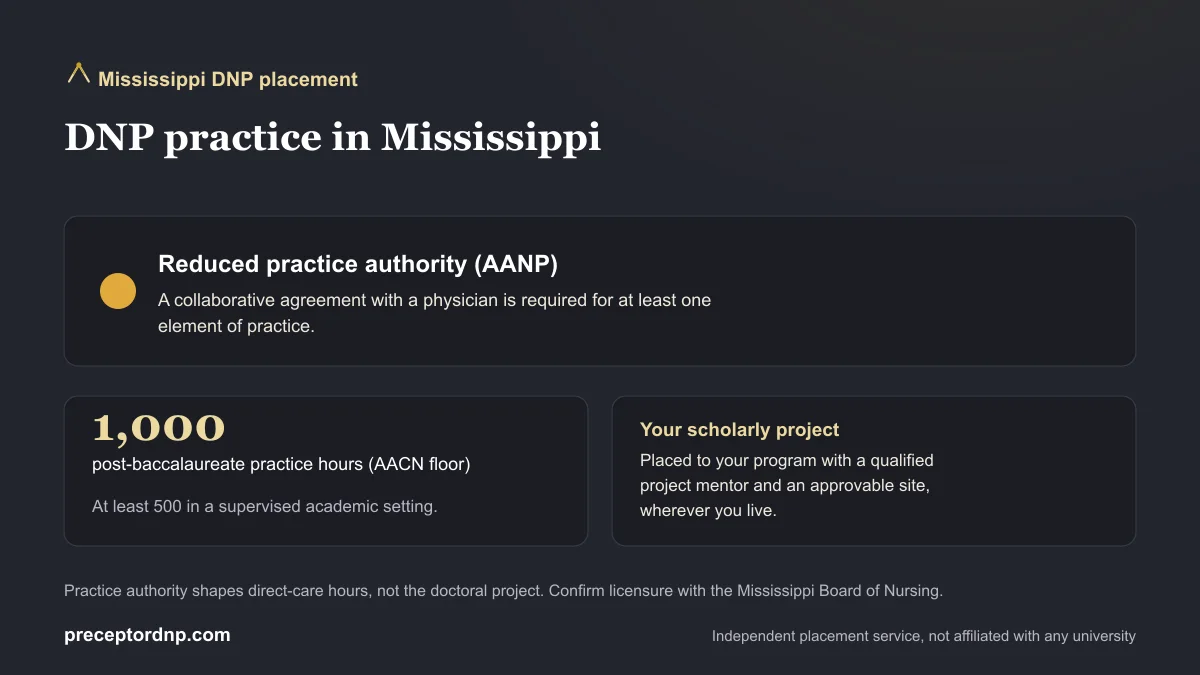
The DNP requires at least 1,000 supervised post-baccalaureate practice hours, varies by program, including at least 500 hours in a supervised academic setting. This is cumulative after the baccalaureate rather than a fixed block of new DNP hours. Post-master's students may receive credit for qualifying prior supervised hours after program review. BSN-to-DNP students typically build population-focus direct care, systems practice, and project hours throughout the curriculum.
Ask for a written gap analysis that separates accepted prior hours, remaining direct-care requirements, project implementation, systems or leadership objectives, and noncountable activities. Mississippi does not set one academic total for every program. Review the DNP practice-hour guide, then confirm categories, evidence, and transfer decisions with your own program before entering a site agreement.
Onboarding can include affiliation paperwork, background checks, immunization records, privacy training, record access, and internal project review. Small organizations may lack a dedicated student office, so approval still takes coordination. Do not begin logging time after an informal yes. Record each approved activity, related objective, outcome, and mentor verification while it is current.
A scholarly-project mentor may be a DNP-prepared nurse, physician, nurse executive, quality leader, public health leader, or another qualified professional accepted by the program. The essential test is practical: can this person guide the method, reach staff and data owners, meet regularly, and verify supervised practice? In a larger Mississippi hospital, an executive sponsor and an operational mentor may share those functions.
Direct-care hours call for a board-certified NP or physician actively practicing in the student's population focus and meeting state plus program requirements. One mentor should not be assumed to cover every objective. A public health leader may be ideal for a population project but not for NP patient encounters. Confirm credentials before onboarding and identify a backup when a rural leader has limited availability. The DNP pathways overview can help sort clinical and systems roles.
AANP currently categorizes Mississippi as a reduced practice state. Current Board of Nursing materials describe a board-approved collaborative relationship for APRN practice and quality assurance activity. Those requirements matter when supervised hours include assessment, diagnosis, treatment, prescribing, or another patient-care function. Verify the preceptor's active authorization, collaboration, and population focus directly with the Mississippi Board of Nursing.
Reduced practice is not the approval framework for every scholarly project. Mapping an authorized workflow, educating staff, testing a process, and evaluating permitted aggregate data are generally governed by site policy, privacy, and project review. The student's own license and role still apply. Keep direct-care and quality-improvement hours distinct, and never present a project mentor's credentials as permission to treat patients independently.
A useful brief names the site problem, affected population, evidence-based change, measures, timeline, required access, and mentor criteria on one page. Include the program contact and state plainly that final approval belongs to the program and site. For Delta, coastal, or other rural placements, address travel, weather, remote meetings, and the site's limited staff time. Offer a smaller scope if data access changes.
PreceptorDNP is independent and assists DNP students at any university. We can help identify possible Mississippi project sites and mentors, but no placement or program approval is guaranteed. When the project stage and hour gap are documented, send the matching request or contact the placement desk. Check current placement costs before choosing support.
Hospitals, FQHCs, rural health clinics, public health programs, long-term care, home health, behavioral health, and community organizations may qualify. The setting must own the problem, support appropriate measurement, provide a program-approved mentor, and complete its review and agreement process.
No. Mississippi's APRN quality framework provides useful context, but a student's scholarly project needs separate program and site approval. Confirm the question, intervention, mentor, review pathway, data permissions, and deliverables before beginning supervised work.
They may count when they are qualifying supervised post-baccalaureate hours and your program accepts the documentation. Ask for a written gap analysis. The cumulative standard should not be treated as a fixed number of new hours required from every post-master's student.
It affects direct patient-care activities within NP authority and may involve collaboration requirements. It usually does not govern an approved quality-improvement project that contains no independent patient care. Confirm direct-care details and preceptor authorization with the Mississippi Board of Nursing.
Yes, when the scope fits the organization's data and staffing capacity. Rural hospitals, clinics, public health, and community partners can support meaningful projects, but travel is longer and formal improvement staff may be limited. Plan simple measures, regular supervision, and extra approval time.
No cost to request, and nothing is billed until a match is confirmed and your school signs off. We'll reply within one business day.
We do not guarantee placement. Final approval rests with your program.
