Missouri offers DNP project settings in two major metros, several regional health hubs, and a wide network of rural hospitals and clinics. Start with the organization's improvement need, not a generic request for clinical hours, then connect the project to a mentor who can authorize access, supervise doctoral practice, and help track an outcome.
St. Louis has mature quality and nursing infrastructure across BJC HealthCare, Mercy, SSM Health, and other hospital and ambulatory networks. Kansas City offers similarly complex settings through Saint Luke's Health System, Children's Mercy, North Kansas City Hospital, and community providers. These metros can support patient safety, care transition, population health, informatics, behavioral health connection, and access projects. They also receive many learner requests and often centralize contracts, privacy review, and data access.
Springfield is a major southwest hub through CoxHealth and Mercy. Joplin, Columbia, Jefferson City, Cape Girardeau, Poplar Bluff, and Hannibal connect smaller cities with surrounding counties. A regional hospital, clinic group, public health program, or long-term care organization may offer a clearer decision chain than a flagship campus. Choose a setting where the affected population and workflow owner are identifiable.
Rural Missouri includes critical access hospitals, rural health clinics, FQHCs, local public health agencies, emergency medical services, and community organizations. The Missouri Office of Rural Health and Primary Care supports quality, performance, and population health improvement in small hospitals. That infrastructure can make rural sites strong doctoral partners, provided the project's workload and data plan fit a lean team.
The DNP project is a supervised translation of evidence into practice. It should not read like a request for master's NP specialty rotations. Ask the site to identify a current gap, baseline signal, and operational owner. A focused project might improve discharge communication, standardize a safety check, increase completion of a screening step, strengthen referral closure, or test a staff education process. The proposed measure must be obtainable within the approved timeline.
Determine the local review route before implementation. Quality improvement and evidence-based practice are often reviewed differently from human-subject research, but only the program and site can classify the work. Ask who may view records, who extracts data, where project files reside, and what results can be presented outside the organization. A mentor's support does not override privacy, compliance, or leadership decisions.
Rural projects often benefit from a narrow first cycle. One unit, clinic, transition, or county program can yield a useful result without overwhelming staff. Avoid importing a metro intervention without adaptation. Travel time, broadband, referral distances, and small sample sizes may shape the design. Secure remote supervision is acceptable only when both the site and program authorize it.
Depending on program criteria, the project mentor may be a DNP-prepared nurse, physician, nurse executive, quality professional, public health leader, or another qualified health-system leader. The best match understands the workflow, can convene affected staff, reaches the data owner, and has time for scheduled supervision. In a large Missouri system, an executive sponsor may approve the work while a unit or clinic leader mentors weekly activity.
For direct-care hours, mentor requirements change. A board-certified NP or physician should practice in the student's population focus, hold the required authorization, and meet the program's experience standards. Missouri's practice requirements must be reflected in the clinical arrangement. Do not assume a systems mentor can sign patient-care hours or that a clinical preceptor can approve organization-wide change. Confirm every role before onboarding.
Discuss meeting cadence, onsite work, project review, hour verification, and backup coverage in writing. If your program requires a particular degree, certification, or employment relationship, share that criterion early. See common DNP preceptor questions before approaching candidates.
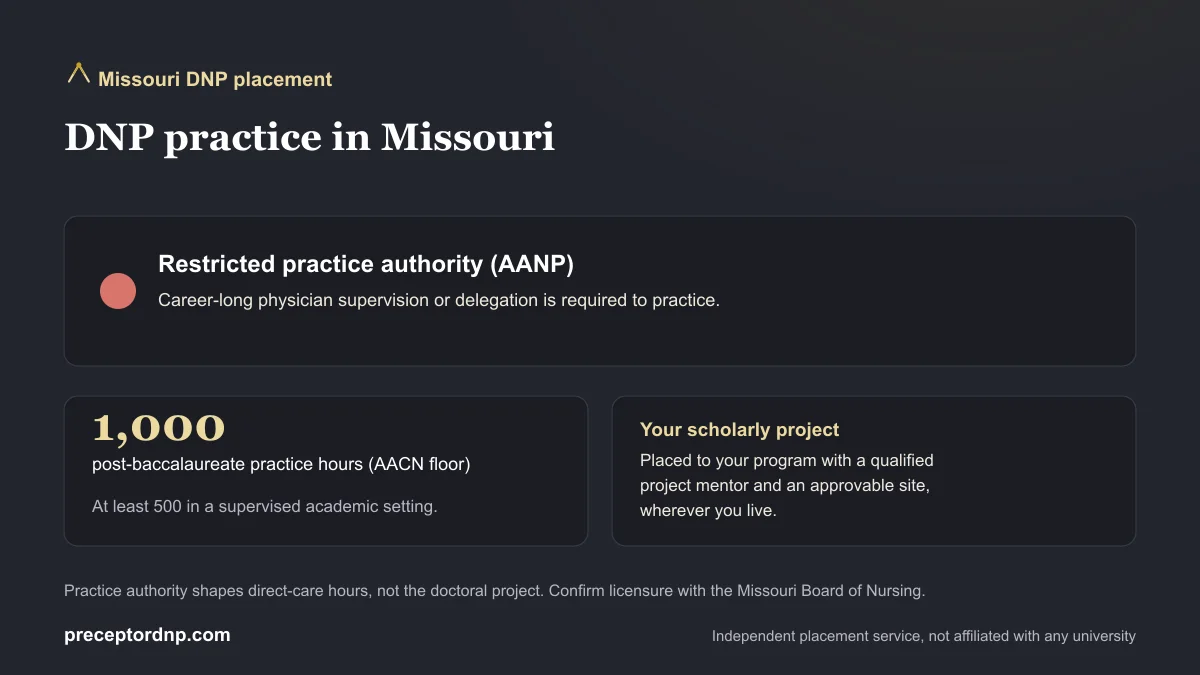
The DNP standard is at least 1,000 supervised post-baccalaureate practice hours, varies by program, with at least 500 hours in a supervised academic setting. This total is cumulative after the baccalaureate. Post-master's students may apply qualifying prior supervised hours after program verification. BSN-to-DNP students normally accumulate direct-care, systems, leadership, and project practice across the curriculum.
Get a written gap analysis before contracting with a Missouri site. It should show accepted prior hours, remaining direct-care requirements, project implementation, systems objectives, and excluded work. Programs differ in what they accept and how they document it. The DNP hours guide can frame your questions, but your own program decides what counts.
Affiliation agreements, background checks, health records, privacy training, electronic access, and project review can take weeks or months. Small sites may not have a dedicated education office, so fewer steps do not always mean faster approval. Log only authorized supervised activity and record the objective, work, outcome, and mentor confirmation for each entry.
AANP currently classifies Missouri as a restricted practice state. Current state policy information describes a career-long collaborative practice arrangement with a physician for NP practice, with additional provisions affecting prescribing and oversight. These rules matter for direct patient-care hours. Verify the proposed preceptor's active authority, collaborative arrangement, population focus, and site privileges with the Missouri State Board of Nursing and the program.
A DNP quality-improvement project is generally not a licensure-gated clinical rotation. With site approval, students may map workflows, educate staff, test a process, and evaluate authorized aggregate results without independently diagnosing or prescribing. Site policy, privacy, the student's own license, and the project review decision still control the activity. Do not use a project placement to work around direct-care requirements.
Prepare one page covering the local problem, population, evidence-based change, measures, schedule, required access, mentor qualifications, and program contact. State that site and program approval are required. If the setting is rural, explain travel and any remote-supervision request. Offer a smaller version of the intervention if leadership limits the population or data available.
PreceptorDNP is independent and serves DNP students at any university. We assist with possible Missouri project-site and mentor matches, but we never guarantee placement or school approval. Once the hour gap and project direction are clear, use the matching form or contact our placement desk. Review how the process works before submitting.
Hospitals, ambulatory networks, critical access hospitals, FQHCs, rural health clinics, public health agencies, long-term care, and community organizations may qualify. The site must own the problem, support approved measurement, provide appropriate supervision, and complete both organizational and program review.
No. Restricted practice directly affects NP patient-care authority and clinical arrangements. An approved quality-improvement project usually follows site operational, privacy, and project-review rules. Keep project work separate from direct care and confirm clinical requirements with the Missouri State Board of Nursing.
Only if that person also meets the program's direct-care preceptor standards, practices in the required population focus, and complies with Missouri requirements. A nurse executive or quality leader may be an excellent project mentor without qualifying to supervise patient encounters.
Qualifying supervised post-baccalaureate hours may count after your program audits the records. Ask for a written gap analysis before choosing a placement. The cumulative expectation is not a fixed block of new hours for every post-master's student.
Yes. Small hospitals and community settings actively work on quality, population health, and operational improvement. Use a limited scope, practical measures, and predictable supervision. Confirm travel, onboarding, data capacity, and remote meeting rules before committing.
No cost to request, and nothing is billed until a match is confirmed and your school signs off. We'll reply within one business day.
We do not guarantee placement. Final approval rests with your program.
