Montana's distances make project fit more important than project size. Regional health systems can offer formal quality teams and data support, while critical access hospitals, tribal health programs, public health departments, and community clinics can support tightly focused improvements with direct local value.
Billings is the largest health care hub, with Billings Clinic, Intermountain Health, specialty services, and statewide referral relationships. Great Falls has Benefis Health System, while Kalispell and the Flathead Valley are served by Logan Health. Missoula, Bozeman, and Helena add hospital quality, ambulatory, public health, and community options through Providence, Bozeman Health, St. Peter's Health, and local partners. These centers can support projects requiring analytics, nursing councils, infection prevention, or care management.
Eastern and north-central Montana rely more heavily on critical access hospitals and small clinics around communities such as Miles City, Glendive, Sidney, Glasgow, Havre, and Lewistown. Travel between services can be substantial. A project on transfer reliability, emergency follow-up, telehealth access, chronic disease outreach, or workforce process may fit better than an intervention needing daily access to a large specialist team.
Tribal health departments, Indian health facilities, FQHCs, county public health, long-term care, and community organizations are important settings. Partnership must begin with the organization's priorities, governance, and data rules. Do not treat tribal communities as interchangeable or assume an outside program agreement grants access. The relevant organization decides whether the project is useful and how information may be handled.
A DNP scholarly project translates evidence into an approved practice change. It is not a substitute for master's-level NP clinical rotations. Start with a gap the Montana site already recognizes, such as inconsistent referral closure, delayed follow-up after transfer, variation in an infection prevention step, missed screening, or weak patient education. Define one population, one workflow owner, and one measure available within the project period.
Montana's Rural Hospital Flexibility Program includes critical access hospital quality improvement, population health, and emergency medical services work. That creates a relevant environment for doctoral projects but not automatic student openings. Site staff still decide whether they can support the intervention, mentor, onboarding, and measurement. A short test in one clinic or department is often more useful than a broad plan that requires data the facility cannot extract.
Ask which review pathway applies. Quality improvement and evidence-based practice may be treated differently from human-subject research, but students cannot make that designation themselves. Confirm record access, privacy, data extraction, storage, and permission to present results. In small facilities, use measures already collected whenever possible and avoid adding documentation burden without a clear benefit.
A program may approve a DNP-prepared nurse, physician, nurse executive, quality leader, public health leader, or another qualified professional as project mentor. The useful mentor understands the local workflow, can reach data and decision makers, meets on a predictable schedule, and can verify supervised practice. In a regional system, one person may sponsor the project while a second operational leader directs weekly work.
Direct-care practice requires a board-certified NP or physician working in the student's population focus and meeting state plus program standards. The project mentor may not qualify for patient-care hours. In remote communities, clarify whether the proposed clinician is available through the entire term and whether remote supervision is accepted. A backup plan matters when staffing changes or weather limits travel.
Share mentor criteria before introductions. Ask who signs logs, which activities require onsite presence, how project review works, and what data the student may see. Review DNP clinical and systems pathways if one placement is expected to cover several kinds of objectives.
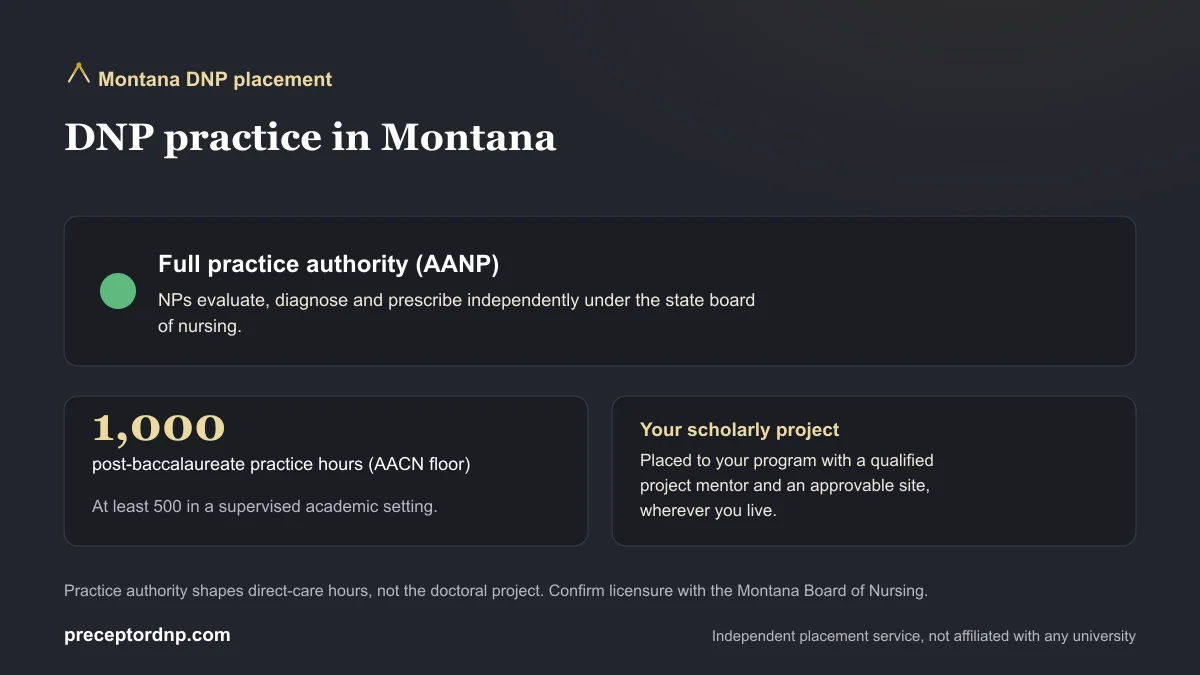
The DNP requires at least 1,000 supervised post-baccalaureate practice hours, varies by program, and includes at least 500 hours in a supervised academic setting. It is a cumulative total after the baccalaureate, not a fixed number of new doctoral hours for everyone. A post-master's student may apply qualifying prior supervised practice after program verification. BSN-to-DNP students typically accumulate direct-care, systems, and project hours across the curriculum.
Request a written gap analysis separating accepted hours, remaining clinical work, project implementation, systems or leadership practice, and excluded activities. Then decide how much travel is sustainable. A Billings student assigned in Glendive or a Missoula student traveling toward the Hi-Line needs a plan for road conditions, overnight stays, and onsite frequency. Remote meetings may supplement supervision only with site and program approval.
Use the DNP hours guide to organize questions, then follow your program's decision. Montana sites may require agreements, background checks, health records, privacy training, and project approval. Log only authorized supervised activity and link each entry to an objective, outcome, and mentor confirmation. Travel time does not automatically count.
AANP currently lists Montana as a full practice state. That classification matters when hours include NP assessment, diagnosis, treatment, or prescribing, because the preceptor's active license, role, population focus, and authority must fit the clinical work. Confirm current licensure and program-specific requirements with the Montana Board of Nursing before direct-care hours begin.
Full practice authority does not replace project approval. A student conducting an authorized workflow review, staff education effort, process test, or analysis of permitted aggregate outcomes is generally following organizational quality and privacy rules rather than independently delivering NP care. Keep direct-care and scholarly-project activities separate in the proposal and logs. A nursing license alone never grants entry to a site or its records.
Prepare one page with the problem, population, evidence-based change, measures, schedule, site access, mentor criteria, and program contact. State that the site retains control of operations and data and that program approval is required. For frontier settings, explain travel and remote supervision clearly. Offer a smaller scope that can proceed if staff capacity or data access is limited.
PreceptorDNP independently assists DNP students at any university. We help identify possible Montana mentors and project sites but cannot guarantee a match or program approval. When your hour gap and project direction are confirmed, use the matching request or contact our placement desk. Read how placement support works first.
Yes, when the hospital owns the problem, can support practical measurement and supervision, and completes program plus site approval. Critical access hospitals participate in statewide quality work, but student access is never automatic. Keep the intervention small enough for local staffing and data capacity.
Potentially, when the tribal or Indian health organization invites the work and approves governance, privacy, data, mentor, and dissemination arrangements. Each community and organization sets its own priorities. A school agreement or outside introduction does not replace local authorization.
Not necessarily. The standard is cumulative after the baccalaureate. A post-master's student may receive credit for qualifying prior supervised hours after program review, while a BSN-to-DNP student generally accumulates practice throughout the program. Ask for a written gap analysis.
No. It describes NP patient-care authority. Your program approves mentor qualifications, and the site approves access and project activity. Full practice is relevant to direct-care hours, while a quality-improvement project follows site review, privacy, and operational requirements.
Confirm onsite frequency, road travel, lodging, weather contingencies, connectivity, and whether remote supervision is allowed. Choose measures the site already collects and identify backup mentor coverage. Do not assume commuting time counts toward supervised practice hours.
No cost to request, and nothing is billed until a match is confirmed and your school signs off. We'll reply within one business day.
We do not guarantee placement. Final approval rests with your program.
