Nebraska combines large improvement teams in Omaha and Lincoln with regional referral centers and an extensive critical access hospital network. A strong DNP placement connects a site-owned problem to a qualified mentor, realistic data, and a project scope that works across the state's urban, rural, and frontier distances.
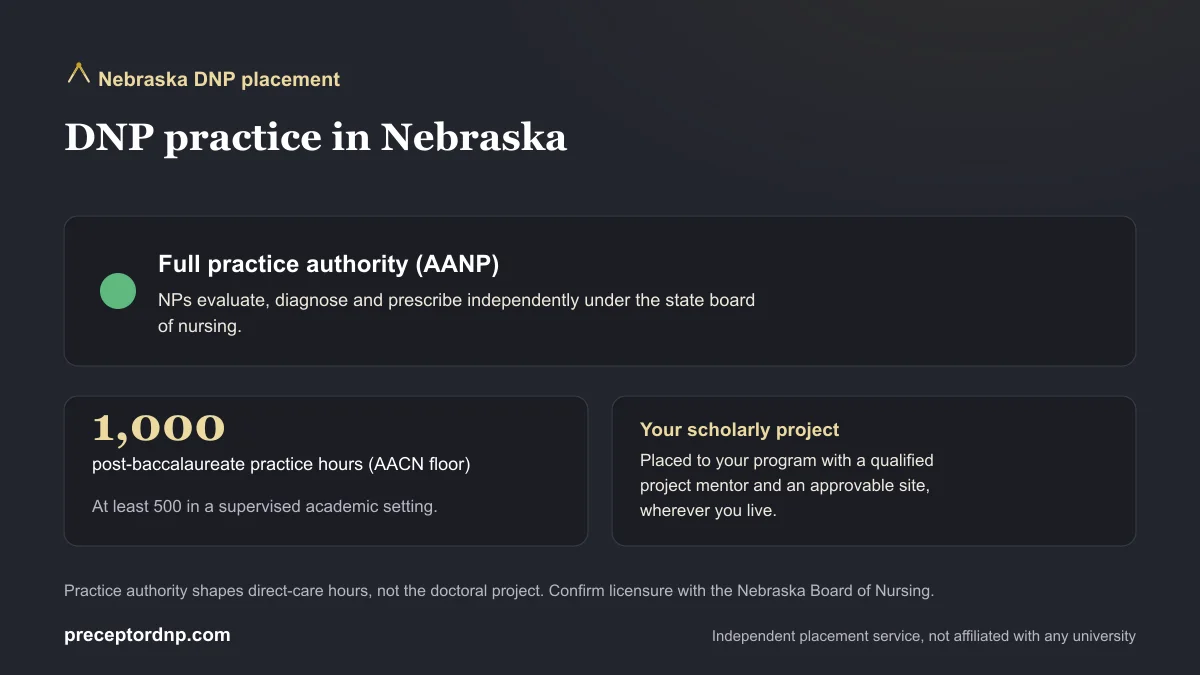
The DNP requires at least 1,000 supervised post-baccalaureate practice hours, varies by program, with at least 500 hours in a supervised academic setting. This is cumulative practice after the baccalaureate, not a fixed number of new hours at the doctoral stage. A post-master's student may apply qualifying prior supervised hours after program verification. A BSN-to-DNP student usually builds population-focus direct care, systems work, and the scholarly project across the curriculum.
Ask the program for a written gap analysis showing prior hours accepted, remaining direct-care requirements, project implementation, systems or leadership practice, and excluded activities. This determines whether the Nebraska search needs a clinical preceptor, a project mentor, or both. Use the DNP practice-hour guide to organize questions, but follow the program's written decision.
Affiliation agreements, background screening, health documentation, privacy training, electronic access, and project review can delay a start. Rural sites may have fewer administrative layers but limited staff for onboarding. Do not count an informal introduction as authorization. Log only approved, supervised work and connect each entry to an objective, outcome, and mentor verification.
Omaha has the state's deepest concentration of specialty care and formal quality infrastructure through Nebraska Medicine, CHI Health, Methodist Health System, Children's Nebraska, and other ambulatory networks. Lincoln adds Bryan Health, state agencies, public health, and community care. These settings can support work on safety, transitions, infection prevention, population health, informatics, and access, but contracts and data governance are often centralized.
Grand Island and Kearney serve central Nebraska, North Platte anchors the west-central region, Scottsbluff supports the Panhandle, and Norfolk connects northeast communities. Regional systems such as Great Plains Health, Regional West Health Services, Faith Regional Health Services, and local hospitals may offer a shorter path to a defined service line. A bounded project can be easier to approve when the workflow owner is close to the mentor.
Critical access hospitals, rural health clinics, FQHCs, local public health districts, tribal health programs, long-term care, and emergency medical services extend across the state. Nebraska's Flex and SHIP programs explicitly support hospital quality, medication safety, falls work, data reporting, and operational improvement. Those priorities provide project context but do not guarantee a student opening.
The scholarly project is the spine of DNP placement, not an extra master's-level NP rotation. Begin with a problem the site has documented and wants to change. Examples include transfer communication, discharge follow-up, fall prevention, medication reconciliation, chronic disease outreach, referral closure, or adoption of an evidence-based screening process. The site should identify the population, workflow owner, baseline signal, and measure available during the term.
Determine whether the work follows a quality-improvement, evidence-based practice, or research pathway. The student cannot make that classification alone. Ask who approves the intervention, whether records contain identifiable information, who extracts data, where files are stored, and what results may be shared. The site's permission and the program's approval are separate decisions.
For a small Nebraska hospital or clinic, use measures already collected and limit the first cycle to one location or team. Travel, weather, workforce shortages, and limited analytics affect feasibility. Remote meetings can help but do not erase onsite or supervision requirements. A modest project completed with staff participation is more doctoral than an oversized plan that never reaches implementation.
A program may approve a DNP-prepared nurse, physician, nurse executive, quality leader, public health leader, or another qualified professional to mentor the project. Choose someone who can reach the workflow and data owners, convene staff, provide regular feedback, and verify practice. In a large system, an executive sponsor and an operational mentor may divide authorization and weekly supervision.
Direct-care hours generally require a board-certified NP or physician practicing in the student's population focus and meeting Nebraska plus program standards. One person may qualify for both project and clinical roles, but this must be confirmed. Initial-practice conditions may affect some NP arrangements even in a full practice state, so check current requirements and experience with the Nebraska Board of Nursing.
Put meeting cadence, onsite expectations, data access, log signatures, and backup coverage in writing. If the program requires a particular credential or employment relationship, disclose it early. Review DNP role and specialty pathways before asking one mentor to cover unrelated objectives.
AANP currently categorizes Nebraska as a full practice state. Effective July 1, 2026, Nebraska law places NP licensure and practice with the Board of Nursing rather than the former separate advanced practice board. Full practice concerns patient-care authority, so it matters when supervised hours include assessment, diagnosis, treatment, or prescribing. Confirm the preceptor's current license, population focus, experience, and any applicable transition requirements directly with the board.
The category does not approve a DNP project. Workflow mapping, staff education, process testing, and review of authorized aggregate outcomes generally proceed under site project, privacy, and operational rules. The student's own license and assigned role still matter. Keep direct patient care separate from quality-improvement activity in the proposal and hour log.
Prepare one page naming the local problem, population, evidence-based change, measures, schedule, access needs, mentor criteria, and program contact. State clearly that the organization controls its workflow and data and that the program must approve the placement. For western or rural sites, explain travel, lodging, remote meetings, and a smaller backup scope.
PreceptorDNP is independent and helps DNP students at any university identify possible Nebraska mentors and project sites. We cannot guarantee placement or program approval. After documenting the project stage and hour gap, submit the matching form or contact the placement desk. Review the placement process before sending details.
Yes, if the hospital owns the improvement need, has a qualified mentor, supports feasible measurement, and completes program plus site approval. Nebraska's rural programs support hospital quality work, but students still need an individual agreement and project review.
As of July 1, 2026, state law places NP licensure and practice with the Nebraska Board of Nursing. Because the transition is recent, verify current instructions directly through Nebraska Department of Health and Human Services licensing resources before direct-care hours begin.
Qualifying supervised post-baccalaureate hours may count after your program audits and accepts the documentation. Request a written gap analysis. Do not assume the cumulative standard means every post-master's student must complete the entire total again.
No. Full practice concerns NP patient-care authority. Site agreements, project review, privacy, data access, onboarding, and program approval still apply. Quality-improvement activities should be distinguished from any direct-care hours in the proposal and logs.
Use one setting, an existing measure, and a change that fits the staff available. Confirm travel, weather contingencies, onsite expectations, and remote-supervision rules. A local operational mentor and backup contact are especially useful in small teams.
No cost to request, and nothing is billed until a match is confirmed and your school signs off. We'll reply within one business day.
We do not guarantee placement. Final approval rests with your program.
