Nevada's project landscape is concentrated in Las Vegas and Reno but extends through regional hospitals, rural clinics, public health services, and tribal care across a very large state. The best DNP placement begins with a site-owned outcome and a mentor who can support approvals, implementation, and honest measurement within the program timeline.
Las Vegas and Henderson hold the largest concentration of hospital quality, nursing practice, analytics, ambulatory care, and population health teams. Intermountain Health, Dignity Health St. Rose Dominican, Valley Health System, and other networks serve a fast-growing metropolitan population. Projects may address emergency care flow, transitions, chronic disease follow-up, behavioral health connection, maternal care, infection prevention, or access, but system agreements and project review are often centralized.
Reno and Sparks offer another major improvement market through Renown Health, Northern Nevada Health System, community clinics, and public health. Carson Tahoe Health anchors Carson City. Elko, Fallon, Winnemucca, Ely, Pahrump, and other regional or frontier communities depend on smaller hospitals, rural health clinics, emergency services, and referral relationships over long distances. A focused telehealth, transfer, follow-up, or screening project may fit those settings better than a multisite analytics plan.
Nevada's Rural Community Health Services includes community health nursing, rural behavioral health, and epidemiology programs across rural and frontier areas. FQHCs, tribal health organizations, long-term care, home health, and community nonprofits add potential project settings. Each organization controls its priorities and data. Do not assume that remote geography makes approval informal or that a statewide agency can authorize work at every local site.
A DNP scholarly project is supervised practice change, not another set of master's NP rotations. Ask the Nevada organization which gap it already wants to improve and what baseline information exists. A feasible project might standardize referral closure, improve heat-related risk education, strengthen discharge contact, increase reliable screening, reduce variation in a safety process, or test a telehealth follow-up workflow. One population and one operational owner keep the work answerable.
Classify the activity through the site's review process. Quality improvement and evidence-based practice may not be human-subject research, but students cannot make that determination independently. Clarify who approves the project, whether identifiable records are needed, who extracts data, where information is stored, and what may be presented. Program approval and site authorization are both required.
Frontier sites often have small teams and limited analytics. Use an existing measure when possible, reduce extra documentation, and offer a smaller intervention if staff capacity changes. Remote meetings can support supervision only when the program and site accept them. Nevada travel can involve several hours of driving and winter conditions in northern counties, so schedule onsite work honestly.
Programs may accept a DNP-prepared nurse, physician, nurse executive, quality leader, public health leader, or another qualified professional as project mentor. The practical criteria are access to the workflow and data owner, authority to involve staff, time for regular feedback, and ability to verify supervised practice. Large systems may use an executive sponsor plus a unit or clinic mentor.
Direct-care hours need a board-certified NP or physician practicing in the student's population focus and meeting Nevada licensing and program rules. One person may serve both roles only when all criteria are met. Confirm the preceptor's active authorization and relevant experience before onboarding, especially when prescribing or other regulated clinical functions are part of the objectives.
Agree on meeting cadence, onsite days, project review, log signatures, planned absences, and backup supervision. A mentor working from another city may offer subject knowledge without enough access to run the local project. Use the DNP specialty overview to distinguish clinical population-focus work from leadership or systems practice.
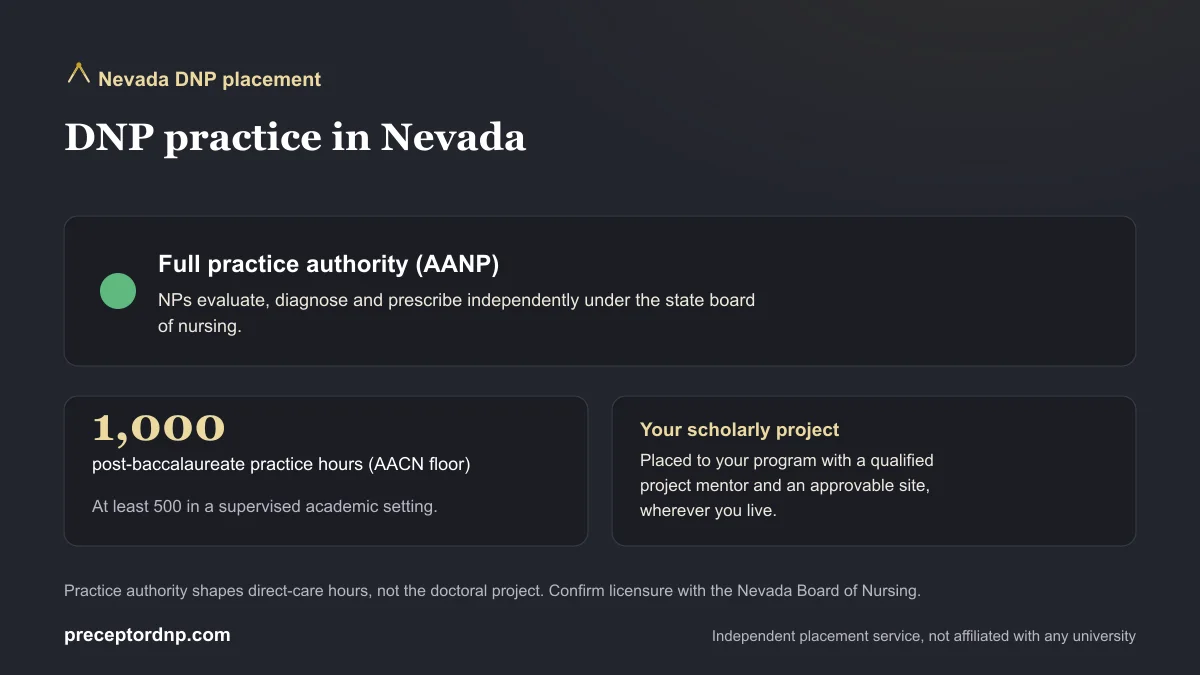
The DNP requires at least 1,000 supervised post-baccalaureate practice hours, varies by program, including at least 500 hours in a supervised academic setting. This is cumulative after the baccalaureate. A post-master's student may apply qualifying prior supervised hours only after the program verifies them. A BSN-to-DNP student usually accumulates direct-care, systems, and project hours throughout the course sequence.
Request a written gap analysis separating accepted prior hours, remaining direct care, project implementation, leadership or systems work, and excluded activities. Then compare the hour need with the site schedule and travel burden. The DNP clinical-hours page can help prepare questions, but your own program decides which activities and documentation count.
Nevada sites may require an affiliation agreement, background screening, health records, privacy training, record access, and internal review. Do not log time because a mentor has expressed interest. Track each approved date, objective, supervised activity, outcome, and mentor verification. Commuting across frontier counties does not automatically qualify as practice.
AANP currently classifies Nevada as a full practice state. This classification concerns NP patient-care authority and matters when DNP hours include assessment, diagnosis, treatment, or prescribing. Current Nevada information includes experience-related provisions for some controlled-substance prescribing, so verify the preceptor's license, authority, population focus, and applicable conditions with the Nevada State Board of Nursing before direct care begins.
Full practice authority does not approve a quality-improvement project. With site authorization, workflow mapping, staff education, process testing, and analysis of permitted aggregate results generally follow project, privacy, and operational rules rather than independent NP care rules. Keep those activities separate from patient encounters in the proposal and log. A license never substitutes for site access.
Prepare a one-page brief with the problem, population, evidence-based change, measures, timeline, access needs, mentor criteria, and program contact. State that the site controls its operations and data and that the program must approve the placement. For rural options, include travel, remote supervision, connectivity, and a smaller backup scope.
PreceptorDNP independently supports DNP students at any university with possible Nevada project sites and mentors. We do not guarantee a match or program approval. Once your project stage and hour gap are documented, send the matching request or contact our placement desk. Review how support works before submitting.
Hospitals, ambulatory networks, rural clinics, public health services, FQHCs, tribal health organizations, long-term care, and community programs may qualify. The setting must own the problem, support appropriate measurement and supervision, and complete both site and program approval.
Yes, when onsite expectations, travel, connectivity, data access, and remote supervision are clear. Small teams often need a narrow scope and measures they already collect. Both the site and program must approve any remote portion of supervision.
They may if they are qualifying supervised post-baccalaureate hours and your program verifies the documentation. Ask for a written gap analysis. The cumulative standard is not a fixed block of new hours for every post-master's student.
No. It concerns NP patient-care authority. Your program still approves credentials, while the organization approves access and project activity. Confirm current licensure and any experience-related prescribing conditions with the Nevada State Board of Nursing for direct-care hours.
No. Carson City, Elko, Fallon, Winnemucca, Ely, Pahrump, rural public health, and tribal or community settings offer different project opportunities. A broader search adds travel and capacity considerations, so align geography with the project's actual needs.
Sources · last updated July 2026
AANP Nevada practice information · Nevada State Board of Nursing · Nevada Rural Community Health Services · Nevada Rural Health Transformation Program · Nevada Health Authority
No cost to request, and nothing is billed until a match is confirmed and your school signs off. We'll reply within one business day.
We do not guarantee placement. Final approval rests with your program.
