New Hampshire offers compact southern health markets, regional hospitals through the center of the state, and rural project settings across the Lakes Region, Upper Valley, and North Country. The strongest DNP placement pairs a local improvement priority with a mentor who can supervise practice, secure operational support, and measure a change that fits the term.
Manchester and Nashua hold the state's densest population and several hospital, ambulatory, and community networks, including Elliot Health System, Catholic Medical Center, and Southern New Hampshire Health. Concord Hospital anchors the capital region. These settings may support projects on safety, transitions, chronic disease, behavioral health connection, workforce processes, or access, but larger systems often centralize agreements, privacy review, and data decisions.
The Seacoast around Portsmouth, Dover, Exeter, and Rochester offers hospital and community care through Portsmouth Regional Hospital, Wentworth-Douglass Hospital, Exeter Hospital, Frisbie Memorial Hospital, and local agencies. Keene and Peterborough serve the southwest, while Laconia and Plymouth connect the Lakes Region. Use geography to identify a realistic patient population and commute, not to assume every facility has student capacity.
Lebanon and the Upper Valley contain complex referral care, while Littleton, Lancaster, Colebrook, North Conway, and other North Country communities depend on critical access hospitals, rural clinics, emergency services, and public health partnerships. New Hampshire's critical access hospitals participate in statewide quality measurement and improvement work. A rural project can be valuable when it uses practical measures and respects a small team's workload.
The DNP scholarly project is the doctoral core, not another master's NP rotation. Ask a prospective site what process it wants to improve and which baseline signal already exists. A feasible project might strengthen discharge contact, standardize a screening or safety step, improve referral closure, increase vaccination outreach, support behavioral health handoffs, or test staff education. One setting, one workflow owner, and one obtainable measure create a credible starting point.
Determine the local review pathway before implementation. Quality improvement and evidence-based practice may not be classified as human-subject research, but the program and organization make that decision. Clarify who approves the change, whether identifiable records are involved, who extracts data, where files are stored, and what may be shared in the final presentation. A mentor's invitation cannot replace formal permission.
For a critical access hospital or rural clinic, align scope with staffing and data capacity. The state's Medicare Beneficiary Quality Improvement work illustrates that rural hospitals use reported measures to guide improvement. Student projects should fit rather than duplicate that work. Use an existing measure when possible, limit new documentation, and prepare a smaller cycle if operational demands change.
Depending on program rules, a DNP-prepared nurse, physician, nurse executive, quality leader, public health leader, or another qualified professional may mentor the project. The person needs access to the workflow, data owner, and affected staff, plus time for regular supervision and log verification. An executive sponsor and an operational mentor can divide authority and weekly guidance in a larger system.
Direct-care hours call for a board-certified NP or physician practicing in the student's population focus, with current New Hampshire authority and program-approved experience. One person may qualify for both roles, but students should not assume it. A quality director can be ideal for systems change without being the right person to supervise patient encounters.
Confirm meeting cadence, onsite requirements, project review, data access, signature responsibility, and backup coverage before onboarding. Rural leaders often cover multiple services, so a predictable schedule matters. Review DNP clinical and systems roles when mapping different objectives to mentors.
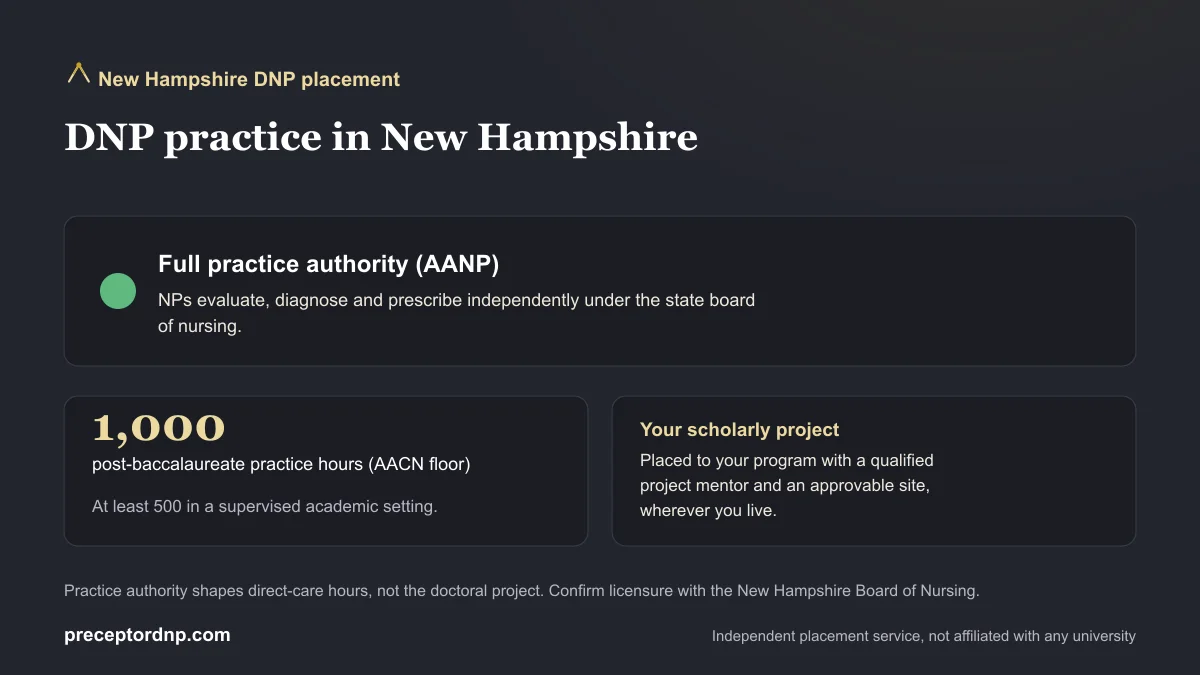
The DNP requires at least 1,000 supervised post-baccalaureate practice hours, varies by program, including at least 500 hours in a supervised academic setting. The total is cumulative after the baccalaureate, not a fixed block of new doctoral hours for every student. Post-master's students may apply qualifying prior supervised hours after program review. BSN-to-DNP students commonly accumulate direct-care, systems, and project work over several courses.
Request a written gap analysis showing accepted prior hours, remaining direct care, project implementation, leadership or systems objectives, and excluded activities. This prevents a search for the wrong type of preceptor. Use the DNP practice-hour guide to prepare questions, then rely on your own program's requirements and approval.
New Hampshire sites may require an affiliation agreement, background checks, health documents, privacy training, record access, and project review. Small sites may lack a dedicated education office, so allow time. Do not log work after only a verbal yes. Keep dates, objectives, supervised activities, outcomes, and mentor confirmation together.
AANP currently categorizes New Hampshire as a full practice state. That category concerns NP patient-care authority and matters when supervised hours include assessment, diagnosis, treatment, or prescribing. Confirm the proposed preceptor's active license, population focus, and any program-specific requirements through the New Hampshire Board of Nursing before direct-care practice begins.
Full practice authority does not grant a student access to a project site. Workflow mapping, staff education, process testing, and review of approved aggregate outcomes generally follow organizational quality, privacy, and operational rules. The student's license and assigned role still apply. Keep clinical encounters and scholarly-project activity clearly separated in the proposal and logs.
Send a one-page brief naming the local problem, population, evidence-based change, measures, schedule, access needs, mentor criteria, and program contact. State that the organization retains control over data and workflow and that the program makes final placement decisions. For North Country sites, explain travel, weather planning, and any remote-supervision request.
PreceptorDNP independently assists DNP students at any university with possible New Hampshire project-site and mentor matches. We cannot guarantee placement or program approval. Once the project stage and hour gap are confirmed, use the matching request or contact our placement desk. Review how support works before submitting.
Yes, when it owns the improvement need, supports a feasible measure, provides an approved mentor, and completes site plus program review. State rural quality work provides useful context but does not create automatic student access. Keep the first cycle modest.
Programs may accept a DNP-prepared nurse, physician, nurse executive, quality leader, public health leader, or another qualified professional. The mentor should reach the workflow and data owners, supervise regularly, and verify hours. Direct-care preceptors need separate population-focus alignment.
They may when they are qualifying supervised post-baccalaureate hours and the program accepts the documentation. Ask for a written gap analysis. The cumulative standard should not be converted into the same number of new hours for every post-master's student.
No. It concerns NP patient-care authority. Affiliation, onboarding, privacy, data access, project review, and program approval remain necessary. Confirm licensure details with the New Hampshire Board of Nursing when direct-care hours are included.
Yes, if a rural project fits your objectives and travel is realistic. Critical access hospitals, clinics, public health, and community partners may offer focused improvement opportunities. Confirm winter travel, onsite frequency, data capacity, and remote supervision before committing.
No cost to request, and nothing is billed until a match is confirmed and your school signs off. We'll reply within one business day.
We do not guarantee placement. Final approval rests with your program.
