New Jersey offers dense hospital and ambulatory networks, statewide quality initiatives, municipal and county public health, and rural pockets with different access needs. A strong DNP placement starts with a problem the organization already owns, then pairs it with an approved mentor, usable data, and a change small enough to complete responsibly.
Newark, Jersey City, Paterson, Hackensack, and the surrounding northern counties contain large hospital, ambulatory, quality, and population health operations through RWJBarnabas Health, Hackensack Meridian Health, Atlantic Health System, Valley Health System, Englewood Health, and other providers. These networks can support safety, care transition, chronic disease, behavioral health, maternal care, and access projects. They also centralize contracts, privacy, onboarding, and data decisions.
Central New Jersey includes New Brunswick, Elizabeth, Edison, Morristown, Trenton, and surrounding suburban communities with health systems, FQHCs, long-term care, home health, public agencies, and nonprofits. Southern markets around Camden, Cherry Hill, Mount Holly, Vineland, Atlantic City, and Cape May include Virtua Health, Inspira Health, AtlantiCare, Capital Health, and community partners. A regional service line may provide a clearer project owner than a system headquarters.
New Jersey is densely populated, yet parts of Salem, Cumberland, Cape May, Warren, Sussex, and Hunterdon counties have rural access and transportation challenges. The State Office of Rural Health supports these communities through partnerships and workforce work. Rural clinics, public health, community organizations, and smaller hospitals can host a bounded project when supervision and data capacity are realistic.
The scholarly project is the spine of DNP placement, not another master's NP clinical rotation. Ask the site which outcome or process is already a priority and what baseline measure exists. A feasible project might improve maternal care processes, behavioral health follow-up after an emergency visit, referral closure, discharge contact, evidence-based screening, infection prevention, or connection to community resources.
New Jersey's hospital Quality Improvement Program focuses on maternal and behavioral health performance and uses learning collaboratives. Healthy New Jersey organizes measurable public health goals and action planning. These statewide efforts are valuable context, not permission to copy a measure or enter a participating hospital. The local site must agree that your project fits its work and can be supported during the term.
Confirm whether quality improvement, evidence-based practice, or human-subject research review applies. Students do not make that decision alone. Ask who approves the intervention, whether identifiable records are involved, who extracts data, where files are stored, and what may be presented. Program approval and organizational authorization remain separate.
Programs may approve a DNP-prepared nurse, physician, nurse executive, quality leader, public health leader, or another qualified professional to mentor the project. Choose the person who can reach affected staff and the data owner, provide regular feedback, and verify supervised practice. In a large New Jersey system, an executive sponsor may authorize the work while a unit, clinic, or quality leader guides implementation.
Direct-care hours require separate alignment with a board-certified NP or physician practicing in the student's population focus and meeting New Jersey plus program requirements. A systems mentor is not automatically qualified to supervise patient encounters. If one person is proposed for both roles, confirm credentials, authority, experience, and responsibilities before onboarding.
Discuss meeting frequency, onsite expectations, project review, data access, log signatures, and backup supervision. High student demand can limit mentor capacity even when a site likes the topic. Review DNP clinical and systems pathways before asking one placement to meet unrelated objectives.
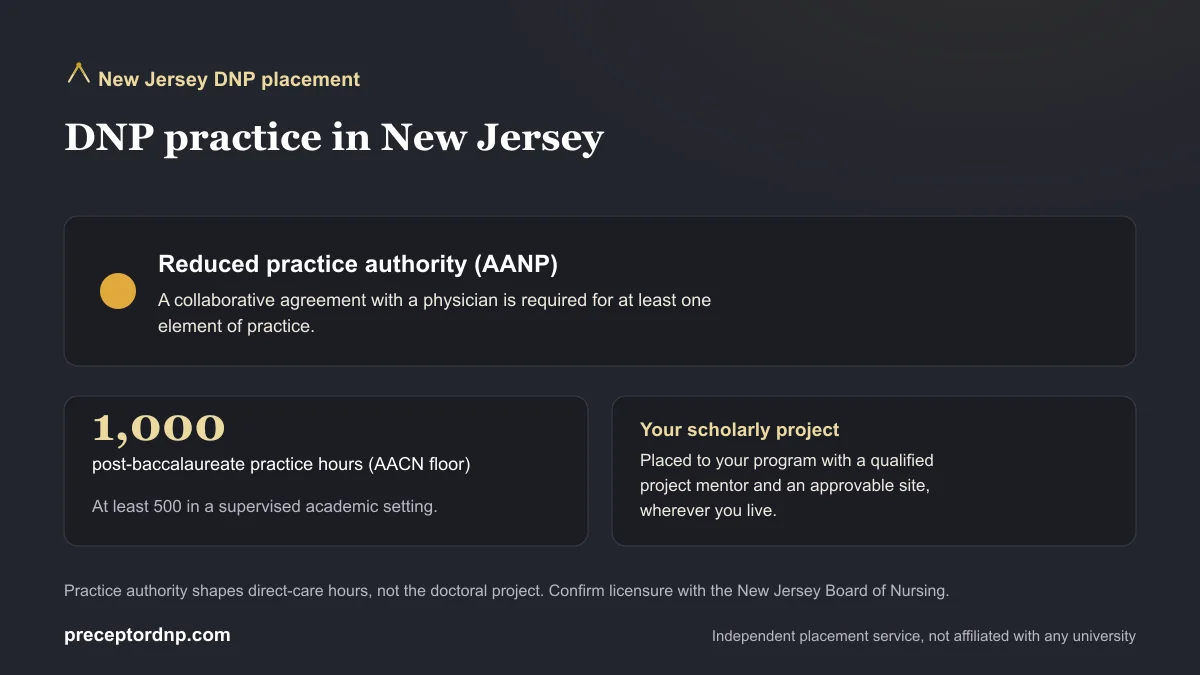
The DNP calls for at least 1,000 supervised post-baccalaureate practice hours, varies by program, including at least 500 hours in a supervised academic setting. This total is cumulative after the baccalaureate. Post-master's students may apply qualifying prior supervised hours after their program verifies the records. BSN-to-DNP students normally build population-focus direct care, systems practice, and project work across the curriculum.
Obtain a written gap analysis before contacting New Jersey sites. Separate accepted prior hours, remaining direct care, project implementation, systems or leadership work, and activities the program will not count. Published designs differ, so no statewide number replaces your program's decision. Use the DNP hours guide to prepare questions and confirm every category with your coordinator.
Hospitals and networks may require agreements, background checks, health records, privacy training, electronic access, and project review. Community sites may use different paperwork but still need authorization. Do not start logging hours after an informal introduction. Record each approved date, objective, supervised activity, outcome, and mentor verification.
AANP currently classifies New Jersey as a reduced practice state. Current state policy information says NPs maintain joint protocols with a collaborating physician to order medications and devices. That requirement matters when DNP hours include assessment, diagnosis, treatment, prescribing, or another direct-care function. Confirm the preceptor's active license, joint protocol, population focus, and site authority with the New Jersey Board of Nursing.
Reduced practice does not make a quality-improvement project a clinical rotation. With site approval, workflow mapping, staff education, process testing, and evaluation of permitted aggregate outcomes generally follow organizational quality, privacy, and operational rules. The student's own license and role still apply. Keep patient encounters separate from project activity in the proposal and log.
Send a one-page brief with the local problem, population, evidence-based change, measures, schedule, access needs, mentor criteria, and program contact. State that the organization controls its data and operations and that program approval is required. If the site limits records or scope, offer a smaller process measure that can still answer the improvement question.
PreceptorDNP independently assists DNP students at any university with possible New Jersey project sites and mentors. We cannot guarantee placement or program approval. Once your project stage and hour gap are documented, use the matching request or contact our placement desk. Review how placement support works first.
Hospitals, ambulatory networks, FQHCs, county or municipal public health, long-term care, home health, rural clinics, and community organizations may qualify. The site must own the problem, support measurement and supervision, and complete organizational plus program approval.
No. AANP currently lists New Jersey as reduced practice. State policy information describes joint protocols with a collaborating physician for ordering medications and devices. Confirm current direct-care requirements with the New Jersey Board of Nursing rather than relying on older summaries.
They may when they are qualifying supervised post-baccalaureate hours and your program accepts the documentation. Request a written gap analysis. The cumulative expectation is not the same fixed block of new doctoral hours for every post-master's student.
Only if the mentor also meets the direct-care preceptor criteria, practices in the student's population focus, and complies with New Jersey requirements. A nurse executive or quality leader may be an excellent project mentor without qualifying for patient-care hours.
Yes. South Jersey and northwestern counties include rural clinics, public health programs, community partners, and smaller hospitals with access and transportation priorities. Confirm travel, mentor capacity, data availability, and site review before committing.
No cost to request, and nothing is billed until a match is confirmed and your school signs off. We'll reply within one business day.
We do not guarantee placement. Final approval rests with your program.
