A New Mexico DNP placement succeeds when the student solves for authority, community fit, and distance before proposing an intervention. Albuquerque offers the largest concentration of formal quality teams, while frontier and tribal settings reward a narrower project designed with local leadership from the start.
A potential host should pass four tests: it sees the selected population often enough, owns the workflow being changed, can provide an ethical and feasible measure, and has a leader willing to sponsor implementation. Presbyterian Healthcare Services and Lovelace Health System in Albuquerque, CHRISTUS St. Vincent in Santa Fe, and Memorial Medical Center in Las Cruces may offer established quality or nursing-leadership pathways. A community health center, county program, long-term care organization, or tribal facility may offer closer access to the actual process. Size is useful only when it comes with permission and a reachable data owner.
Use the site's problem statement to shape the project, rather than arriving with a finished solution. Diabetes follow-up, medication access, maternal care, infection prevention, emergency-transfer communication, and telehealth workflow reliability all fit New Mexico settings when a local team identifies the gap. Before choosing one, ask what baseline is already collected, how many eligible encounters occur, and whether the intervention can be maintained after the student's evaluation period. Those answers make a better feasibility screen than brand recognition.
The distance from Albuquerque to Farmington, Gallup, Roswell, Clovis, Carlsbad, or smaller frontier communities changes the search. These settings may not have a separate nursing-research office, yet they often have clear priorities and leaders who know exactly where a process fails. A compact intervention with two dependable measures is often more useful than a data-heavy design that strains a small team. Travel days, weather, connectivity, and the student's required on-site presence belong in the first conversation, not the final calendar.
Projects involving Indian Health Service or tribally operated settings require attention to local governance and community priorities. A student's academic approval does not replace the host organization's permission, and one tribal or federal facility cannot approve work for another. Ask the local contact which operational, privacy, cultural, and review steps apply before requesting data or recruiting a mentor. Community partnership should shape the question and dissemination plan. Remote faculty meetings may help with distance, but the program must decide which supervised activities can occur remotely.
A New Mexico project may need three functions even when one approved mentor fills more than one: an executive sponsor who can authorize the change, a data contact who can define and release aggregate measures, and a day-to-day practice mentor who can coach implementation. Depending on program criteria, the primary mentor may be a DNP-prepared nurse, physician, nurse executive, or health-system leader. The student's program, not the site or our service, decides whether that person's preparation and responsibilities qualify.
Do not confuse that role with a clinical preceptor. A board-certified NP or physician in the student's population focus supervises direct patient care. A project mentor guides evidence translation, staff engagement, workflow testing, and evaluation. Before submitting a name, document credentials, access to the chosen setting, meeting availability, and authority over the process. If a respected clinician cannot obtain operational approval, add a site sponsor rather than expecting goodwill to carry the project.
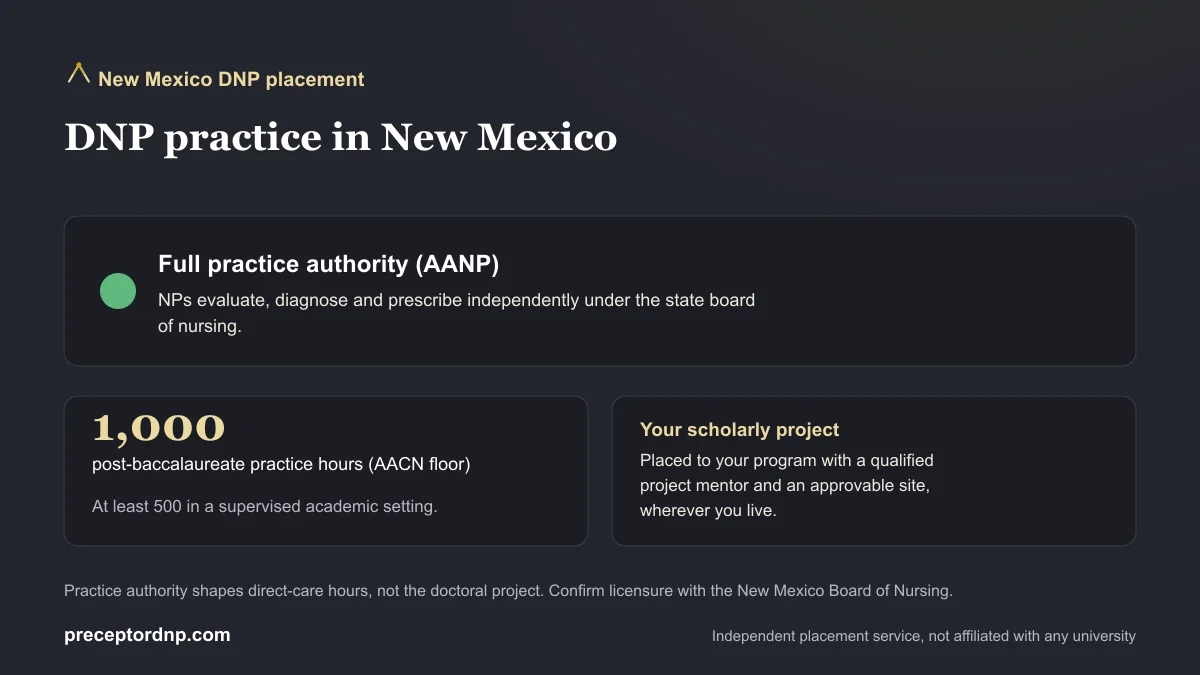
AACN calls for at least 1,000 supervised post-baccalaureate practice hours, with at least 500 completed in a supervised academic setting, and the exact requirement varies by program. The total is cumulative after the bachelor's degree. It is not automatically 1,000 new DNP-level hours. A post-master's student may receive credit for qualifying prior master's hours only after the program audits them; a BSN-to-DNP student generally builds direct-care and systems experiences across the doctoral plan. Confirm the remaining total, permitted activity categories, documentation format, and remote limits before presenting a schedule to a New Mexico site.
Then place each remaining hour into the right lane. Population-focus care might occur in Albuquerque specialty services, a Las Cruces clinic, a community health center, or an approved rural or tribal setting. Systems hours could involve public health, informatics, quality, care management, or telehealth operations. Project implementation hours may overlap with program-defined practice categories, but a project milestone should not be assumed to satisfy a clinical-hour requirement. Use the DNP clinical-hours guide to organize questions for the program.
AANP currently categorizes New Mexico as a full practice state. That can widen the pool of independently practicing nurse practitioners who might supervise population-matched direct-care hours, subject to current licensure, prescribing rules, and the student's program criteria. Confirm those details with the New Mexico Board of Nursing because a national category is not a substitute for checking an individual clinician's license or the current state requirements.
Full practice authority does not decide whether a DNP scholarly project may proceed. A quality-improvement project that changes screening, referral, documentation, or follow-up is generally a systems activity rather than a licensure-gated clinical rotation. When the student personally assesses, diagnoses, prescribes, or treats patients, direct-care rules apply and the program should approve a properly licensed, board-certified NP or physician in the student's population focus. Write the proposal so reviewers can see where project work ends and patient care begins.
First obtain the program's mentor rubric, affiliation requirements, project-review path, and hour worksheet. Next create a one-page concept that states the local problem, target group, intervention, two or three measures, proposed dates, and data requested. Only then approach the department that owns the workflow. Most online programs expect some self-sourcing, while others offer coordinator help or a placement pledge, so ask what assistance is actually included before duplicating effort. Never promise a start date until both site and program approvals are complete.
PreceptorDNP is independent, serves DNP students at any university, and works independently of a school. We can help search for a New Mexico project site, practice mentor, or population-matched clinical preceptor, but we cannot guarantee a placement or anyone's approval. If the four-test screen produces no viable contact, send the program requirements through the match form or review our outreach process.
Do not assume so. Tribal and Indian Health Service settings may have their own community, operational, privacy, and evidence-review requirements. Ask the specific facility who has authority before requesting data or proposing implementation. Program approval remains separate from the host's permission.
Choose the program-approved primary mentor who can guide the scholarly work and influence the workflow. A separate executive sponsor or data contact can strengthen the team. For direct-care hours, the approved clinical preceptor must also match the student's population focus.
There is no safe statewide number. The DNP expectation is at least 1,000 supervised post-baccalaureate hours, varies by program, and includes at least 500 in a supervised academic setting. The program must audit prior qualifying master's hours and tell the student what remains.
No. Albuquerque systems may have more formal quality infrastructure but also centralized review and heavier student demand. A rural site may decide faster if the project is small, useful, and supported by a local leader. Compare approval time, data access, travel, and mentor capacity rather than city size alone.
Sources · last updated July 2026
AACN: Doctor of Nursing Practice education · AANP: New Mexico practice profile · New Mexico Board of Nursing · New Mexico Department of Health: Office of Primary Care and Rural Health · Indian Health Service: Navajo Area facilities · Presbyterian Healthcare Services: About the system
No cost to request, and nothing is billed until a match is confirmed and your school signs off. We'll reply within one business day.
We do not guarantee placement. Final approval rests with your program.
