New York gives DNP students many possible settings but no single route into them. A useful scholarly project search separates the project owner, the approval lane, and the practice-hour plan, then adjusts each one for a downstate health system, an upstate regional network, or a small county-based service.
In a large New York network, the unit manager who likes a project may not be the person who can approve it. NYC Health and Hospitals, Northwell Health, Mount Sinai Health System, Rochester Regional Health, Kaleida Health, and Albany Med Health System may route proposals through nursing education, quality, privacy, evidence review, or affiliation offices. Ask which route applies to a DNP quality-improvement project and who can release aggregate data. Starting with the correct office prevents a promising mentor from making commitments outside that person's authority.
County health departments, community health centers, long-term care organizations, and nonprofit programs usually have shorter reporting lines, but they still need a written decision about data and supervision. Before outreach, prepare a one-page brief with the population, current gap, proposed workflow change, measures, timeline, and expected staff burden. The setting is viable only if it owns the problem, sees enough eligible cases, and can maintain the intervention long enough to evaluate it.
New York's public hospital profiles and state quality reporting illustrate how much health data exist, but a student may use only what the host authorizes. Care transitions, hypertension control, infection prevention, maternal care, language access, behavioral-health referrals, and avoidable emergency use are project themes, not ready-made protocols. A student should ask which measure the local team already reviews, where the denominator comes from, and how frequently results can be obtained. A simple measure that arrives on time is stronger than an ambitious outcome delivered after the doctoral deadline.
Match the intervention to the site's operating scale. A large hospital service line may support an electronic prompt, staff education, and a dashboard, but obtaining access can take months. A home-health agency or county clinic may be able to test a discharge call script or referral checklist quickly with a manual audit. Neither setting is inherently better. The doctoral test is whether evidence can be translated into a sustained practice change with a defensible baseline and follow-up.
New York City, Long Island, and the lower Hudson Valley form a dense downstate market with broad specialty capacity and centralized onboarding. Albany, Syracuse, Rochester, Buffalo, Utica, Binghamton, and Plattsburgh each anchor a different upstate referral network. Search by the population and workflow rather than by statewide distance. A student studying inpatient transitions may need a regional hospital service, while one improving preventive follow-up may find better access through a community health center or county program.
The North Country, Southern Tier, Adirondack communities, and rural western counties depend more heavily on critical-access hospitals, home health, local public health, and small ambulatory teams. These hosts can support high-value doctoral projects when the data plan fits their staffing. Combine site visits into realistic travel blocks and define which mentor meetings can occur online. Telehealth participation does not automatically satisfy supervised presence, so obtain the program's remote-activity rules before counting hours.
The project mentor guides stakeholder alignment, evidence translation, testing, and evaluation. That person may be a DNP-prepared nurse, physician, nurse executive, or health-system leader if the student's program accepts the credentials and role. In a downstate system, the mentor may work in a formal quality office but need a second operational sponsor on the unit. Upstate, one clinical director may own both the workflow and the data. Confirm decision authority, protected time, meeting frequency, and access to aggregate measures before seeking program approval.
A clinical preceptor has a different duty: supervising direct patient care within the student's population focus. An approved, board-certified NP or physician may fill that role. One person can sometimes serve as both project mentor and clinical preceptor, but the program must approve each function separately. Treating the titles as interchangeable creates preventable delays when a capable improvement leader lacks the required clinical population match or a skilled clinician lacks authority over the project setting.
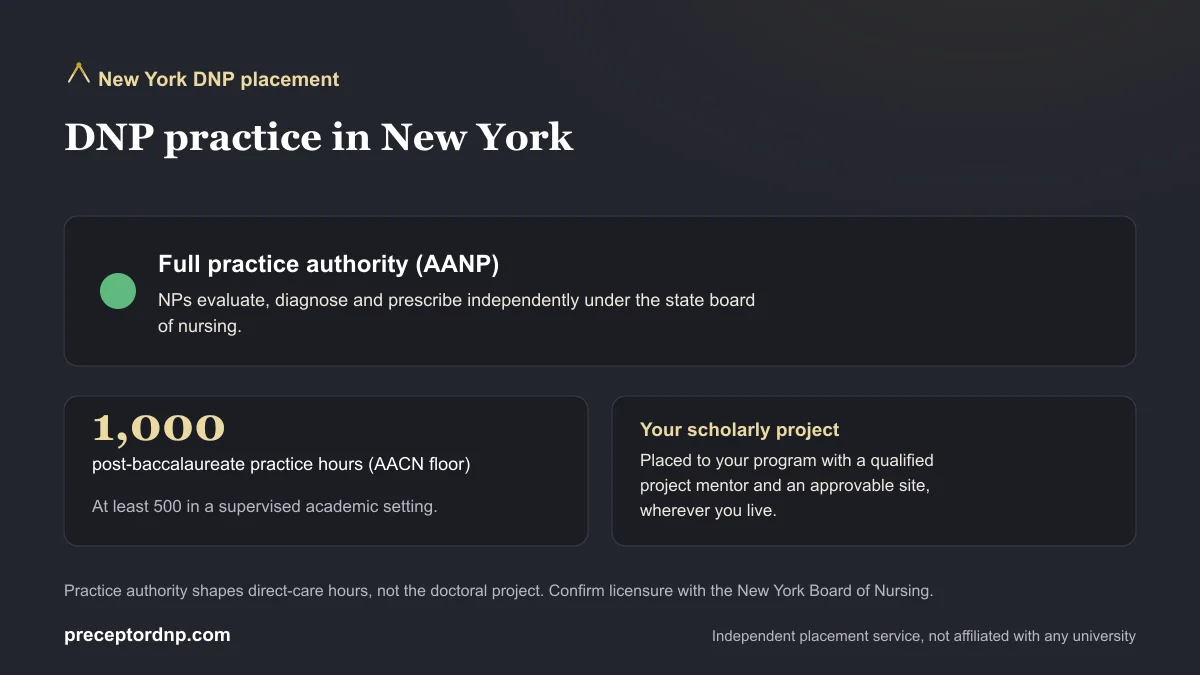
AACN's expectation is at least 1,000 supervised post-baccalaureate practice hours, with at least 500 completed in a supervised academic setting, and the precise total varies by program. This is a cumulative post-baccalaureate portfolio, not a universal demand for 1,000 new DNP hours. A post-master's student should ask the program to verify qualifying prior master's hours in writing. A BSN-to-DNP student usually accumulates direct-care, systems, leadership, and project experiences across the curriculum.
Map the remaining categories to settings before asking any New York host for a schedule. Direct-care hours may fit hospital services, specialty practices, community clinics, long-term care, or home-based care. Systems hours may fit informatics, care management, public health, patient safety, or operations. Project implementation can contribute only as the program allows; do not assume every project meeting counts toward a direct-care category. Our hours overview can help frame the questions, but the student's own program makes the final determination.
AANP currently lists New York as a full practice state, but the state's Office of the Professions explains experience-based requirements that still matter to individual nurse practitioners. For direct-care supervision, verify the clinician's license, scope, population fit, and current practice arrangement rather than relying on the category alone. Rules can change, so the New York State Education Department Office of the Professions is the proper source for licensure and practice details.
Practice authority generally does not gate a DNP quality-improvement project focused on a workflow or system. It does govern any hour in which the student assesses, diagnoses, prescribes, or treats a patient. Keep those activities explicit in the proposal. Most online programs ask students to self-source at least part of the site or mentor search, while some offer coordinator assistance or a placement pledge. PreceptorDNP is independent, works with students at any university, and never guarantees placement or program approval. When the regional search stalls, send the exact requirements through the match form or contact our placement desk.
Ask the organization which pathway controls DNP quality-improvement projects. A unit leader can confirm local need, but a central quality, education, privacy, or affiliation office may hold final authority. Secure both operational sponsorship and formal permission before implementation.
Sometimes. The person must satisfy the program's project-mentor criteria and, for direct care, be an appropriately licensed, board-certified NP or physician in the student's population focus. The program should approve the two responsibilities separately.
No. At least 1,000 supervised post-baccalaureate hours are expected, the total varies by program, and at least 500 must be completed in a supervised academic setting. Only the student's program can audit prior qualifying hours and calculate what remains.
No. Value comes from a meaningful problem, usable measures, an authorized mentor, and a change the host can sustain. Upstate and rural organizations may offer closer workflow access, while downstate systems may offer larger data sets and formal improvement support.
Sources · last updated July 2026
AACN: Doctor of Nursing Practice education · AANP: New York practice profile · New York Office of the Professions: Nurse practitioners · New York Office of the Professions: NP practice requirements · New York State hospital quality profiles · New York State Department of Health: Hospital infection data
No cost to request, and nothing is billed until a match is confirmed and your school signs off. We'll reply within one business day.
We do not guarantee placement. Final approval rests with your program.
