North Carolina supports DNP projects through very different operating environments: large Piedmont systems, regional referral centers, county public health, and rural primary care. The right match is found by testing the project's data and decision needs against one of those environments, not by sending the same request statewide.
Write a short charter before searching: population, current process, unwanted result, proposed evidence-based change, measures, and the staff whose work would change. North Carolina topics may include readmission prevention, maternal follow-up, infection control, chronic-disease outreach, behavioral-health referral, or rural transfer reliability. A charter lets a prospective site decide whether the gap is genuinely local. It also exposes requests that depend on a patient volume, data field, or staffing resource the organization does not have.
A host is ready when three assets are present: a leader who can authorize the intervention, a practical source of baseline and follow-up data, and a mentor who will supervise the work. Atrium Health, Novant Health, Cone Health, Mission Health, and Cape Fear Valley Health may have formal quality channels, but their size can add multiple approvals. Community clinics, long-term care, nonprofit programs, and county services may have fewer review layers and less analytic capacity. Choose the combination that fits the charter.
The first lane covers Charlotte, the Raleigh and Durham Triangle, and the Greensboro and Winston-Salem Triad. These markets offer dense hospital and specialty networks, informatics support, and experienced quality leaders. They also receive heavy student demand and may require centralized affiliation, privacy, and operational reviews. A request should name the exact service line and data need. Addressing a generic request to a system-wide executive is less useful than identifying the team that owns the chosen workflow.
The second lane uses regional hubs such as Asheville, Wilmington, Fayetteville, and Greenville. The third covers mountain counties, the coastal plain, and smaller communities where critical-access hospitals, rural health centers, telehealth programs, and county health departments carry more of the work. Rural sites benefit from modest sample requirements, simple measures, and a schedule that respects travel and limited staff coverage. Ask the program which activities may be remote, since an online meeting is not automatically a supervised practice hour.
A DNP scholarly project is practice change, so the most influential contact is often the person who owns the workflow rather than the most senior clinician. For a county immunization reminder, that may be a public-health nursing supervisor. For a hospital discharge process, it may be a service-line quality lead. For a rural referral handoff, it may be a clinic director working with the receiving network. Ask who can authorize staff participation, approve aggregate data use, and decide whether the new process continues after evaluation.
Use the mentor rubric supplied by the student's program. A DNP-prepared nurse, physician, nurse executive, or health-system leader may qualify when the role and expertise fit, but credentials alone are not enough. A project mentor guides evidence translation, implementation, stakeholder work, and evaluation. A clinical preceptor supervises direct patient care and should be a program-approved, board-certified NP or physician in the student's population focus. One person may serve in both capacities only if the program approves both.
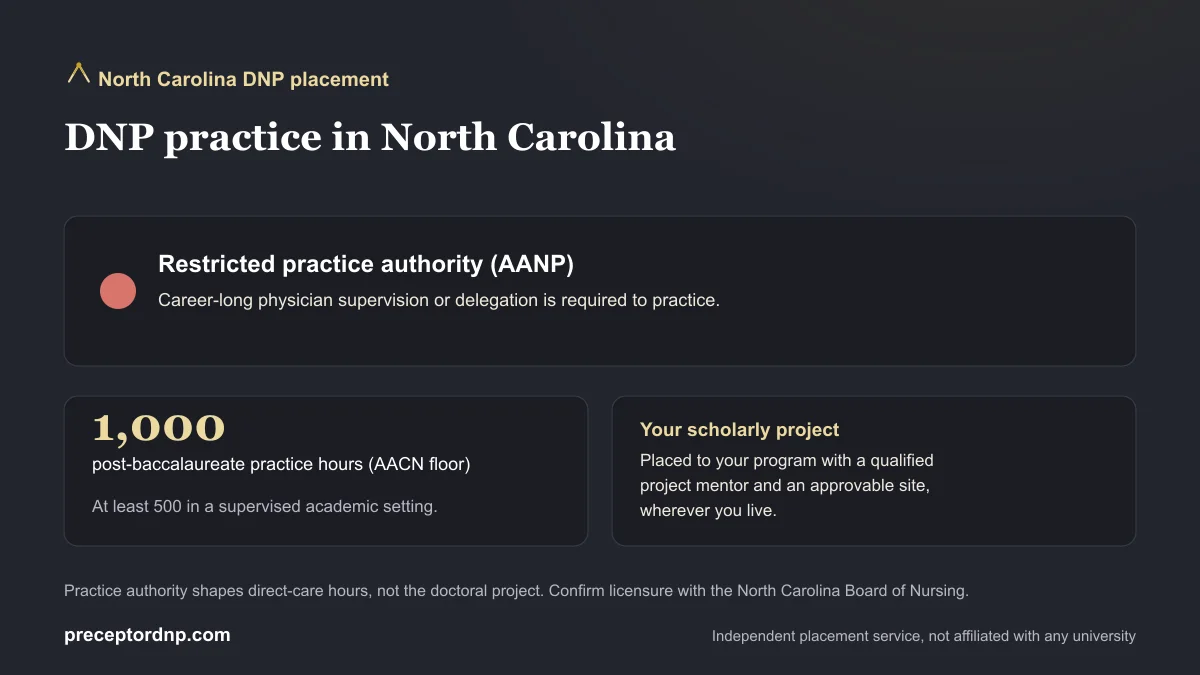
On one axis, list the hours the program has already verified and the hours still required. AACN expects at least 1,000 supervised post-baccalaureate practice hours, with at least 500 in a supervised academic setting, and the exact total varies by program. This is cumulative after the bachelor's degree. A post-master's student may apply qualifying prior supervised hours only after a formal program review; a BSN-to-DNP student usually builds the total through population-focus practice plus systems and project activity.
On the other axis, list approved categories and settings. Direct-care hours might sit in a hospital service, ambulatory network, community health center, or rural practice. Leadership and systems hours might involve public health, quality, informatics, care coordination, or operations. Project work may count in a program-defined category, but it does not automatically replace population-focus care. Confirm supervision, documentation, and remote rules before outreach, then use the clinical-hours guide to keep the questions organized.
AANP currently categorizes North Carolina as a restricted practice state, and nurse practitioner practice involves both the Board of Nursing and Medical Board. That framework matters for any supervised hour involving assessment, diagnosis, prescribing, or treatment. Confirm the proposed preceptor's current authority and arrangement through official board guidance, then obtain the student's program approval. A placement form cannot expand state scope or substitute for license verification.
The restriction should not be projected onto every doctoral activity. A DNP quality-improvement project that changes a workflow, staff process, or system is generally not a licensure-gated clinical rotation. State clearly whether the student will observe operations, analyze aggregate data, educate staff, or personally deliver care. That boundary helps a site choose the right approval route and keeps the project mentor role separate from direct-care supervision.
Send the charter, program forms, mentor criteria, requested dates, hour categories, and data description together. Ask for a yes or no on workflow ownership before requesting signatures. Most online DNP programs require students to self-source some combination of site, mentor, or clinical preceptor, though some offer coordinator help, referrals, or a placement pledge. Confirm what the program will do, and do not promise an organization that approval is automatic.
PreceptorDNP is independent and assists DNP students at any university; we are not connected to a school. We can search for North Carolina project sites, qualified practice mentors, and population-matched clinical preceptors, but placement and program approval are never guaranteed. Submit the charter and requirements through the match form, or review how outreach works before deciding whether support fits the search.
Include the local problem, target population, current process, proposed change, two or three feasible measures, implementation dates, staff burden, and mentor criteria. Add the program's review forms so the host can evaluate the operational and academic request together.
Not usually when the project changes a system or workflow without the student providing patient care. Restricted practice rules apply to direct-care activities. Define the boundary in writing and confirm any clinical component with the boards and the student's program.
Ask the program to audit qualifying prior supervised hours. The expectation is at least 1,000 supervised post-baccalaureate hours, varies by program, and includes at least 500 in a supervised academic setting. The verified balance should drive the placement request.
Yes, when the intervention and measures fit a small team. Rural hospitals, community health centers, county departments, and telehealth programs may offer direct access to workflow owners. Plan travel, data collection, and permitted remote activity before accepting the site.
Sources · last updated July 2026
AACN: Doctor of Nursing Practice education · AANP: North Carolina practice profile · North Carolina Board of Nursing: Nurse practitioners · North Carolina Medical Board: Nurse practitioner rules · North Carolina Office of Rural Health · Atrium Health: About the care continuum and quality work
No cost to request, and nothing is billed until a match is confirmed and your school signs off. We'll reply within one business day.
We do not guarantee placement. Final approval rests with your program.
