A North Dakota DNP search works best as a hub-and-spoke plan. Regional systems provide formal quality resources, while critical-access hospitals and local public health units provide close access to rural workflows, so the project question should determine which side leads and which side supports.
Fargo and West Fargo, Bismarck and Mandan, Grand Forks, and Minot hold the state's largest referral and specialty capacity. Sanford Health, Altru Health System, CHI St. Alexius Health, and Trinity Health may offer quality, safety, population-health, or nursing-leadership contacts. Dickinson, Williston, Jamestown, and Devils Lake connect broad rural service areas. A project involving referral completion or transfer communication should follow that actual patient path instead of treating the nearest facility as an isolated site.
Outside the hubs, critical-access hospitals, long-term care, tribal services, community clinics, and local public health units may have fewer analysts but more direct workflow authority. North Dakota Health and Human Services identifies hospitals and critical-access hospitals, while the state's local public health network provides another way to think about population projects. Start with the county or referral region where the problem occurs, then identify the organization that can change the process and supply a practical measure.
Give every proposed site a simple feasibility score. Can it identify enough eligible cases within the implementation window? Is a baseline already available? Can a leader approve the intervention? Will one person provide aggregate follow-up data? Can the student meet on-site requirements despite weather and driving distance? Care transitions, diabetes follow-up, immunization outreach, maternal access, telehealth reliability, and emergency-transfer communication are plausible themes only after the local team confirms the gap.
A large system may score well on data but slowly on approval because privacy, affiliation, education, and operational reviews are separate. A small hospital or local health unit may decide quickly but need a narrow measure that staff can collect without a dedicated analyst. Do not solve those tradeoffs by inflating the project. Reduce the target population, shorten the workflow, or use a process measure so the host can complete the cycle and retain the change.
A North Dakota project mentor may be a DNP-prepared nurse, physician, nurse executive, clinical director, or public-health administrator if the student's program approves the person's expertise and role. In a small organization, that leader may also cover daily operations or patient care. Ask who can answer when the mentor is on call, away, or managing a staffing problem. A backup contact for data or scheduling protects the project without changing who serves as the approved mentor.
The mentor's job is to guide implementation, evidence translation, stakeholder work, and evaluation. A clinical preceptor instead supervises direct patient care and should be a program-approved, board-certified NP or physician in the student's population focus. One person may qualify for both, but never assume it. Confirm credentials, authority, meeting frequency, and the exact duties on the program form before either party signs.
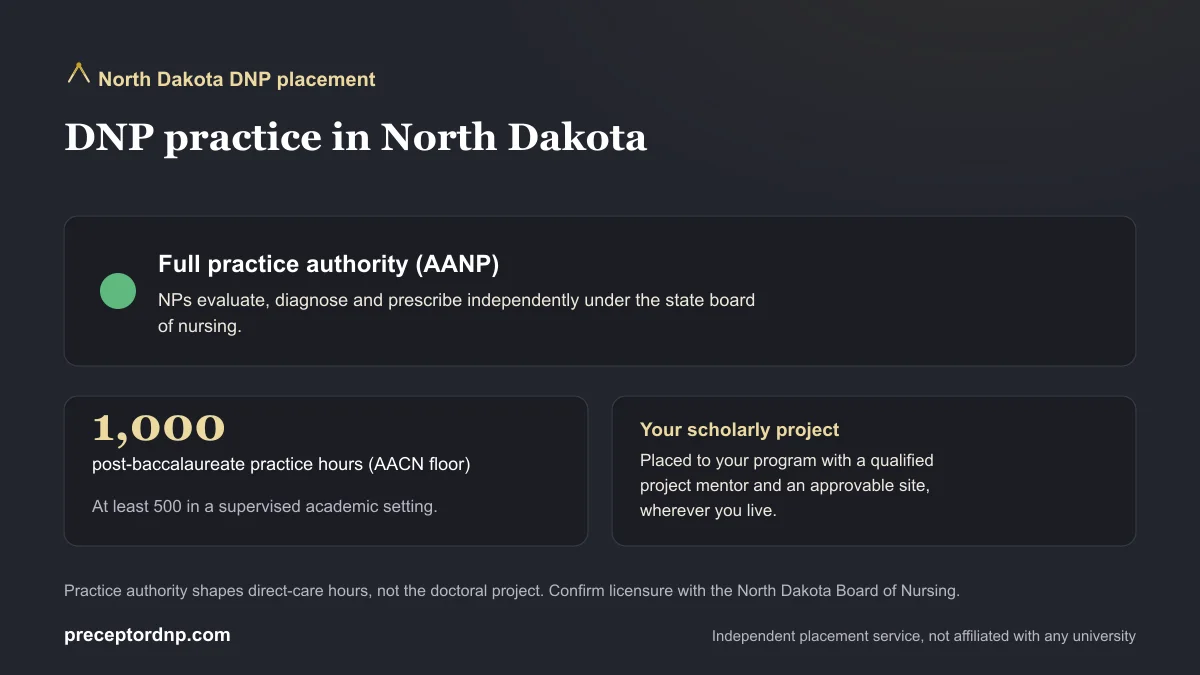
AACN expects at least 1,000 supervised post-baccalaureate practice hours, including at least 500 in a supervised academic setting, and the exact total varies by program. The figure is cumulative after the bachelor's degree. Post-master's students may apply qualifying earlier supervised hours only after their program verifies them. BSN-to-DNP students generally accumulate population-focus clinical practice alongside systems, leadership, and project work. No North Dakota site should be asked to cover an invented fixed balance.
Use the verified balance to decide whether one setting or a combination is needed. Regional hospitals may fit specialty direct care, informatics, patient safety, or network operations. Rural clinics, long-term care, public health, and tribal settings may fit population care, emergency preparedness, prevention, or community implementation when aligned with the track. The program must approve supervision and any remote activity. Project meetings and travel should not be counted in a direct-care category unless program rules explicitly allow it. Review the cumulative-hour framework before proposing dates.
AANP lists North Dakota in the full practice category. For direct-care placements, that means an eligible nurse practitioner is not subject to a career-long physician agreement imposed by the state, but the individual's license, certification, and scope still need verification. Practice categories and licensure details can change, so confirm current requirements with the North Dakota Board of Nursing and ask the student's program whether the clinician meets its population-focus criteria.
That review belongs only where clinical care occurs. A DNP scholarly project that tests a workflow or quality process generally is not a licensure-gated rotation. If the student assesses, diagnoses, prescribes, or treats patients, full clinical rules apply. Label those activities separately in the plan so a quality mentor is not mistakenly presented as the direct-care preceptor.
A concise packet should state the problem, intervention, measures, dates, expected on-site time, mentor criteria, data request, and all approval forms. Most online DNP programs ask students to self-source at least some sites and mentors, while others provide coordinator support, referrals, or a placement pledge. Confirm that division of work first. A rural administrator should not have to reconstruct the academic requirements from several messages.
PreceptorDNP is an independent service for DNP students at any university and works independently of a school. We can assist with a North Dakota project-site, mentor, or population-matched clinical-preceptor search, but no placement or program approval is guaranteed. Send the verified hour balance and feasibility score through the match form, or read how the search works before requesting help.
It can when the host organizations and program approve the plan, responsibilities, supervision, and data use. Keep one clear intervention owner. A referral or transition project may benefit from two settings, but adding sites only to increase volume can make approval and measurement harder.
A narrow population, simple measure, local decision maker, realistic travel calendar, and backup contact are especially useful. The site must have enough eligible cases and permission to provide the approved data within the doctoral timeline.
Not automatically. At least 1,000 supervised post-baccalaureate hours are expected, the total varies by program, and at least 500 must occur in a supervised academic setting. The program audits qualifying prior hours and sets the remaining balance.
No. It describes nurse practitioner direct-care authority. The host and the student's program approve the quality-improvement project, while the Board of Nursing governs licensure for any patient-care activity.
Sources · last updated July 2026
AACN: Doctor of Nursing Practice education · AANP: North Dakota practice profile · North Dakota Board of Nursing: APRN licensure · North Dakota Health and Human Services: Hospitals and critical-access hospitals · North Dakota local public health units · Sanford Health: About the regional system
No cost to request, and nothing is billed until a match is confirmed and your school signs off. We'll reply within one business day.
We do not guarantee placement. Final approval rests with your program.
