Ohio's many health systems can make a DNP search look easier than it is. Progress comes from narrowing the state into a care market, locating the owner of one measurable workflow, and keeping project mentorship separate from the direct-care arrangement required for any clinical hours.
Cleveland, Columbus, and Cincinnati contain the deepest specialty and quality infrastructure. Dayton, Toledo, Akron, Canton, and Youngstown anchor additional regional networks. Cleveland Clinic, OhioHealth, Mercy Health, ProMedica, Premier Health, and Summa Health may offer nursing quality, patient safety, informatics, or service-line teams. Choose a market based on the target population and travel radius, then approach the department that owns the process. A statewide list without a population or workflow creates low-quality outreach.
For an older-adult safety project, long-term care or home health may be a stronger fit than a tertiary hospital. Substance-use linkage may fit a community organization or public health district. Heart-failure follow-up or readmission work may need an ambulatory or inpatient service with stable data. Ohio's breadth is an advantage only after the student rules out settings that cannot supply the required population, measure, mentor, or approval timeline.
Gate one is local ownership: a leader agrees that the practice gap matters and has authority to test a change. Gate two is measurement: the site can provide an approved baseline and follow-up within the doctoral calendar. Gate three is capacity: a qualified mentor has time to supervise implementation and the staff can carry the intervention. Readmission prevention, infection control, maternal follow-up, referral completion, and chronic-disease outreach are starting points, but only the host can confirm which gap and measure are real.
Do not proceed to academic signatures while one gate is missing. A supportive nurse manager without data access needs an analyst or data owner. A quality leader without authority over front-line work needs an operational sponsor. A data-rich system with a six-month review cycle may not fit the course start. A concise go or no-go decision at this stage protects both the student and the site from a project that cannot reach implementation.
Southeastern Appalachian counties and agricultural areas in northwest Ohio often rely on critical-access hospitals, community health centers, local health districts, and small practice networks. Formal improvement departments may be limited, but the person who owns the workflow may be readily identifiable. Use a short intervention, a measure staff already collect, and an implementation schedule that avoids peak staffing strain. A project does not need a complex dashboard to demonstrate disciplined evidence translation.
Travel and the availability of regional referral services should appear in the feasibility plan. Remote mentor meetings can reduce driving, but they do not automatically fulfill program requirements for supervised presence or site engagement. Confirm remote rules, affiliation needs, and whether a rural host can participate without a separate health-system agreement. The Ohio Department of Health's shortage-designation information can help frame a rural search, but it does not prove that a listed area has an available mentor.
Depending on program criteria, a DNP-prepared nurse, physician, nurse executive, or health-system leader may mentor the scholarly project. The person guides evidence translation, stakeholder engagement, implementation, and evaluation. In a large Ohio network, the mentor may need an operational co-sponsor to obtain staff time or approve a workflow. In a community setting, the mentor may already control those decisions. Confirm credentials, authority, data access, meeting frequency, and who will cover absences before completing the program's form.
Direct-care supervision is a separate job. A board-certified NP or physician in the student's population focus should supervise assessment, diagnosis, prescribing, or treatment hours as the program requires. A project mentor may also qualify, but the program must approve both roles. This distinction is especially important when a systems-focused student works with an executive mentor while still owing clinical hours in a defined population.
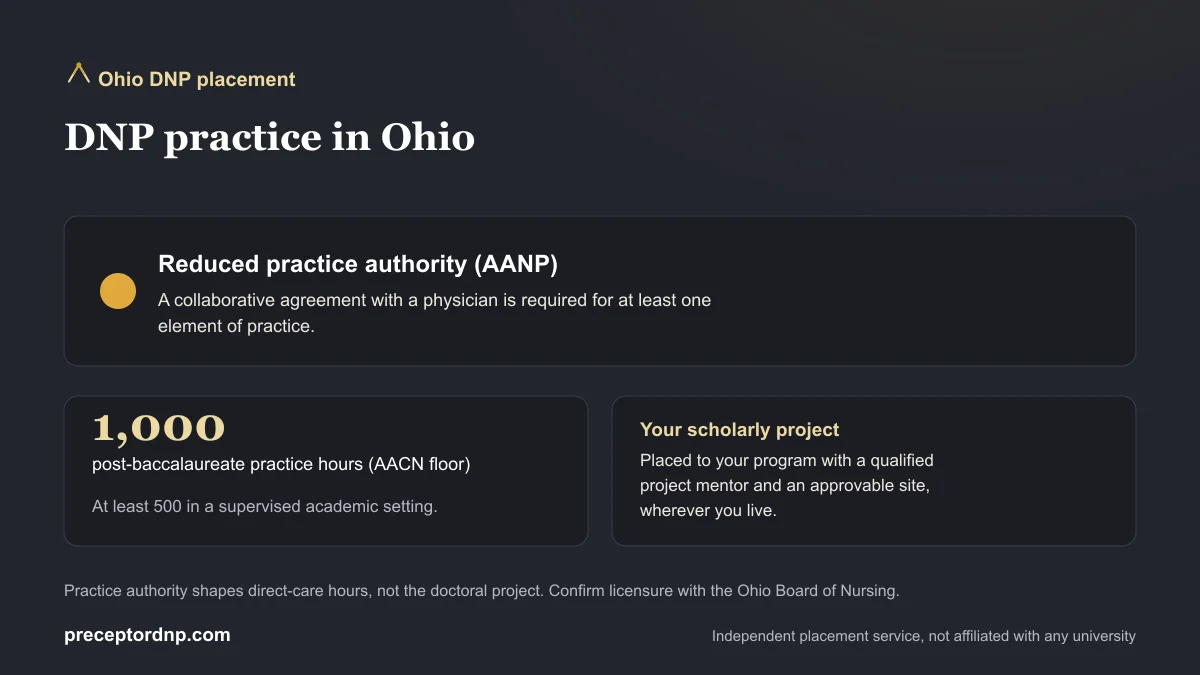
AACN expects at least 1,000 supervised post-baccalaureate practice hours, including at least 500 completed in a supervised academic setting, and the precise total varies by program. These are cumulative post-baccalaureate hours, not necessarily 1,000 new hours after enrollment in the DNP. A post-master's student may receive credit for qualifying prior supervised master's hours only after program verification. A BSN-to-DNP student generally accumulates population-focus care along with project, systems, and leadership experiences.
Ask the program to identify the remaining balance by category. Acute care, ambulatory networks, specialty practice, community health, and long-term care may support clinical hours. Quality, public health, informatics, care coordination, or executive operations may support systems hours. Project work counts only as the program defines it. Give a prospective site the verified categories rather than a single unexplained number, and use the hours explainer to prepare that conversation.
AANP currently places Ohio in the reduced practice category. Nurse practitioners who provide direct care work within Ohio's standard care arrangement framework, so verify the proposed preceptor's current license and practice arrangement with the Ohio Board of Nursing. The category can change and does not itself establish that an individual meets the student's population-focus or program requirements.
A quality-improvement project focused on a system or workflow is generally not a licensure-gated clinical rotation. The reduced practice framework becomes relevant when the student personally assesses, diagnoses, prescribes, or treats patients. Most online programs require students to self-source some placement elements, while others offer coordinator help or a pledge. PreceptorDNP independently serves DNP students at any university and does not guarantee placement or program approval. Submit a three-gate summary through the match form or contact us if the Ohio search needs support.
The site needs an authorized workflow owner, usable baseline and follow-up measures, and enough mentor and staff capacity to implement the change. If one gate is missing, identify a co-sponsor or revise the project before seeking signatures.
Generally, the arrangement concerns nurse practitioner direct care. A workflow or quality project is not usually a licensure-gated rotation. Any patient assessment, diagnosis, prescribing, or treatment must follow current state rules and program approval.
A program may accept qualifying prior post-baccalaureate master's hours after verification. The cumulative expectation is at least 1,000 supervised post-baccalaureate hours, varies by program, and includes at least 500 in a supervised academic setting.
Choose the setting that owns the chosen workflow and can approve usable measures in time. Large systems may offer formal quality support but longer review. Community sites may offer closer access but need a simpler data plan.
No cost to request, and nothing is billed until a match is confirmed and your school signs off. We'll reply within one business day.
We do not guarantee placement. Final approval rests with your program.
