Oklahoma DNP placement is not one market. Metro health systems, community health centers, rural hospitals, and tribal or federal services each control projects differently, so the student should choose an approval pathway first and build the scholarly project question around the setting that actually owns the work.
A metro pathway may run through quality, nursing education, privacy, and affiliation offices inside systems such as INTEGRIS Health or other Oklahoma City and Tulsa networks. A community-health pathway may begin with an Oklahoma Primary Care Association member clinic. A rural pathway may center on a small hospital, public-health program, or long-term care organization. A tribal or Indian Health Service pathway begins with the specific facility's leadership and governance, not with a general statewide contact. Identify the path before requesting a mentor.
Each path offers a different exchange. Metro systems may have larger data sets and formal improvement staff but longer review queues. Community and rural sites may give quicker access to a workflow owner but need a simpler measure. Tribal and federal services may offer important community-based priorities while requiring additional local, cultural, operational, or privacy review. The student's academic approval never substitutes for permission from the organization and community where implementation will occur.
Diabetes and hypertension follow-up, maternal access, behavioral-health referral, emergency transfers, infection prevention, and telehealth continuity may be relevant, but they are not assumptions about every Oklahoma site. Ask the host which process is underperforming, what it already measures, and which change staff are prepared to test. A doctoral project should answer a local practice question, not import a prewritten intervention that exists mainly to meet a course calendar.
Before accepting the site, confirm the denominator, baseline period, data owner, and release format. Then test whether enough eligible cases will occur before evaluation is due. A small rural clinic may succeed with a checklist audit or referral-completion measure. A metro service line may support an electronic report but require weeks of analyst approval. Pick the measure the host can deliver reliably, even when a more sophisticated outcome looks attractive on paper.
A project mentor needs more than clinical expertise. The person must be able to guide evidence translation, convene stakeholders, solve implementation barriers, and obtain or coordinate approved data. Depending on program rules, a DNP-prepared nurse, physician, nurse executive, clinical director, or health-system leader may qualify. In tribal or rural settings, local trust and decision authority may matter as much as a formal quality title. The student's program decides which credentials and duties meet its rubric.
Write down four decision rights: who approves the intervention, who changes staff workflow, who releases aggregate data, and who decides whether the process continues. If the proposed mentor holds only one, add a sponsor or data partner. Keep the direct-care preceptor role distinct. A board-certified NP or physician in the student's population focus supervises patient care; one individual may hold both roles only after program approval.
Oklahoma City and Tulsa contain the largest specialty and health-system networks, while Norman, Edmond, Lawton, Enid, Stillwater, Muskogee, and McAlester serve regional populations. Western Oklahoma, the Panhandle, and many southeastern communities rely more on rural hospitals, community health centers, tribal services, and telehealth. A student may need concentrated site days rather than frequent short trips. Put those travel blocks, mentor availability, and implementation milestones on one calendar before agreeing to a start date.
Remote check-ins can support stakeholder work, but telehealth or video meetings do not automatically satisfy on-site or supervised-hour requirements. Ask the program which activities may be remote and how supervision must be documented. Ask the host which meetings or data tasks can occur off-site without crossing privacy boundaries. The feasible plan is the overlap between those two answers, not the maximum amount of work the student hopes to count from home.
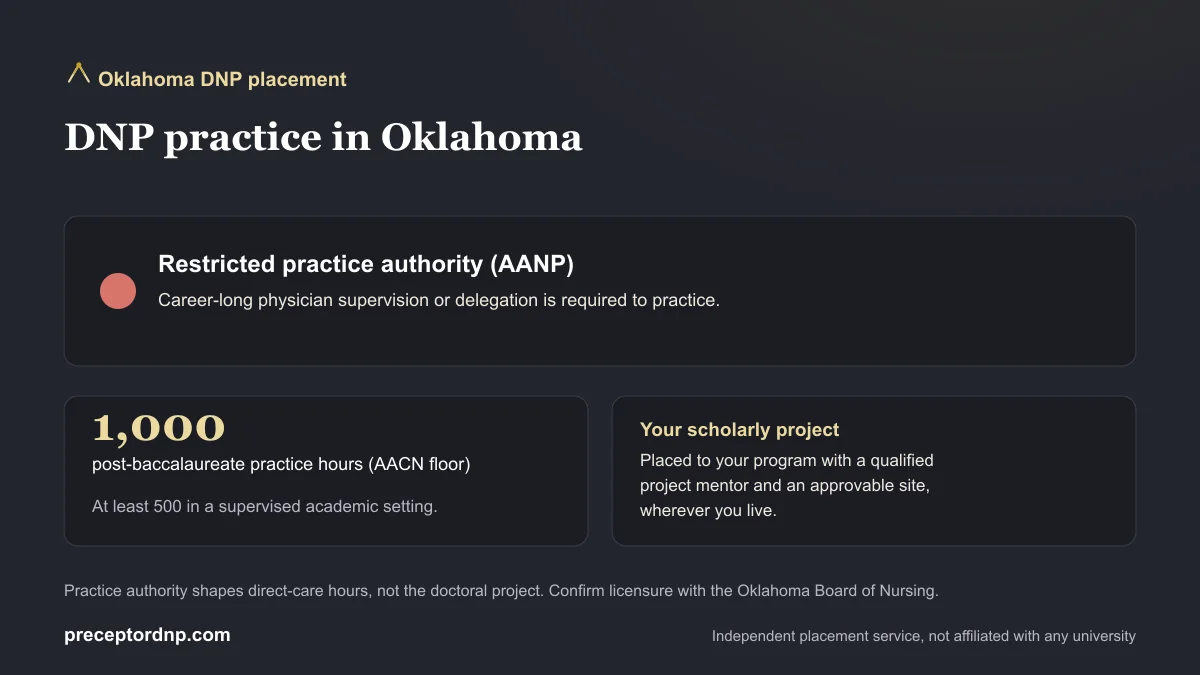
AACN expects at least 1,000 supervised practice hours after the bachelor's degree, including at least 500 in a supervised academic setting, and the exact total varies by program. The requirement is cumulative post-baccalaureate, not a fixed set of 1,000 new DNP hours. A post-master's student may apply qualifying earlier supervised hours only after the program verifies them. A BSN-to-DNP student generally accumulates direct-care hours alongside systems, leadership, and project practice.
List the remaining hours by approved activity before selecting settings. Hospitals, specialty clinics, community health centers, tribal facilities, and rural practices may support population-focus care. Public health, informatics, care coordination, emergency preparedness, quality, and telehealth operations may support systems practice. Project tasks count only within the student's program rules and should not be assumed to replace clinical care. Review the cumulative framework, then ask the program for written confirmation of the balance.
AANP currently categorizes Oklahoma as a restricted practice state. For direct-care hours, verify current physician-supervision or related practice requirements and the proposed preceptor's license through the Oklahoma Board of Nursing. That legal check does not decide whether a systems-focused DNP project is academically sound. A quality-improvement project generally changes a workflow and is not itself a licensure-gated clinical rotation, unless the student also assesses, diagnoses, prescribes, or treats patients.
Most online DNP programs ask students to self-source some combination of site, mentor, or preceptor, though some provide coordinator support or a placement pledge. PreceptorDNP independently serves students at any university and cannot guarantee a match or program approval. If the chosen Oklahoma pathway has no qualified contact, send the project summary and verified hours through the match form or review our process.
No. Tribal and Indian Health Service organizations can have distinct local governance, operational, privacy, and community-review steps. Ask the specific host who can approve the project and data use. Program approval is a separate requirement.
Only if the person separately meets the program's direct-care criteria, including appropriate licensure, board certification, and population focus. The project mentor role centers on implementation and evaluation. Ask the program to approve each role explicitly.
There is no statewide fixed answer. At least 1,000 supervised post-baccalaureate hours are expected, the total varies by program, and at least 500 must be in a supervised academic setting. The program verifies prior hours and determines the remaining categories.
Confirm host permission, mentor coverage, eligible case volume, on-site requirements, remote-activity rules, and data-collection dates. Concentrated site days may be more practical than repeated trips, but the program must approve the supervision plan.
No cost to request, and nothing is billed until a match is confirmed and your school signs off. We'll reply within one business day.
We do not guarantee placement. Final approval rests with your program.
