Oregon DNP projects must solve two placement questions at once: can the organization support measurable practice change, and can the student realistically participate across the state's long travel corridors? The answer may point to a Portland system, a regional hospital, a community organization, or a frontier setting with a deliberately small project.
Create a two-by-two screen. Readiness means the host owns a meaningful practice gap, has baseline data, can authorize an intervention, and can name a qualified mentor. Reach means the student can meet required on-site time, travel safely, communicate with the mentor, and complete data collection before the course deadline. A Portland organization may be highly ready but slow to approve. A distant clinic may be reachable only in concentrated blocks. A site belongs on the shortlist when both dimensions are workable.
Providence and other Portland-area systems may offer quality, safety, population-health, and nursing-leadership infrastructure. Regional hospitals, community health centers, long-term care, public health, and nonprofit organizations may offer more direct access to a workflow owner. Oregon Health Authority quality-improvement resources show the state's broader attention to coordinated care, but a statewide initiative does not grant a student data access or site permission. Verify the local need and authority.
Potential questions include care transitions, rural referral completion, substance-use follow-up, maternal access, infection prevention, chronic-disease outreach, and telehealth reliability. Treat these as prompts for a conversation, not conclusions about a facility. Ask what the local team is already trying to improve, which outcome or process measure it trusts, and whether the proposed intervention changes work the team actually controls.
A strong scholarly project translates evidence into one bounded practice change. It does not need to solve a statewide shortage. A clinic could test a referral-tracking process, a hospital unit could improve a discharge element, or a community program could standardize follow-up. The proposal should state the eligible population, baseline window, staff burden, evaluation date, and plan for sustaining the process. If the organization cannot answer who will retrieve follow-up data, the design is not ready.
Portland and the Willamette Valley contain the densest hospital and specialty networks. Salem, Eugene and Springfield, Bend, Medford, and Corvallis anchor additional regional markets. Larger systems may have formal review paths and experienced analysts, but they also receive more placement requests. Ask for the specific service line and project-review process rather than sending a general request to every location in a network.
Coastal communities, southern Oregon, and areas east of the Cascades may depend on critical-access hospitals, rural clinics, community health, and telehealth. These settings can support valuable implementation work when the measure fits a small patient volume and limited staffing. Build travel blocks around the local calendar, and obtain the program's decision on remote activities before counting them. Video meetings help continuity but do not automatically replace supervised presence.
The program may approve a DNP-prepared nurse, physician, nurse executive, or health-system leader as the project mentor when credentials and expertise fit. That person guides evidence translation, stakeholder engagement, implementation, and evaluation. The workflow owner authorizes the change and protects staff time. In a small Oregon organization, one leader may fill both roles. In a large network, a quality mentor may need a unit or clinic sponsor who controls daily operations.
Confirm five details before submitting a mentor: credentials, authority, access to the setting, meeting availability, and responsibility for aggregate data. A clinical preceptor is different. A program-approved, board-certified NP or physician in the student's population focus supervises direct care. One professional can sometimes serve in both capacities, but the program must evaluate each role rather than approve a title in the abstract.
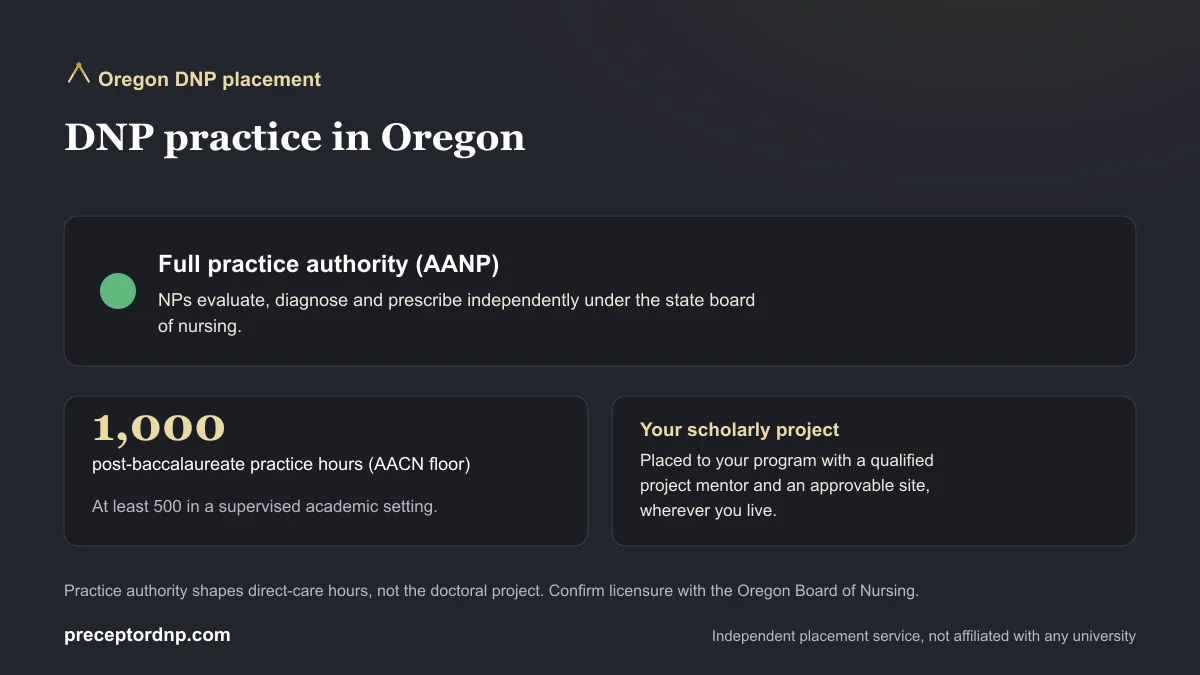
AACN expects at least 1,000 supervised post-baccalaureate practice hours, with at least 500 completed in a supervised academic setting, and the exact requirement varies by program. This is a cumulative total after the bachelor's degree, not an automatic block of 1,000 new hours at the DNP level. A post-master's student may apply qualifying prior supervised hours only after the program audits them. A BSN-to-DNP student usually combines population-focus practice with systems and project learning.
Direct-care hours may fit hospitals, specialty clinics, primary care, community health, long-term care, or rural practice when the population focus matches. Systems hours may fit quality, informatics, public health, care coordination, leadership, or telehealth operations. Project work may contribute to a program-defined category but does not automatically replace clinical hours. Ask for the remaining balance, acceptable supervision, documentation method, and remote limit in writing. The DNP hours guide can help structure that audit.
AANP currently categorizes Oregon as a full practice state. For direct-care hours, an eligible nurse practitioner can practice without a career-long physician agreement imposed by the state, but the clinician's license, certification, scope, and population match still need review. Categories and details can change, so confirm current requirements with the Oregon State Board of Nursing and obtain the student's program approval.
Full practice status does not approve a DNP quality-improvement project. A project that changes a workflow, staff process, or system is generally not a licensure-gated clinical rotation. Clinical law becomes relevant when the student assesses, diagnoses, prescribes, or treats patients. Most online programs require some self-sourcing, while others offer coordinator support or a placement pledge. PreceptorDNP independently helps students at any university and never guarantees a match or program approval. Share the readiness-and-reach screen through the match form or contact the placement desk.
Score both for readiness and reach. Check workflow authority, available measures, mentor fit, review time, travel, on-site expectations, and the implementation calendar. The larger organization is not automatically the more feasible host.
Yes, if the program approves that person's credentials and project role. Direct patient care requires a separately approved, population-matched clinical preceptor. One person may fill both roles only when qualified and approved for each.
Not necessarily. At least 1,000 supervised post-baccalaureate hours are expected, varies by program, and at least 500 must occur in a supervised academic setting. The student's program decides which prior qualifying master's hours count and what remains.
No. It concerns nurse practitioner direct-care authority. The host must still approve the project, the program must approve the site and mentor, and any clinical preceptor must meet current licensure and population-focus requirements.
No cost to request, and nothing is billed until a match is confirmed and your school signs off. We'll reply within one business day.
We do not guarantee placement. Final approval rests with your program.
