Pennsylvania's DNP scholarly project opportunity lies in its variety: major urban systems, integrated regional networks, independent community services, long-term care, and rural providers. The placement challenge is to find one organization that can own the change and data even when the underlying care problem crosses several parts of that landscape.
Many doctoral questions appear where one service hands work to another: hospital to primary care, emergency department to behavioral-health care, specialty practice to community support, or long-term care to an acute-care facility. Readmissions, opioid-use follow-up, maternal continuity, older-adult safety, infection prevention, and rural referrals may fit this pattern. A seam is project-ready only when one host can change a defined part of the process and measure whether it improved.
Avoid proposing a multi-organization transformation before establishing local control. A Pennsylvania site should identify the target population, current workflow, process owner, baseline source, and follow-up date. The student can involve external partners as stakeholders without asking every partner to serve as a formal site. One accountable host and one bounded intervention are usually more feasible than several agreements and incompatible data systems.
Philadelphia and Pittsburgh contain large teaching, specialty, and quality infrastructures. The Lehigh Valley, Harrisburg, Lancaster, York, Reading, Scranton, Wilkes-Barre, Erie, Altoona, and Williamsport anchor regional markets with their own referral patterns. Jefferson Health, Allegheny Health Network, Geisinger, WellSpan Health, Lehigh Valley Health Network, and other systems may offer formal improvement teams, but access depends on the selected service and approval channel.
The northern tier and Appalachian southwest rely more on small hospitals, rural health, long-term care, community organizations, and public health. Those settings may give a student closer access to a workflow owner but less analyst time. Select a region where travel is sustainable, then search by problem owner. A student improving rural referral completion needs a different contact from one testing an inpatient infection-prevention workflow, even when both placements are within the same network.
Treat data like a limited resource. Decide which two or three measures are necessary, who collects each one, how often they are available, and whether the site can release aggregate results. A large Pennsylvania system may require privacy, evidence, operational, and analyst reviews. A small organization may rely on a manual chart audit. Both can support rigorous practice change if the method is consistent and the data arrive within the academic calendar.
Pennsylvania Department of Health resources on operational excellence and shortage designations can inform context, but they do not prove a local site's capacity or authorize access. Ask the host to validate the need and choose the measure. If baseline extraction takes longer than implementation, use an existing process measure or narrow the population. The project should leave the organization with a monitoring method it can continue without the student.
A project mentor guides evidence translation, stakeholder engagement, implementation, and evaluation. Depending on program rules, the approved person may be a DNP-prepared nurse, physician, nurse executive, quality leader, or health-system administrator. In a Philadelphia, Pittsburgh, or regional network, the mentor may sit outside the unit where the change occurs. Name a separate operational sponsor when that person controls staff workflow or data permissions.
A clinical preceptor is selected for a different reason. An appropriately licensed, board-certified NP or physician in the student's population focus supervises direct patient care. One person may qualify for both functions, but the program should approve the project role and clinical role separately. Before asking for signatures, confirm credentials, scope, decision authority, meeting frequency, data access, and who will resolve barriers.
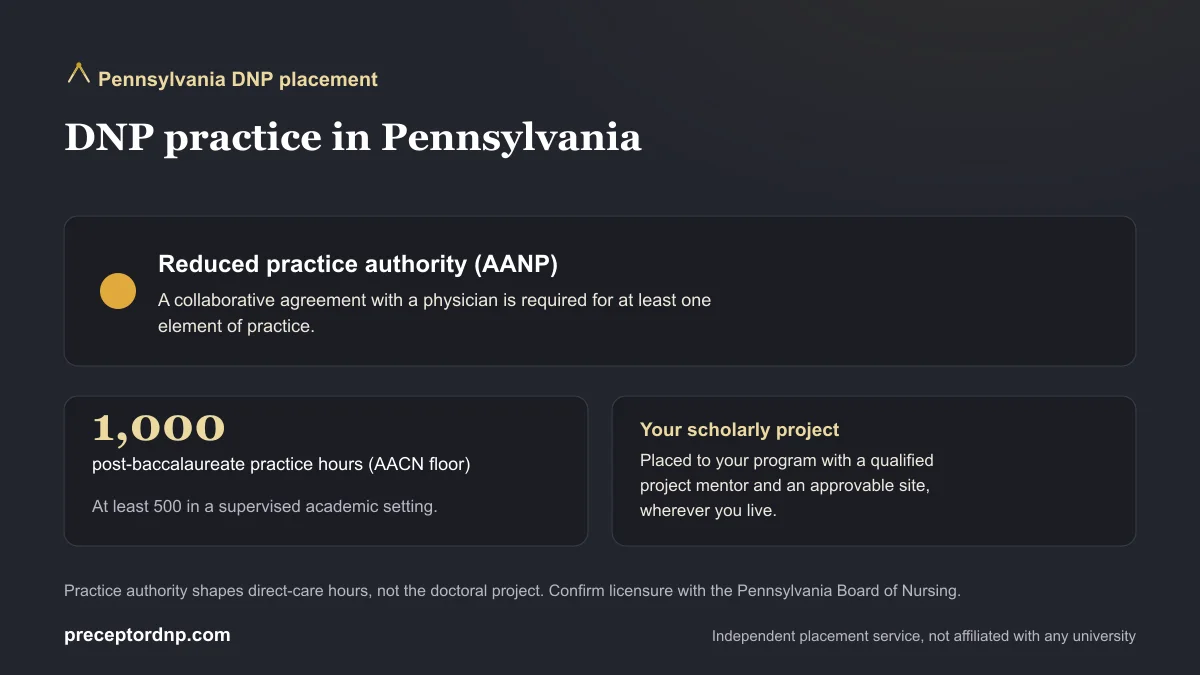
AACN expects at least 1,000 supervised post-baccalaureate practice hours, including at least 500 in a supervised academic setting, and the precise total varies by program. The hours are cumulative after the bachelor's degree. They are not automatically 1,000 new hours at the DNP level. A post-master's student may apply qualifying prior supervised hours after the program verifies them. A BSN-to-DNP student typically accumulates population-focus clinical practice alongside systems, leadership, and project work.
Build the remaining portfolio by approved category. Hospital services, specialty clinics, community health centers, long-term care, and rural practices may host direct care. Quality, informatics, public health, care management, patient safety, and executive operations may host systems practice. A project task can count only where the program permits it and should not be assumed to satisfy direct-care expectations. Confirm site, supervisor, documentation, and remote rules before scheduling. See the cumulative-hour overview for questions to take to the program.
AANP currently lists Pennsylvania in the reduced practice category. Nurse practitioners providing direct patient care operate within the state's collaborative-agreement framework, so verify the proposed preceptor's current license and arrangement with the Pennsylvania State Board of Nursing. The category can change and does not prove that a clinician meets the student's population-focus or academic criteria.
Keep that legal framework in the clinical portion of the plan. A DNP quality-improvement project focused on a workflow or system is generally not a licensure-gated rotation. If the student assesses, diagnoses, prescribes, or treats patients, direct-care rules apply. Most online DNP programs expect some self-sourcing, while others offer coordinator help or a placement pledge. PreceptorDNP independently assists students at any university without guaranteeing placement or program approval. Send the care seam, regional target, and verified requirements through the match form or review our process.
It can if every organization and the program approve the plan, data use, supervision, and responsibilities. A single accountable host is often simpler. External partners can participate as stakeholders without becoming separate formal sites.
Choose a narrow population and two or three measures the staff can collect consistently. Name the data owner, baseline period, release format, and evaluation date. A manual audit can be appropriate when it is approved and reproducible.
No universal rule says so. At least 1,000 supervised post-baccalaureate hours are expected, varies by program, and includes at least 500 in a supervised academic setting. The student's program audits prior qualifying hours and sets the remaining balance.
It governs nurse practitioner direct-care practice, not the scholarly mentor title by itself. Project mentors must meet program criteria and site needs. Any person supervising patient care must also satisfy current state law and population-focus requirements.
Sources · last updated July 2026
AACN: Doctor of Nursing Practice education · AANP: Pennsylvania practice profile · Pennsylvania State Board of Nursing · Pennsylvania Department of Health: Operational Excellence · Pennsylvania Department of Health: Primary-care shortage designations · Geisinger: Care delivery and health innovation
No cost to request, and nothing is billed until a match is confirmed and your school signs off. We'll reply within one business day.
We do not guarantee placement. Final approval rests with your program.
