Rhode Island's compact map reduces distance but concentrates competition for the same hospitals and community networks. A successful DNP search uses that compactness to compare several types of settings quickly, then commits to the host with the clearest workflow authority, mentor capacity, and data path.
Providence, Pawtucket, Cranston, Warwick, and East Providence form the main clinical corridor. Woonsocket, Newport, Westerly, Wakefield, and South County broaden the search without creating the travel demands found in larger states. A student can often evaluate a hospital, community health center, public-health program, long-term care organization, and home-health service within a practical radius. Use that advantage to compare project fit, not to send one generic request to every organization.
Screen each host with the same questions: Does the practice gap affect a reachable population? Who owns the workflow? Which baseline is already collected? Who can approve the intervention? Can an eligible mentor meet throughout implementation? Because the market is small, a vague request may reach several people in the same network. Keep outreach coordinated and withdraw duplicate requests once the correct approval channel is identified.
Care New England, South County Health, and other hospital networks may offer nursing quality, safety, and population-health infrastructure. Rhode Island's community health centers, public health, long-term care, and nonprofit services may offer a closer view of transitions and access. Care transitions, older-adult safety, maternal follow-up, behavioral-health access, infection prevention, health equity, and seasonal continuity may be useful themes only when a local team confirms the problem.
A statewide footprint does not require a statewide intervention. Choose one population, one workflow, and two or three measures that can be completed within the doctoral timeline. A community clinic might improve referral closure, a hospital service might standardize a discharge step, or a long-term care team might test a safety process. The scholarly value comes from disciplined evidence translation and evaluation, not the number of facilities listed in the proposal.
Ask the operational owner for preliminary interest, then identify formal site review. Depending on the setting, the proposal may need affiliation, nursing education, privacy, quality, or evidence-review approval. Public-health and community organizations may use a different path from hospital systems. Academic approval and local permission are separate, and neither should be described as automatic.
Prepare one packet containing the local problem, intervention, measures, staff burden, data request, dates, hour categories, mentor rubric, and program forms. Large networks may need more review time even when a department is enthusiastic. Smaller settings may decide sooner but need help narrowing data collection. A complete packet lets the organization identify missing steps before the student's implementation term begins.
The project mentor may be a DNP-prepared nurse, physician, nurse executive, clinical director, or health-system leader if the student's program approves the person's credentials and role. The mentor guides evidence translation, stakeholder work, implementation, and evaluation. In Rhode Island's interconnected care environment, the strongest mentor also knows where referrals, data, and decisions cross organizational boundaries without claiming authority the host does not have.
Ask who will maintain the process after the student's final evaluation and who can cover mentor absences. A clinical preceptor is different: a program-approved, board-certified NP or physician in the student's population focus supervises patient care. One person may sometimes meet both sets of criteria, but the program should approve the roles separately. A respected clinician without workflow authority may be an adviser rather than the primary project mentor.
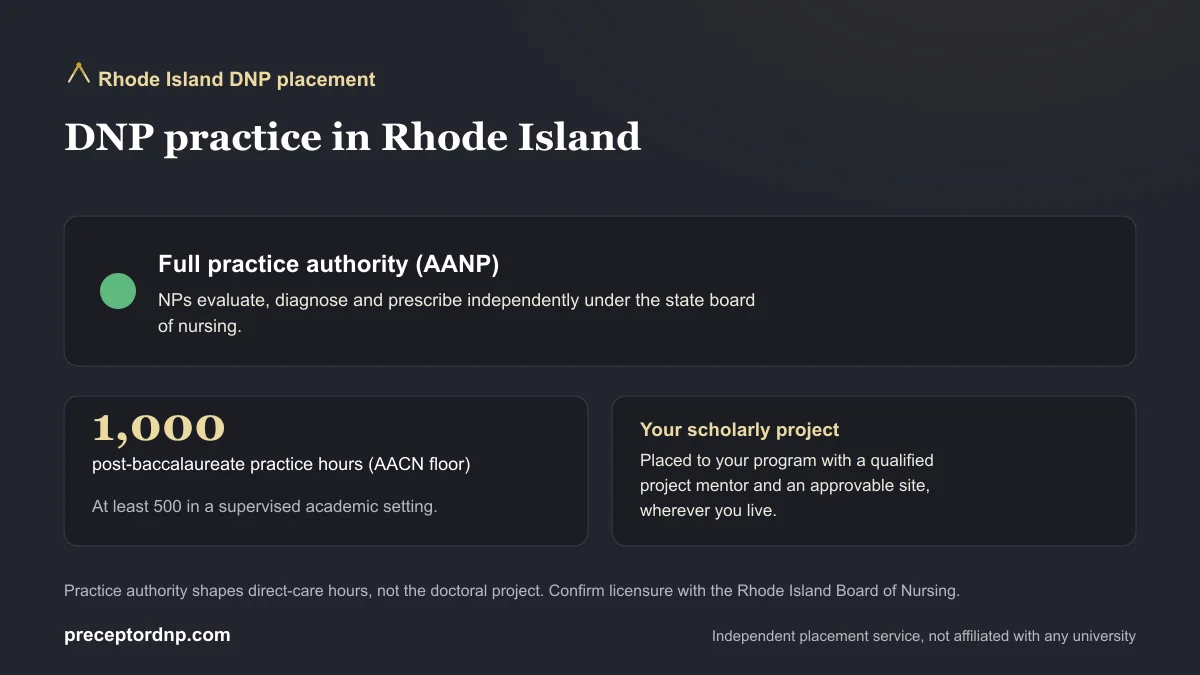
AACN expects at least 1,000 supervised post-baccalaureate practice hours, with at least 500 completed in a supervised academic setting, and the precise requirement varies by program. The hours are cumulative after the bachelor's degree, not necessarily 1,000 new hours during the DNP. A post-master's student may apply qualifying previous supervised hours after program verification. A BSN-to-DNP student generally combines population-focus clinical practice with systems, leadership, and project work.
One Rhode Island project site may fit quality, public health, informatics, care coordination, or leadership hours but not the student's remaining direct-care category. Hospitals, ambulatory practices, community health centers, long-term care, and home-based care may support clinical hours when the population focus and supervision match. Ask the program to identify the remaining balance, acceptable settings, documentation, and remote limits before seeking a schedule. The DNP hours overview helps organize those questions.
AANP currently categorizes Rhode Island as a full practice state. Eligible nurse practitioners can provide direct care without a career-long physician agreement imposed by the state, but the individual's license, certification, scope, and population fit still require verification. Confirm current details through the Rhode Island Board of Nurse Registration and Nursing Education because categories and rules may change.
Full practice status does not grant permission for a scholarly project. A quality-improvement project that changes a workflow or system is generally not a licensure-gated clinical rotation. The rule matters when the student assesses, diagnoses, prescribes, or treats patients. Most online programs involve some self-sourcing, while others offer coordination or a placement pledge. PreceptorDNP independently supports DNP students at any university without guaranteeing a site or program approval. Share the screened setting and verified requirements through the match form or contact us.
No. Distance is often manageable, but student demand is concentrated among a limited number of networks. Site capacity, approval time, data access, mentor availability, and program criteria still determine feasibility.
It can if the host and program approve the scope and the data are feasible, but statewide reach is not required. A focused project in one setting can demonstrate meaningful practice change more reliably than an overextended intervention.
The student's program audits them. At least 1,000 supervised post-baccalaureate hours are expected, varies by program, and at least 500 must be in a supervised academic setting. Prior qualifying master's hours may reduce the remaining balance after verification.
Possibly, when the program approves the person's credentials and project expertise. Direct patient-care supervision is separate and requires an appropriately licensed, population-matched clinical preceptor under program and state requirements.
Sources · last updated July 2026
AACN: Doctor of Nursing Practice education · AANP: Rhode Island practice profile · Rhode Island Department of Health: Nursing licenses · Rhode Island Department of Health: About the agency · Rhode Island Health Care Quality Program · Rhode Island Health Center Association: Community health centers
No cost to request, and nothing is billed until a match is confirmed and your school signs off. We'll reply within one business day.
We do not guarantee placement. Final approval rests with your program.
