South Carolina DNP scholarly project placement should begin with a regional care pattern, then narrow to the organization that owns the proposed change. Upstate, Midlands, Lowcountry, and Pee Dee settings differ in referral routes, project-review capacity, and travel, so the student needs a local implementation plan rather than a statewide template.
Greenville and Spartanburg anchor the Upstate, while Columbia and Lexington anchor the Midlands. Charleston and Summerville lead the Lowcountry, and Florence and Myrtle Beach connect the Pee Dee and coastal markets. Prisma Health, McLeod Health, Spartanburg Regional Healthcare System, Roper St. Francis Healthcare, Lexington Medical Center, and community networks may offer formal quality or nursing-leadership channels. Select a region based on the project's population and the student's sustainable travel radius.
Counties along the I-95 corridor and parts of the interior Pee Dee often have fewer large quality departments and longer referral paths. Rural hospitals, community health centers, public-health services, long-term care, and telehealth programs can host doctoral work when the design fits smaller teams. Plan travel around the host's staffing and determine which activities the program permits remotely. A virtual meeting does not automatically count as supervised site practice.
Maternal follow-up, diabetes management, readmission prevention, infection control, behavioral-health referral, rural transitions, and chronic-disease outreach may be relevant project themes. Begin by asking the host which gap it is prepared to address and which measure it already trusts. A health system may provide an electronic report after formal review, while a community clinic may support a small manual audit. Both approaches can be appropriate when the denominator and collection method are clear.
The project needs one accountable workflow owner, a baseline available before implementation, and a follow-up that arrives before evaluation is due. Do not promise a broad outcome when the site can reliably measure only a process. A referral checklist, staff protocol, patient-education step, or follow-up workflow can demonstrate practice change if it is evidence-based and sustained. The site name matters less than its ability to authorize, measure, and continue the intervention.
A useful mentor agreement answers who guides evidence translation, who can authorize the workflow change, who provides aggregate data, how often meetings occur, and who resolves barriers. The program may approve a DNP-prepared nurse, physician, nurse executive, quality leader, or health-system administrator when the credentials and role fit. In a rural organization, one director may hold several functions; in a large system, the student may need both a scholarly mentor and an operational sponsor.
The project mentor is not automatically the clinical preceptor. A clinical preceptor supervises direct patient care and should be a program-approved, board-certified NP or physician in the student's population focus. One person may sometimes fulfill both roles, but only after the program reviews each function. Put duties and availability in writing before requesting final approval so the host and student share the same expectations.
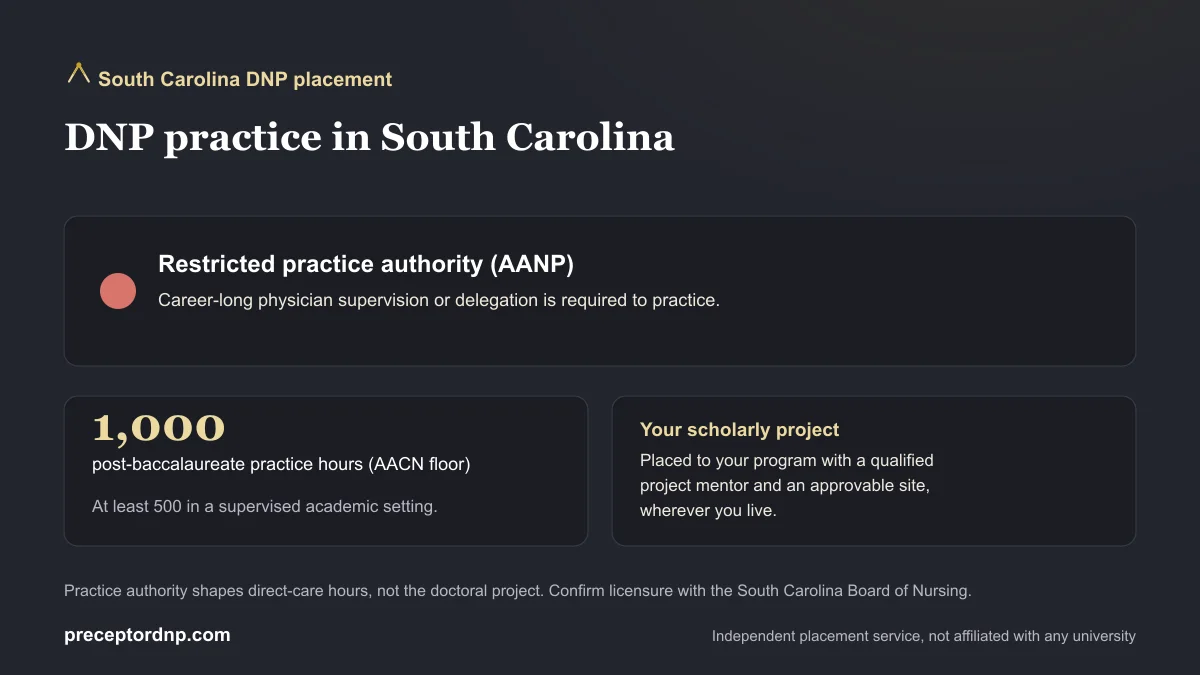
The first rung is the program's verified total. AACN expects at least 1,000 supervised post-baccalaureate practice hours, with at least 500 completed in a supervised academic setting, and the exact total varies by program. This is cumulative after the bachelor's degree, not automatically 1,000 new DNP-level hours. A post-master's student may receive credit for qualifying prior supervised master's hours after program review. A BSN-to-DNP student usually builds the total across clinical, systems, and project experiences.
The second rung assigns remaining categories to approved settings. Hospitals, specialty practices, community health centers, rural clinics, and public-health services may support direct care when the population focus fits. Quality, informatics, care coordination, emergency planning, leadership, and population health may support systems practice. The third rung confirms supervision, documentation, and remote limits. Project milestones do not automatically replace clinical hours. Use the DNP hour framework to prepare the questions, then obtain the program's decision.
AANP currently categorizes South Carolina as a restricted practice state. Nurse practitioners providing direct care work under state practice-agreement requirements, so confirm the proposed clinical preceptor's current license and arrangement with the South Carolina Board of Nursing. Practice categories can change, and the student's program must still confirm board certification, population fit, and supervision.
Restricted practice authority does not automatically control a DNP quality-improvement project. A project that changes a workflow, documentation process, or staff practice is generally not a licensure-gated clinical rotation. When the student personally assesses, diagnoses, prescribes, or treats patients, direct-care law applies. Spell out that boundary so the site routes the project correctly and reviewers do not mistake systems work for independent patient care.
Include the local problem, eligible population, intervention, measures, dates, staff burden, data request, mentor criteria, verified hour categories, and program forms. Ask the organization which quality, privacy, nursing-education, or affiliation review is required. Most online DNP programs expect students to self-source some combination of site, mentor, or preceptor, although some provide coordination, referrals, or a placement pledge. Confirm the program's actual help before duplicating outreach.
PreceptorDNP is an independent service for DNP students at any university and works independently of a school. We can help identify South Carolina project sites, practice mentors, or population-matched clinical preceptors, but we cannot guarantee placement or program approval. When the four-region search produces no decision-ready option, submit the packet through the match form or read how our process works.
Start where the target population and workflow exist within a sustainable travel radius. Upstate, Midlands, Lowcountry, and Pee Dee markets offer different systems and community settings. The best region is the one with an authorized host and usable measures.
Document the mentor's credentials, implementation role, decision authority, data access, meeting schedule, backup contact, and responsibilities after evaluation. Add an operational sponsor if the mentor cannot change the workflow directly.
No. At least 1,000 supervised post-baccalaureate hours are expected, varies by program, and at least 500 must be in a supervised academic setting. The program verifies prior qualifying hours and decides the remaining balance and locations.
Generally no. The restriction applies to nurse practitioner direct care. A quality-improvement project focused on a workflow or system follows site and program approval, while any patient-care activity must also follow current state law.
No cost to request, and nothing is billed until a match is confirmed and your school signs off. We'll reply within one business day.
We do not guarantee placement. Final approval rests with your program.
