South Dakota DNP placement starts with geography: a few regional hubs support formal improvement work, while rural and tribal settings operate with smaller teams and longer travel. The best plan connects a locally owned practice problem, a mentor with decision authority, and a program-approved route through the student's cumulative practice hours.
Sioux Falls has the state's deepest concentration of hospital, specialty, analytics, and nursing-leadership resources. Rapid City anchors western South Dakota, while Aberdeen, Watertown, Pierre, Brookings, Yankton, and Mitchell serve broad regional catchments. Sanford Health, Avera Health, Monument Health, Prairie Lakes Healthcare System, community health centers, local public-health programs, and long-term care organizations illustrate the range of possible settings. A named organization is a prospect, not a promised placement.
Outside those hubs, critical-access hospitals, rural clinics, Indian Health Service facilities, and tribally operated programs may offer important questions about emergency transfer, diabetes follow-up, maternal access, behavioral health, care coordination, or telehealth continuity. Students must respect tribal sovereignty, local review, and data-governance rules. Build travel, weather, onsite presence, and remote meetings into the proposal, then confirm with the program which activities can be completed away from the site.
The DNP scholarly project is the center of the placement. A viable South Dakota host can identify a measurable gap, authorize a bounded intervention, provide access to appropriate measures, and support evaluation. Suitable work might standardize discharge follow-up, improve a referral handoff, strengthen infection-prevention practice, or test a rural care-coordination process. Observation alone, a literature summary, or a schedule of ordinary clinical shifts does not provide the same doctoral practice-change experience.
Start with a one-page concept rather than a finished solution. Describe the population, current workflow, proposed change, likely measures, staff burden, and semester window. Ask how the organization classifies quality improvement, evidence-based practice, and human-subjects research. A mentor's interest does not authorize record access or implementation, so site review, privacy requirements, community approval where applicable, and program approval must be complete before work or hours begin.
A project mentor should understand the setting and be able to move the proposed change through it. Depending on program criteria, that person may be a DNP-prepared nurse, physician, nurse executive, quality leader, or health-system administrator. In a small rural or tribal organization, operational access may matter more than a formal quality title. Confirm the required degree, experience, meeting cadence, evaluation duties, and whether an academic adviser remains separate from the practice mentor.
Direct-care supervision is a different match. Population-focus clinical hours generally require a board-certified nurse practitioner or physician whose patients and practice fit the student's track. One professional may fill both roles only if the program approves the credentials and duties for each. Ask who can approve the intervention, who controls the data, and who can verify hours. A supportive clinician without those permissions may be an adviser but not the right primary mentor.
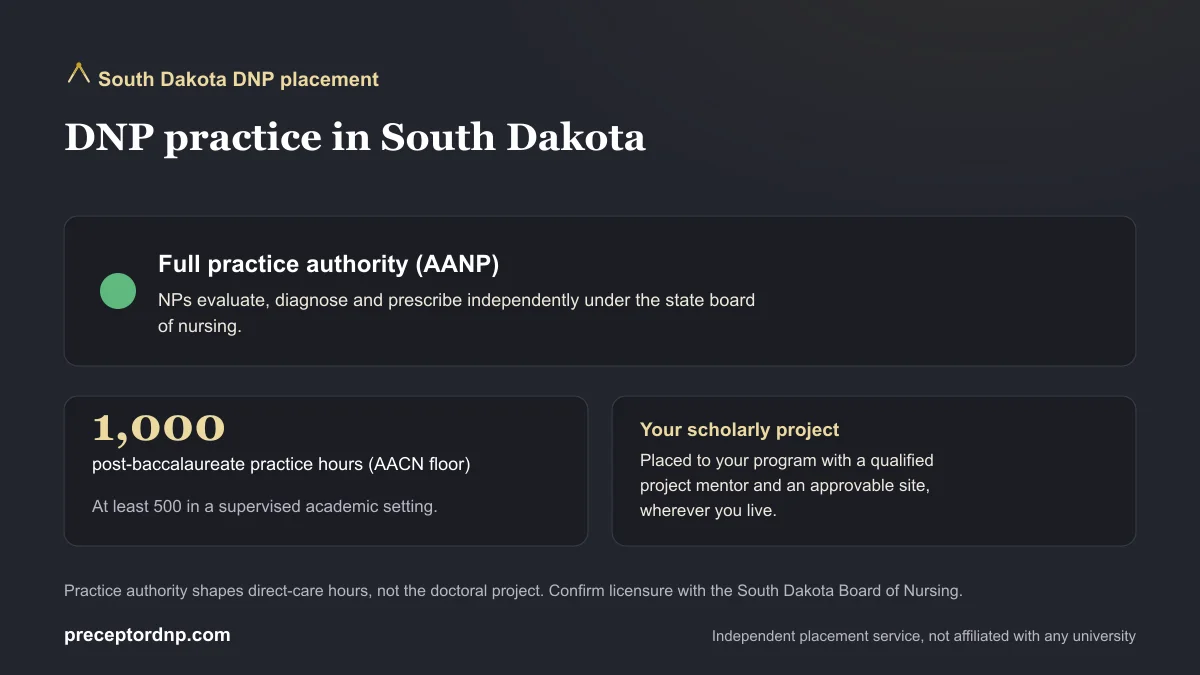
AACN guidance calls for at least 1,000 supervised post-baccalaureate practice hours, including at least 500 hours in a supervised academic setting. The requirement is cumulative and the exact doctoral balance varies by program. A post-master's DNP student may apply qualifying prior graduate hours after the program reviews them. A BSN-to-DNP student usually completes population-focus clinical practice alongside systems, leadership, and scholarly-project work.
Request a written gap analysis that identifies accepted hours, remaining competencies, supervision rules, and the activities the program will count. South Dakota experiences may include approved direct care, quality improvement, informatics, public health, emergency planning, care management, or leadership. Do not assume every project task satisfies the remaining hour categories. Keep the hour ledger and project timeline separate, and review the DNP clinical-hours framework before a site receives a proposed schedule.
AANP currently categorizes South Dakota as a full practice state. That classification matters when a supervised experience includes assessment, diagnosis, treatment, or prescribing. It does not make a student independent or replace a program's population-focus, credential, and supervision standards. Confirm current licensure and any transition requirements with the South Dakota Board of Nursing before relying on a direct-care arrangement.
A quality-improvement project that changes a workflow or evaluates an authorized system process is generally not a licensure-gated clinical rotation. It still requires academic and organizational review, and the student's license and assigned role continue to apply. If a proposal mixes project activity with patient care, label the direct-care tasks separately and secure the appropriate clinical preceptor and approvals for those tasks.
Many online DNP programs expect students to self-source a site and mentor, while some provide coordinator help, referrals, or a placement-assistance process. Verify the actual support offered before outreach. A useful South Dakota packet includes the pathway, project theme, target community, remaining hours, dates, travel range, mentor criteria, data needs, program contacts, and every agreement or evaluation form the organization must review.
PreceptorDNP is independent, serves DNP students at any university, and cannot guarantee participation or program approval. We can research plausible project settings, approach qualified mentors or population-matched preceptors, and support the paperwork handoff. Review how matching works, then send the confirmed South Dakota requirements through the match form or contact our desk.
Potentially, when the work answers a priority identified by the tribal organization and follows its approval, community-engagement, privacy, and data-governance processes. Program approval does not replace tribal authority, and a placement service cannot promise access on an organization's behalf.
Yes, but only if the student's program approves that person's credentials and responsibilities for both roles. Project mentorship requires authority over implementation and evaluation, while direct-care precepting requires a licensed, population-matched clinical practice.
There is no universal new-hour total. The cumulative expectation is at least 1,000 supervised post-baccalaureate hours and the total varies by program, with qualifying prior graduate hours subject to formal review. Ask the program for a written audit before committing to a South Dakota schedule.
They may support mentorship, planning, and evaluation when the site and program allow them, but they do not automatically replace required onsite or supervised activity. Confirm which tasks may be remote and whether weather or distance requires a backup calendar.
Sources · last updated July 2026
AACN CCNE DNP Programs and Accreditation FAQs · AANP: South Dakota practice profile · South Dakota Board of Nursing: Certified nurse practitioner practice · South Dakota Board of Nursing: APRN practice guidelines · HRSA: South Dakota health-center program data · Sanford Health: About the regional system
No cost to request, and nothing is billed until a match is confirmed and your school signs off. We'll reply within one business day.
We do not guarantee placement. Final approval rests with your program.
