Tennessee gives DNP students several distinct placement markets rather than one statewide pool. A successful search links the scholarly project to a regional care priority, finds a mentor who can authorize change, and separates project implementation from any population-focus direct-care hours.
Nashville, Memphis, Knoxville, and Chattanooga contain Tennessee's largest hospital, specialty, analytics, and nursing-leadership teams. The Tri-Cities, Jackson, Cookeville, Clarksville, and Murfreesboro serve surrounding counties through regional networks. TriStar Health, Ascension Saint Thomas, Methodist Le Bonheur Healthcare, Ballad Health, Erlanger, and Covenant Health show the range of system structures a student may encounter. Each organization controls its own student, privacy, and improvement-review process.
Eastern Appalachian counties, the Cumberland Plateau, and western Delta communities may rely on rural hospitals, community health centers, local public health, and telehealth-supported referrals. These settings can support doctoral work in maternal access, substance-use care, diabetes follow-up, behavioral-health integration, infection prevention, or transfer coordination. A smaller site often needs a tighter intervention and simpler measures, but it may offer closer access to the leaders who own the workflow.
The DNP scholarly project should implement and evaluate an evidence-based practice change. A Tennessee host needs an active problem, a defined population, permission to change a process, and measures that can show what happened. Examples include revising a discharge-call workflow, improving referral completion, standardizing a screening process, or strengthening a rural transition pathway. Observation, staff shadowing, and routine NP visits alone do not make the project doctoral work.
Bring a provisional aim rather than a finished intervention. Ask the host which outcome it wants to improve, what data already exist, who approves workflow changes, and whether the work follows a quality, evidence, privacy, or research-review route. Keep the scope within one service, clinic, unit, or population when possible. The organization and program must approve the intervention, data access, implementation dates, and dissemination plan before the student starts.
A strong project mentor combines subject knowledge with operational reach. Depending on the program, a DNP-prepared nurse, physician, nurse executive, quality leader, or health-system administrator may qualify. In a metro system, that person may lead a service line or improvement team. In a regional clinic or rural hospital, the nursing director, medical director, or public-health leader may be better positioned to coordinate staff and protect the project timeline.
Project mentorship is not the same as clinical precepting. Direct-care hours call for a board-certified nurse practitioner or physician whose patient population matches the student's focus. One person can sometimes perform both jobs, but the program must approve each function. Before accepting a mentor, confirm credentials, meeting frequency, access to data, authority over the intervention, evaluation duties, and who will sign the practice-hour record.
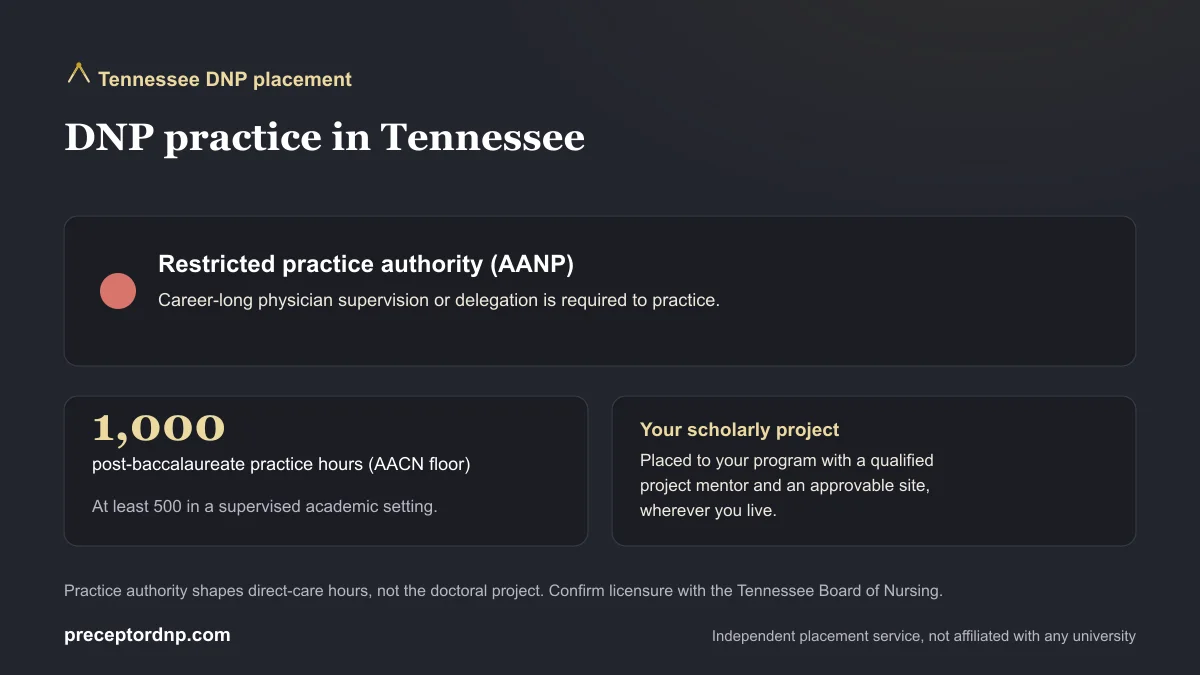
AACN guidance requires at least 1,000 supervised post-baccalaureate practice hours, with at least 500 hours completed in a supervised academic setting. The requirement is cumulative and the amount completed during the DNP varies by program. A post-master's student may apply qualifying prior graduate hours after review. A BSN-to-DNP student generally completes population-focus clinical preparation alongside systems, leadership, and project experiences.
Ask the program to identify the accepted prior hours, remaining competencies, required supervision, and documentation method. Tennessee opportunities may include approved direct care, project implementation, public health, quality, informatics, care coordination, emergency planning, or leadership. Do not promise a host a fixed total until the audit is complete. Use the DNP clinical-hours guide to organize questions, then obtain the program's written answer about what will count.
AANP currently categorizes Tennessee as a restricted practice state. That classification matters when supervised work includes patient assessment, diagnosis, treatment, or prescribing. A direct-care preceptor and site must meet current Tennessee requirements as well as the student's population-focus standards. Confirm licensure, supervision, and prescribing details with the Tennessee Board of Nursing rather than relying on a general placement description.
The category does not control every scholarly-project task. A quality-improvement project focused on an approved workflow, staff practice, or aggregate outcome is generally not a licensure-gated clinical rotation. Site policy, privacy, academic review, and the student's assigned role still govern the work. If a project also contains patient-care activities, list them separately and secure the clinical approvals they require.
Most online DNP programs use a self-source model, while some provide coordinator support, referrals, or a placement pledge. Verify the program's actual assistance and final approval rules. Send a concise packet with the student's pathway, improvement theme, regional preference, remaining hours, dates, weekly availability, mentor qualifications, data needs, required agreements, and approval deadline. A complete request lets a busy Tennessee leader assess feasibility without guessing.
PreceptorDNP independently serves students at any university. We can research appropriate Tennessee settings, approach project mentors or population-matched preceptors, and help move approved documents between the parties, but we cannot guarantee acceptance or academic approval. Read how placement works, then share the verified requirements through the match form or contact us.
Choose the region that contains the population, workflow, and measures your project needs. Metro systems may offer formal quality teams, while Appalachian, Plateau, or Delta settings may offer focused access and rural priorities. The host's capacity and program approval matter more than the size of the market.
No. A project mentor guides implementation and evaluation inside the organization. A clinical preceptor supervises direct care in the student's population focus. The program may approve separate people, or one person for both roles when all credentials and duties fit.
No fixed new total applies to every student. DNP preparation includes at least 1,000 supervised post-baccalaureate hours cumulatively and the exact total varies by program. Qualifying prior graduate hours may count after formal review, so request an hour audit before site outreach.
Not by itself. Restricted practice rules govern nurse practitioner patient care. An approved systems or quality-improvement project usually follows organizational and academic review instead, although any direct-care activity inside it must meet current state and program requirements.
Sources · last updated July 2026
AACN CCNE DNP Programs and Accreditation FAQs · AANP: Tennessee practice profile · Tennessee Board of Nursing · Tennessee Primary Care Association · Rural Health Information Hub: Tennessee
No cost to request, and nothing is billed until a match is confirmed and your school signs off. We'll reply within one business day.
We do not guarantee placement. Final approval rests with your program.
