Texas has enough project settings to make an unfocused search inefficient. A DNP student should first choose a realistic service area, identify the type of practice change a host can support, and arrive with a verified hour gap and mentor criteria rather than asking an entire state for a generic preceptor.
Houston, Dallas and Fort Worth, Austin, and San Antonio hold the largest concentrations of tertiary hospitals, specialty services, quality teams, and nurse executives. El Paso, the Rio Grande Valley, Corpus Christi, Tyler, Beaumont, Lubbock, and Amarillo anchor very different regional networks. A student who defines a county cluster, travel radius, and target population can approach the right operational leaders instead of sending the same request to unrelated systems.
Border communities, Panhandle towns, West Texas, and rural East Texas may rely on critical-access hospitals, federally qualified health centers, local public health, and telehealth connections. Those settings can support work in maternal access, emergency transfers, heat preparedness, diabetes follow-up, behavioral-health referral, or chronic-disease outreach. Use measures the site already collects and plan around real staffing and travel limits. A rural need does not guarantee that an organization has capacity to host a student.
The DNP scholarly project is a practice-change effort, not a collection of master's-level NP shifts. A strong Texas site can name a gap, authorize an intervention, assign an operational sponsor, and permit evaluation. The project might improve a referral loop, standardize infection-prevention practice, strengthen discharge follow-up, or test a screening workflow. It should be narrow enough for one unit, clinic, service line, or community program to implement and sustain.
Ask about data access before finalizing the question. The host should identify the baseline, process measure, outcome measure, and person who owns each data source. It should also explain whether the proposal follows quality, evidence, privacy, compliance, or research review. Keep publication and record-access assumptions out of the initial request. Program approval and a willing mentor do not replace the Texas organization's authority over its patients, staff, information, or workflow.
The best project mentor is often the person who can convene staff, solve access problems, and keep the intervention on the operational calendar. Program rules may allow a DNP-prepared nurse, physician, nurse executive, quality leader, or health-system administrator. In a large metro system, a service-line or quality leader may fit. In a community health center or rural hospital, a clinical director or executive may have better day-to-day reach.
Direct-care hours require a separate competency match. A board-certified nurse practitioner or physician should practice with the population and services required by the student's track. One mentor may also qualify as the clinical preceptor, but the program must approve both functions. Confirm degrees, licenses, experience, meeting cadence, data permissions, evaluation duties, and hour-verification responsibilities before asking the site to sign an agreement.
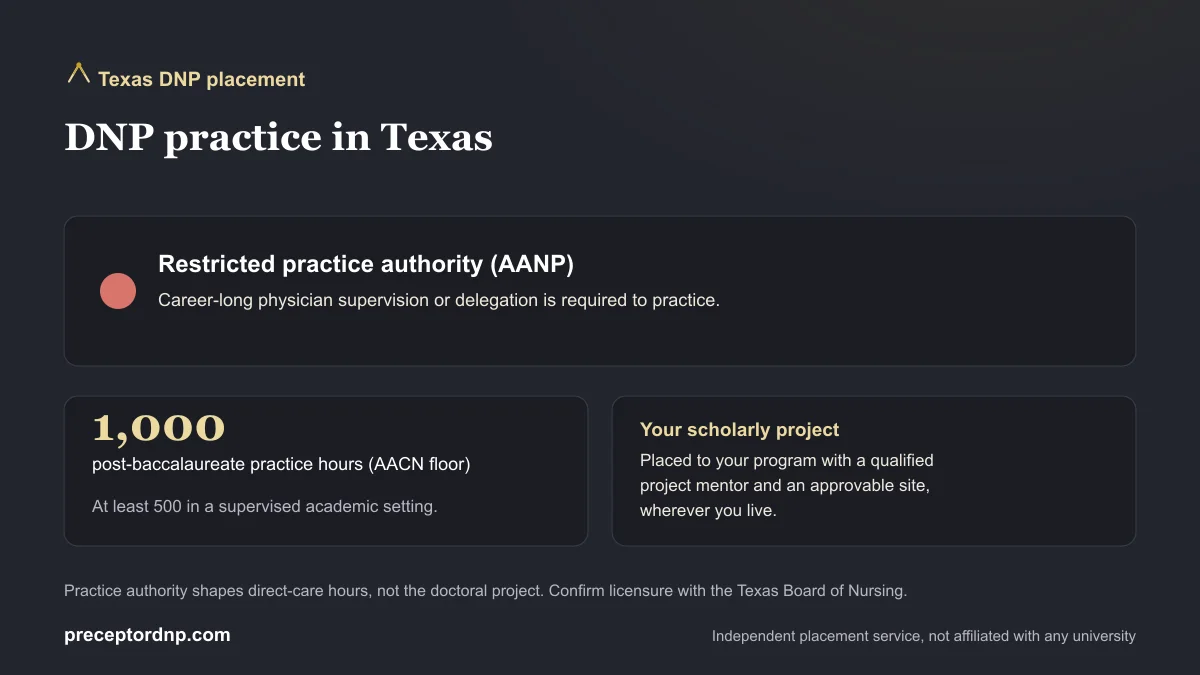
AACN guidance sets at least 1,000 supervised post-baccalaureate practice hours, including at least 500 hours in a supervised academic setting. This is a cumulative expectation and the doctoral-level remainder varies by program. A post-master's student may bring qualifying prior graduate hours for program review. A BSN-to-DNP student generally completes population-focus clinical work while building systems, leadership, and scholarly-project competencies.
Do not quote a Texas site an assumed total. Obtain a written review showing accepted hours, remaining categories, required credentials, and documentation rules. Approved experiences may include direct care, quality improvement, population health, informatics, emergency planning, care management, and leadership, but the program decides what satisfies each outcome. Keep a prospective activity log and compare it with the DNP clinical-hours guide before outreach.
AANP currently categorizes Texas as a restricted practice state. That category is relevant to supervised patient care, including assessment, diagnosis, treatment, and prescribing. A clinical placement must satisfy current Texas Board of Nursing requirements and the student's population-focus standards. Verify the preceptor's license and practice arrangement directly rather than assuming that a facility badge or program form resolves state scope questions.
A DNP quality-improvement project generally follows a different route. Changing an approved workflow, educating staff, or evaluating permitted aggregate outcomes is not automatically a licensure-gated clinical rotation. The student remains bound by the assigned role, privacy rules, and organizational review. If patient-care tasks are included, identify them separately and secure a qualified clinical preceptor and all required approvals for that part of the plan.
Many online programs ask DNP students to self-source project sites and mentors, while some provide coordinators, referrals, or a placement-assistance commitment. Confirm the actual model. A Texas request should state the pathway, service area, practice problem, target population, remaining hours, weekly availability, mentor requirements, data needs, affiliation documents, and approval deadline. Large systems may centralize student review, while smaller hosts may need time to identify an internal sponsor.
PreceptorDNP is independent, works with students at any university, and cannot guarantee a host or a program decision. We can research settings that fit the Texas region and project, approach project mentors or population-matched clinical preceptors, and assist with the document handoff. Review our placement process, then submit confirmed requirements through the match form or contact the placement desk.
Yes, when the center identifies an improvement priority, permits implementation and measurement, assigns an approved mentor, and has capacity for the required review. Access, referral, screening, and chronic-disease workflows can be suitable, but the project must fit the center's own operations.
Confirm authority over the workflow, access to the proposed measures, program-approved credentials, meeting availability, evaluation duties, and the site's review route. Interest in the topic is helpful, but it is not enough if the person cannot authorize change or data use.
No. The category governs nurse practitioner patient care. A quality-improvement project focused on an organizational process is generally reviewed through academic and site channels. Any assessment, diagnosis, treatment, or prescribing inside the experience must still follow current Texas rules.
Only the student's program can set that number. The cumulative expectation is at least 1,000 supervised post-baccalaureate hours and the exact total varies by program, with qualifying prior graduate hours subject to review. Obtain the written gap before proposing dates to a host.
Sources · last updated July 2026
AACN CCNE DNP Programs and Accreditation FAQs · AANP: Texas practice profile · Texas Board of Nursing · Texas Board of Nursing: APRN scope of practice · Texas Department of State Health Services: Federally qualified health centers · Texas Department of State Health Services: Shortage designations
No cost to request, and nothing is billed until a match is confirmed and your school signs off. We'll reply within one business day.
We do not guarantee placement. Final approval rests with your program.
