Utah DNP projects succeed when the host has a current improvement priority and the mentor can move work through that organization. The Wasatch Front offers concentrated system resources, while southern, eastern, and frontier communities require a smaller scope, a realistic travel plan, and measures that local teams can maintain.
A Utah scholarly project should implement and evaluate a practice change, not simply observe care or collect clinical shifts. Possible questions include care transitions, maternal access, behavioral-health referral, infection prevention, chronic-disease follow-up, heat response, or telehealth continuity. The useful question is the one a site already recognizes, can authorize, and can measure. One defined clinic, unit, pathway, or community program is usually more feasible than a statewide aim.
Before proposing an intervention, ask who owns the current workflow and which data can be used. The site should confirm the target population, baseline, measures, staff burden, privacy route, and internal review. Some organizations distinguish quality improvement from research through a formal process. Keep the idea adjustable until both the host and program approve it, and do not count project activity during unresolved affiliation, compliance, or evidence review.
Salt Lake City, Ogden, and Provo form the main Wasatch Front corridor, where Intermountain Health, MountainStar Healthcare, CommonSpirit Holy Cross hospitals, community health centers, and local health departments provide varied improvement infrastructure. St. George, Logan, Cedar City, Vernal, Price, and Moab serve large surrounding areas. Urban systems may offer analysts and formal quality teams, but centralized student review can add time and competition for mentors.
Southern, eastern, and frontier counties often depend on smaller hospitals, rural clinics, public health, long-term care, and telehealth connections. A strong project there uses existing measures and does not assume a large research office or extra staff. Define travel, weather alternatives, remote meetings, and onsite activity before the calendar is approved. Telehealth can support a project, but the program and site decide whether any supervised activity may occur remotely.
For project work, the mentor needs both relevant expertise and access to the people who will implement the change. Program criteria may allow a DNP-prepared nurse, physician, nurse executive, clinical director, quality leader, or health-system administrator. Ask whether the person can convene staff, secure measures, approve practical adjustments, and meet throughout implementation and evaluation. A prestigious title is less useful than dependable operational reach.
For population-focus direct care, the program usually needs a board-certified nurse practitioner or physician whose practice matches the student's track. These can be separate people. If one Utah professional is proposed for both roles, document the credentials and activities for each and seek explicit approval. Also clarify who signs hour records, who handles site agreements, and whether the practice mentor and academic adviser have different responsibilities.
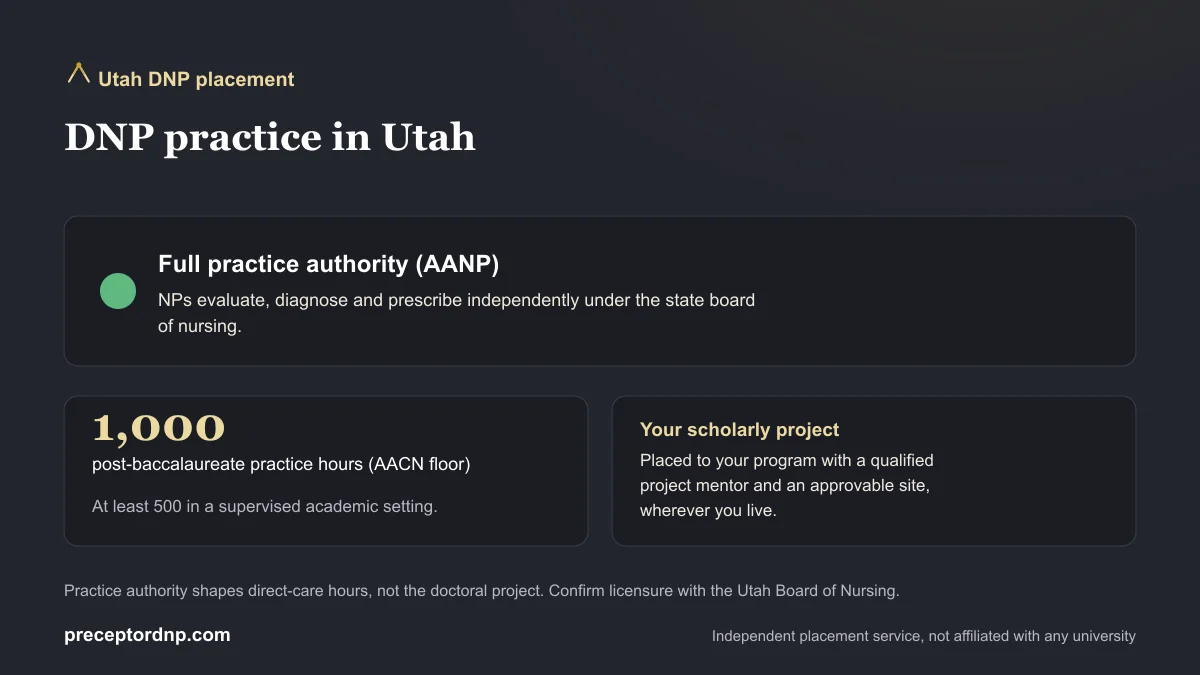
AACN guidance calls for at least 1,000 supervised post-baccalaureate practice hours, with at least 500 hours in a supervised academic setting. The total is cumulative and the doctoral balance varies by program. A post-master's DNP student may apply qualifying prior graduate hours after review. A BSN-to-DNP student commonly completes population-focus clinical preparation together with systems, leadership, and scholarly-project work.
Request a written hour audit before selecting a Utah site. It should identify accepted hours, open competencies, direct-care needs, mentor requirements, and logging rules. Approved experience may occur in hospitals, ambulatory networks, rural clinics, public health, long-term care, quality, informatics, care coordination, or leadership. Location alone never determines whether an activity counts. Use the cumulative DNP hours overview, then confirm the final plan with the program.
AANP currently categorizes Utah as a full practice state. This affects nurse practitioner direct care and can support clinical experiences when the preceptor's active license, population focus, and setting fit the program. Full practice does not make a student autonomous and does not waive supervision, facility credentialing, or program approval. Confirm current licensure details with the Utah Division of Professional Licensing.
A DNP quality-improvement project that changes an authorized process without independent patient care is generally not a licensure-gated clinical rotation. That work still follows academic, organizational, privacy, and evidence-review requirements. If the student will assess, diagnose, treat, or prescribe as part of the experience, separate those direct-care tasks and approve them with the properly licensed clinical preceptor.
Many online DNP programs expect students to self-source, while some provide coordinator assistance, referrals, or a placement-support process. Verify the actual level of help and who makes the final decision. A Utah packet should include the pathway, improvement theme, preferred region, remaining hours, dates, mentor criteria, data needs, remote-work assumptions, and every program form. Ask a large system whether review is centralized and a small site who has signature authority.
PreceptorDNP is independent and serves students at any university. We can identify plausible Utah project settings, contact mentors or population-matched clinical preceptors, and support document exchange, but we cannot guarantee participation or program approval. Review how the service works, then send confirmed requirements through the match form or contact our placement desk.
Yes, if the clinic identifies a useful problem, can support a bounded intervention, permits measurement, and has an approved mentor with time to guide the work. Use existing data and staffing rather than designing a project that depends on infrastructure the clinic does not have.
Not usually. The project mentor needs authority over implementation, while the clinical preceptor needs a licensed, population-matched practice. A program may approve two people, or one person whose qualifications and duties satisfy both sets of requirements.
Not automatically. The minimum is at least 1,000 supervised post-baccalaureate hours cumulatively and the exact total varies by program. A post-master's student may receive credit for qualifying prior graduate practice after formal review. Confirm the remaining balance and location rules in writing.
It chiefly affects nurse practitioner direct care. A systems or quality-improvement project generally proceeds through host and academic review instead of NP practice authority alone. Any patient-care activity still requires current licensure, appropriate supervision, and program approval.
No cost to request, and nothing is billed until a match is confirmed and your school signs off. We'll reply within one business day.
We do not guarantee placement. Final approval rests with your program.
