Vermont's compact size does not make every DNP placement interchangeable. Burlington has the deepest specialty and improvement resources, while regional hospitals, community health centers, home-health programs, long-term care, and public health offer close operational access when the project fits a small team's capacity.
Burlington and Chittenden County form Vermont's principal referral hub. Rutland, Bennington, Brattleboro, Barre and Montpelier, St. Johnsbury, Newport, and Middlebury anchor smaller regional networks. Rutland Regional Medical Center, Southwestern Vermont Medical Center, Brattleboro Memorial Hospital, North Country Hospital, Gifford Health Care, community health centers, and state public-health programs illustrate possible settings. The important question is who owns the relevant workflow, not which name looks largest.
The Northeast Kingdom, southern mountain towns, and communities away from the main interstate corridors often rely on critical-access hospitals, primary-care networks, home health, and local public health. Staff may cover several roles and have little extra analytic capacity. A student should choose simple measures, limit meeting burden, and build travel and remote communication into the plan. Connected networks help referrals, but they do not create one statewide student-approval process.
A Vermont DNP scholarly project should change and evaluate practice in a real setting. Older-adult safety, care transitions, behavioral-health access, chronic-disease follow-up, infection prevention, rural referrals, and home-based care can all support doctoral work when the host identifies the need. Avoid a broad intervention that requires new software, extra staff, or data the organization cannot release. One durable workflow change is more useful than an ambitious plan the team cannot continue.
Prepare a brief that names the population, present process, proposed intervention, available measures, data owner, staff effort, and implementation dates. Ask how the host classifies quality improvement and whether privacy, compliance, leadership, or research review applies. Keep the aim provisional until the organization and program approve it. A site conversation or mentor signature does not authorize data collection, practice change, or counting hours.
In a small Vermont organization, the mentor may connect clinical, quality, and administrative work that larger systems assign to separate departments. Program requirements may permit a DNP-prepared nurse, physician, nurse executive, clinical director, or other health-system leader. The right person can reach the staff, measures, and decision makers the intervention requires. Confirm degree expectations, experience, meeting frequency, evaluation duties, and who can approve changes to scope.
Direct-care precepting remains a separate competency question. A board-certified nurse practitioner or physician should practice with the population required by the student's track. One person may cover both project and clinical roles only when the program approves each. If the project mentor is operationally strong but lacks the needed population-focus practice, use a second preceptor rather than forcing one relationship to satisfy unrelated requirements.
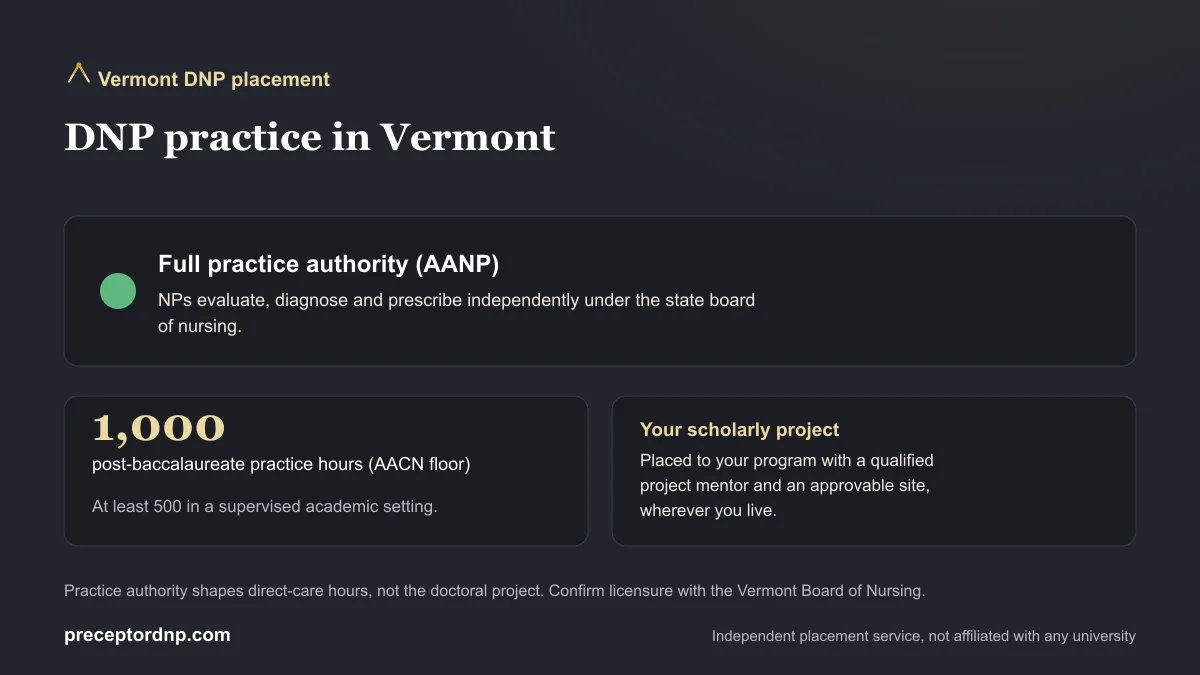
AACN guidance requires at least 1,000 supervised post-baccalaureate practice hours, including at least 500 hours in a supervised academic setting. The total is cumulative and the DNP-level balance varies by program. A post-master's student may receive credit for qualifying prior graduate hours after review. A BSN-to-DNP student typically completes population-focus clinical work alongside systems, leadership, and scholarly-project practice.
Vermont students may need more than one setting to meet different outcomes. Direct care might occur in a regional clinic, while project implementation sits with home health, long-term care, public health, or a hospital quality team. Obtain a written audit of accepted hours, remaining categories, supervision, and logging rules before asking sites to coordinate. Review how cumulative DNP hours work, then confirm every planned activity with the program.
AANP currently lists Vermont as a full practice state. Board requirements may still include transition details for some newer practitioners, so the category should not be treated as a substitute for an individual license check. For direct-care hours, confirm the preceptor's current authority, population focus, and setting with the Vermont State Board of Nursing and with the student's program.
Full practice status does not approve a doctoral project. Workflow mapping, staff education, implementation, and review of authorized aggregate outcomes generally proceed through the host's project, privacy, and operational rules. A quality-improvement project is not automatically a licensure-gated clinical rotation. When the student also performs patient-care tasks, define those tasks separately and approve the clinical supervision they require.
Many online DNP programs expect students to self-source mentors and sites, while some provide coordinators, referrals, or placement assistance. Ask exactly what the program will do and what remains the student's responsibility. A Vermont request should include the pathway, project area, remaining hours, target region, dates, onsite needs, mentor criteria, data expectations, required agreements, and approval deadline. Make the requested staff time visible.
PreceptorDNP independently assists students at any university and does not guarantee acceptance or academic approval. We can research feasible Vermont settings, approach project mentors or population-matched clinical preceptors, and support the paperwork handoff. Read how placement works, then share confirmed requirements through the match form or contact the desk.
No. Burlington offers concentrated specialty and improvement resources, but regional hospitals, community health centers, public-health teams, home-health programs, and long-term care organizations can support strong projects when the question and measures fit local capacity.
Potentially. The program must own a relevant improvement need, permit implementation and measurement, assign a qualified mentor, and complete organizational and academic review. Care transitions, safety, and follow-up workflows may fit if data and staff time are available.
Not automatically. The program reviews prior supervised graduate practice and decides what applies toward at least 1,000 cumulative post-baccalaureate hours. The exact total varies by program, so request a written gap analysis before arranging the remaining experiences.
Only when the site and program approve the arrangement and the mentor can still guide implementation, reach staff, and verify work. Remote meetings may help with distance, but they do not automatically replace required onsite or directly supervised activity.
No cost to request, and nothing is billed until a match is confirmed and your school signs off. We'll reply within one business day.
We do not guarantee placement. Final approval rests with your program.
