Virginia's placement map changes sharply from Northern Virginia and Richmond to Hampton Roads, the Shenandoah Valley, Southwest Virginia, and the Eastern Shore. DNP students do best when they choose a corridor, define the doctoral project separately from direct care, and identify a mentor who can act inside the proposed setting.
Northern Virginia, Richmond, and Hampton Roads contain dense hospital and specialty networks. Roanoke, Charlottesville, Lynchburg, Winchester, Harrisonburg, and the Tri-Cities anchor regional care, while Southwest Virginia, Southside, and the Eastern Shore face different travel and access conditions. Inova, Sentara Health, Carilion Clinic, Bon Secours, Riverside Health System, Valley Health, community health centers, and local health departments illustrate possible project environments without promising access to any organization.
Urban systems may offer quality analysts, nursing-research support, and formal evidence review, but they also centralize student onboarding. Rural hospitals, public-health teams, and clinics may offer a clearly owned problem with fewer layers, yet smaller staff and data limits. Define the population, travel radius, onsite expectations, and timeline first. Telehealth can support rural work, but the site and program decide whether remote activity satisfies supervision and project requirements.
The DNP scholarly project should implement an evidence-based change and evaluate it in practice. A Virginia host might support work on care transitions, maternal access, behavioral-health referral, infection prevention, rural emergency transfer, older-adult safety, or chronic-disease follow-up. The proposal needs a defined population, feasible intervention, baseline, measures, and a leader who owns the affected workflow. Routine clinical shifts or observation are not a substitute for the practice-change cycle.
Ask the organization how it distinguishes quality improvement, evidence-based practice, and research. Identify who can approve staff education, workflow changes, record access, and use of aggregate outcomes. Keep the project question adjustable until those answers are known. Neither a verbal invitation nor program interest authorizes implementation, and a student should not promise publication, access to protected data, or a result the site cannot guarantee.
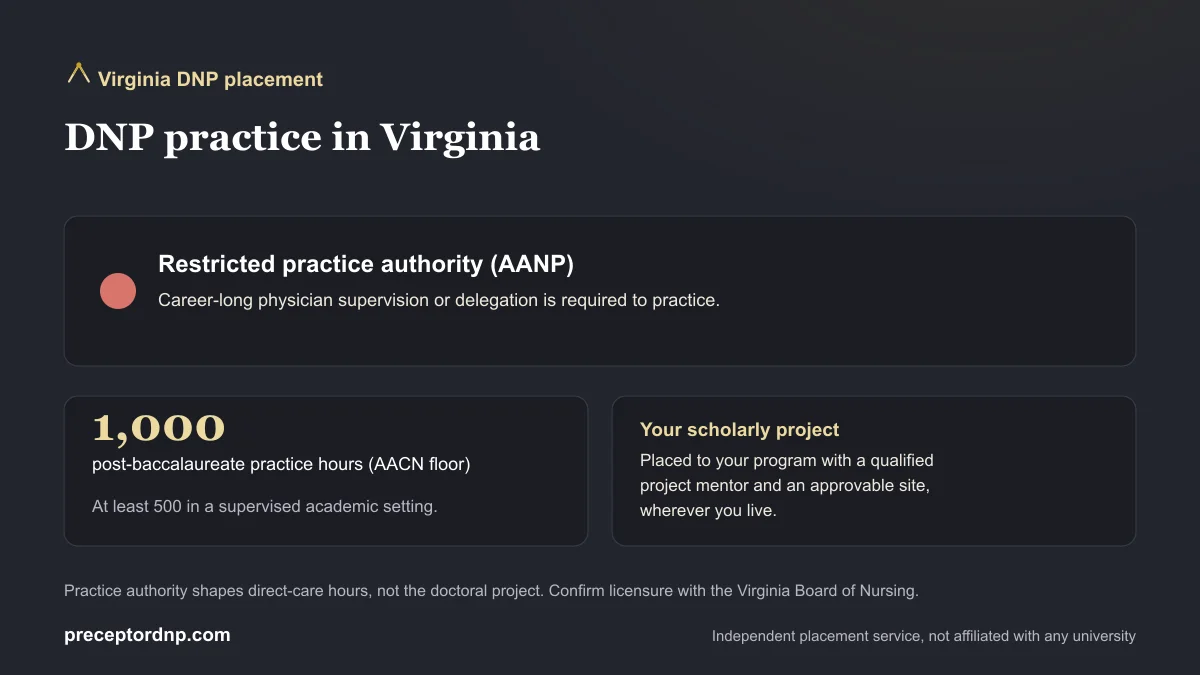
AACN guidance calls for at least 1,000 supervised post-baccalaureate practice hours, with at least 500 hours completed in a supervised academic setting. The total is cumulative and the DNP-level amount varies by program. A post-master's DNP student may apply qualifying prior graduate hours after the program verifies them. A BSN-to-DNP student usually completes population-focus clinical work while also developing systems, leadership, and project competencies.
Request a formal audit of accepted hours, remaining outcomes, direct-care needs, and documentation rules before contacting Virginia hosts. The clinical plan may require a population-matched setting, while project work may sit with quality, public health, informatics, care coordination, or leadership. Do not assume the same site can cover both. Use the DNP practice-hour guide to prepare questions, then rely on the program's written determination.
A project mentor should have enough organizational reach to support implementation. Depending on program rules, a DNP-prepared nurse, physician, nurse executive, quality leader, public-health director, or health-system administrator may qualify. In a large system, clarify whether the proposed mentor can actually secure staff time and data. In a rural setting, choose someone close enough to daily operations to keep the intervention moving despite limited formal improvement support.
A direct-care preceptor serves a different purpose and usually must be a board-certified nurse practitioner or physician in the student's population focus. Programs may approve separate people or one person who satisfies both roles. Confirm credentials, licensure, experience, meeting frequency, data access, evaluation duties, and who signs each type of hour. Site sponsorship and clinical supervision should never be treated as interchangeable without approval.
AANP currently categorizes Virginia as a restricted practice state. Virginia has pathways and requirements that can differ by practitioner, so direct-care placements need an individual review rather than a broad assumption. Confirm the preceptor's current license, authority, population focus, and practice arrangement with the Virginia Board of Nursing and the student's program before supervised patient care begins.
That category is not the approval framework for the scholarly project as a whole. An authorized quality-improvement project that changes a process or reviews permitted aggregate outcomes is generally not a licensure-gated clinical rotation. It still follows academic, privacy, operational, and evidence-review rules. List any assessment, diagnosis, treatment, or prescribing activities separately and secure the clinical approvals they require.
Many online DNP programs ask students to self-source a project site, mentor, or clinical preceptor, while some provide coordination, referrals, or placement support. Verify the exact model. A Virginia packet should include the pathway, target corridor, project theme, remaining hours, dates, mentor criteria, data needs, onsite expectations, and all affiliation and evaluation forms. Ask whether a health system reviews students centrally or the individual site can decide.
PreceptorDNP independently serves students at any university. We can research plausible Virginia hosts, approach qualified project mentors or population-matched clinical preceptors, and help with the document handoff, but we cannot guarantee participation or academic approval. Review how matching works, then submit confirmed requirements through the match form or contact our team.
Usually not. Start with the population, travel range, and type of infrastructure the project needs, then select a corridor. Northern Virginia, Richmond, Hampton Roads, regional cities, and rural areas have different review processes, data resources, and mentor capacity.
It can when the agency has an improvement priority, permits implementation and measurement, assigns a program-approved mentor, and completes its own review. Population-health, referral, preparedness, and prevention workflows may fit, but the local agency controls feasibility and data use.
No. The program evaluates qualifying prior supervised graduate hours and determines what remains toward at least 1,000 cumulative post-baccalaureate hours. The exact total varies by program, so obtain the decision before proposing a project or clinical calendar.
It mainly affects nurse practitioner direct care. A quality-improvement project focused on workflow or systems change generally follows site and academic review instead. Any patient-care activity must still comply with current Virginia licensure rules and the approved population focus.
Sources · last updated July 2026
AACN CCNE DNP Programs and Accreditation FAQs · AANP: Virginia practice profile · Virginia Board of Nursing: Advanced practice registered nurses · Code of Virginia: Nurse practitioner licensure and practice · Virginia Community Healthcare Association · Inova: About the Northern Virginia system
No cost to request, and nothing is billed until a match is confirmed and your school signs off. We'll reply within one business day.
We do not guarantee placement. Final approval rests with your program.
