Washington DNP students can choose among large Puget Sound systems, regional networks east of the Cascades, community health centers, public-health agencies, tribal services, and rural hospitals. The workable placement is not simply the nearest site; it is the setting that owns the problem, can approve a practice change, and has the right mentor and measures.
Seattle, Tacoma, Everett, Bellevue, and Olympia form the densest hospital and specialty corridor. Providence Swedish, MultiCare, Virginia Mason Franciscan Health, EvergreenHealth, and other regional systems may offer quality, safety, nursing-leadership, and population-health teams. Spokane anchors eastern Washington, while Vancouver, the Tri-Cities, Yakima, Wenatchee, and Bellingham serve distinct regional markets. Each system has its own affiliation and student-review route.
Central agricultural counties, the Olympic Peninsula, island communities, and remote eastern areas often rely on rural hospitals, public health, community clinics, and telehealth. Tribal health settings add sovereign governance and community-specific approval. A student should plan travel across mountains or water, seasonal disruption, onsite expectations, and remote meetings before seeking a signature. No geographic label determines whether the program will count an activity.
The Washington DNP scholarly project should implement and evaluate a practice change. Care transitions, behavioral-health access, maternal health, wildfire and heat response, infection prevention, rural referrals, and chronic-disease outreach may all fit when a host identifies the gap. A promising setting can authorize an intervention, provide an operational sponsor, and release appropriate process or outcome measures. Observation and routine clinical encounters do not replace this project cycle.
Begin with the data the site can lawfully and practically use. Ask who owns the registry, dashboard, audit, or workflow record, what baseline is available, and how often a measure can be reviewed. The host should classify the work under its quality, evidence, privacy, or research process. Keep the project narrow enough for one unit, clinic, program, or community team, and leave the intervention adjustable until local and academic review are complete.
Project mentorship requires more than subject knowledge. Depending on program criteria, a DNP-prepared nurse, physician, nurse executive, quality leader, public-health director, or health-system administrator may qualify. The person should be able to reach staff, approve practical changes, address data barriers, and remain involved through implementation and evaluation. In a rural or tribal setting, local trust and governance knowledge may be essential to that role.
Direct-care supervision is a separate match. A board-certified nurse practitioner or physician should serve the required population and practice in a setting that fits the student's focus. One Washington professional may fill both roles only after program approval of the separate duties. Confirm credentials, active licensure, meeting frequency, data access, evaluation responsibilities, and who can verify each kind of hour before finalizing the relationship.
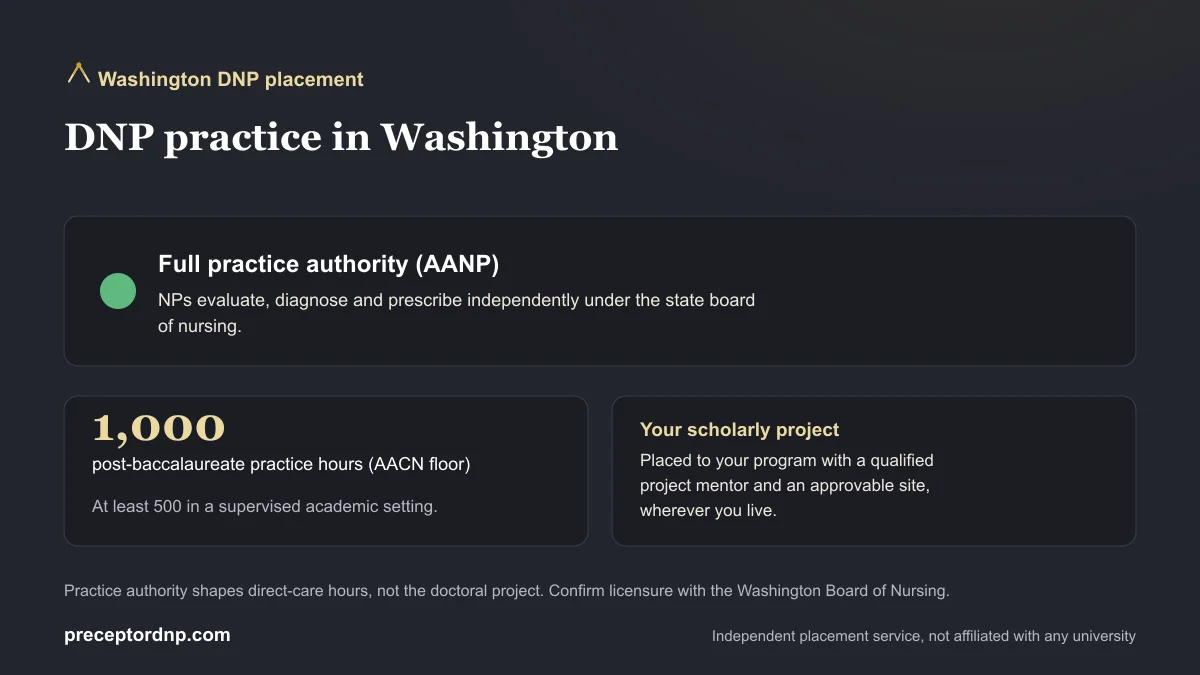
AACN guidance requires at least 1,000 supervised post-baccalaureate practice hours, with at least 500 hours completed in a supervised academic setting. The requirement is cumulative and the balance completed during the DNP varies by program. A post-master's student may apply qualifying prior graduate hours after verification. A BSN-to-DNP student generally develops population-focus clinical skill alongside systems, leadership, and project practice.
Washington students may use different settings for direct care, project implementation, public health, quality, informatics, or leadership. Request a written audit that states accepted hours, remaining competencies, required supervision, remote-activity limits, and logging rules. Do not ask a host to cover an assumed number. Review the cumulative DNP hour framework, then obtain program approval for the specific activities and locations.
AANP currently categorizes Washington as a full practice state. That classification supports nurse practitioner direct-care planning, but it does not make a student independent or remove program, facility, or supervision requirements. Verify the proposed preceptor's current ARNP license, population focus, and practice with the Washington State Board of Nursing before clinical activity begins.
A quality-improvement project that changes an approved workflow or evaluates permitted aggregate data is generally not a licensure-gated clinical rotation. It remains subject to organizational, privacy, community, and academic review. When project work includes assessment, diagnosis, treatment, or prescribing, label those direct-care tasks separately and confirm the proper clinical supervision and scope for each.
Many online DNP programs expect students to self-source sites and mentors, while some provide coordinator help, referrals, or placement support. Verify which model applies. A Washington packet should state the pathway, target region, improvement question, remaining hours, dates, mentor criteria, data needs, travel assumptions, and required forms. For a tribal or public-health setting, ask what community or agency approvals must precede program paperwork.
PreceptorDNP is independent, serves students at any university, and cannot guarantee site participation or academic approval. We can research suitable Washington settings, approach project mentors or population-matched clinical preceptors, and assist with document exchange. Review how placement works, then send confirmed requirements through the match form or contact our desk.
Usually the project population, travel plan, and site capacity should decide. Puget Sound has dense system resources, while central and eastern settings offer different rural, agricultural, and regional priorities. Choose a workable service area rather than assuming statewide travel will solve the match.
Potentially, when the work addresses a priority identified by the tribal organization and follows its sovereign review, community-engagement, privacy, and data-governance requirements. Neither a program nor a placement service can grant access on the organization's behalf.
They may count after the program verifies that they qualify. The student must reach at least 1,000 supervised post-baccalaureate hours cumulatively, and the exact total varies by program. Ask for a written audit before planning the remaining site experiences.
No. Full practice status concerns nurse practitioner patient care. The program separately decides whether a project mentor's education, experience, role, and access fit the scholarly project, while the host decides whether the proposed work can proceed.
Sources · last updated July 2026
AACN CCNE DNP Programs and Accreditation FAQs · AANP: Washington practice profile · Washington State Board of Nursing: ARNP licensure · Washington State Department of Health: Rural health · HRSA: Washington health-center program data · MultiCare: About the Washington health system
No cost to request, and nothing is billed until a match is confirmed and your school signs off. We'll reply within one business day.
We do not guarantee placement. Final approval rests with your program.
