West Virginia's mountains, regional referral patterns, and small clinical teams shape every DNP placement decision. A useful project starts with a local care problem that the host wants to change, uses measures available to that organization, and pairs the student with a mentor who can work across clinical and operational boundaries.
Charleston, Huntington, Morgantown, Parkersburg, Wheeling, Beckley, Martinsburg, and Clarksburg act as regional hubs rather than one statewide market. Charleston Area Medical Center, Mon Health, Valley Health, Vandalia Health, community health centers, rural hospitals, and county health departments show the range of potential settings. A student should map where patients are referred, how far staff and mentors travel, and where the affected workflow is actually managed.
Coalfield counties, mountain communities, and the Potomac Highlands may depend on critical-access hospitals, community clinics, public health, home health, and telehealth connections. Projects there can address substance-use care, diabetes follow-up, maternal access, emergency transfer, infection prevention, older-adult safety, or care transitions. The proposal should work with the site's staffing and existing measures rather than import a large-system design that cannot be sustained.
The DNP scholarly project should implement a practice change and evaluate its effect. A feasible West Virginia project might standardize referral follow-up, revise a discharge process, improve medication reconciliation, strengthen a screening pathway, or test a rural transfer checklist. Limit the scope to a defined unit, clinic, program, or population. A literature review or ordinary sequence of NP clinical shifts does not provide the same doctoral implementation experience.
Ask the host which measures it already collects and who controls them. A simple audit, registry field, referral log, or aggregate outcome may be more realistic than a new data system. Clarify how the organization distinguishes quality improvement from research and which privacy, compliance, or leadership reviews apply. Do not begin implementation or log hours until the site and program approve the population, intervention, measures, and calendar.
A project mentor needs authority close to the work. Depending on program rules, a DNP-prepared nurse, physician, nurse executive, clinical director, quality leader, or health-system administrator may qualify. In a smaller organization, the right mentor may carry several responsibilities and can connect the student directly with staff and data owners. Confirm the required degree, relevant experience, meeting cadence, evaluation duties, and authority to adjust the intervention.
Direct-care preceptors are matched differently. A board-certified nurse practitioner or physician should practice with the patient population and services required by the student's focus. The project mentor and clinical preceptor may be separate, especially when the project sits with leadership or public health. If one person is proposed for both roles, the program should approve the credentials, activities, supervision, and hour verification for each.
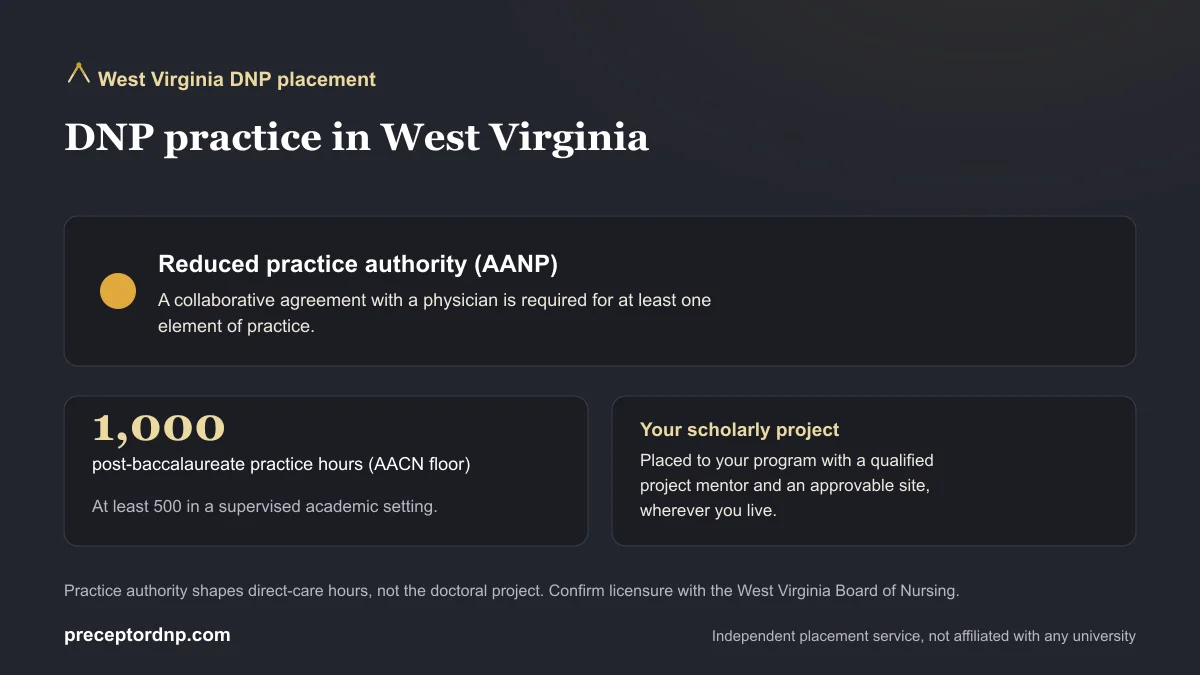
AACN guidance requires at least 1,000 supervised post-baccalaureate practice hours, including at least 500 hours in a supervised academic setting. The minimum is cumulative and the balance at the DNP level varies by program. A post-master's student may apply qualifying prior graduate hours after verification. A BSN-to-DNP student generally completes population-focus clinical work together with systems, leadership, and scholarly-project experiences.
Ask for a written gap analysis before committing to travel or a rural schedule. It should identify accepted hours, remaining competencies, population-focus needs, mentor criteria, and logging rules. West Virginia experiences may include direct care, quality, public health, informatics, care coordination, emergency planning, and leadership, but the program decides what counts. Review the DNP hour framework and keep project milestones separate from the hour ledger.
AANP currently categorizes West Virginia as a reduced practice state. The details can differ by practitioner and activity, so a direct-care plan requires an individual license and scope review. Confirm the proposed preceptor's current authority, population focus, and any practice requirements with the West Virginia Board of Registered Nurses and the student's program.
Reduced practice status is not the main gate for every quality-improvement project. Workflow mapping, staff education, process testing, and review of authorized aggregate data usually proceed under organizational, privacy, and academic rules. A scholarly project is generally not a licensure-gated clinical rotation. Separate any patient assessment, diagnosis, treatment, or prescribing from project activity and approve it with the correct clinical supervision.
Many online DNP programs expect students to self-source a site or mentor, while some provide coordination, referrals, or placement help. Verify the actual support. A West Virginia packet should include the pathway, project theme, target region, travel radius, remaining hours, dates, mentor criteria, data needs, remote-work plan, and all program forms. It should state which details remain provisional until local review.
PreceptorDNP independently works with students at any university and cannot guarantee host participation or academic approval. We can research possible West Virginia settings, approach project mentors or population-matched clinical preceptors, and assist with the document handoff. Review our process, then send verified requirements through the match form or contact the placement desk.
Yes, when the hospital has a defined improvement need, usable measures, an approved mentor, and enough staff capacity for implementation. Keep the intervention focused and avoid relying on analytics or personnel the hospital does not have.
The person should meet program credential standards and have practical access to staff, data, and decision makers. A mentor who can authorize changes and solve operational barriers is often more useful than a distant adviser with a stronger title.
Not for every student. The expectation is at least 1,000 supervised post-baccalaureate hours cumulatively and the exact total varies by program. Qualifying prior supervised graduate hours may apply after formal review. Obtain the gap in writing before arranging sites.
Usually not. The category governs nurse practitioner direct care. A quality-improvement project centered on an organizational process generally follows site and academic approval instead, while any patient-care activity inside the plan must meet current state and program rules.
Sources · last updated July 2026
AACN CCNE DNP Programs and Accreditation FAQs · AANP: West Virginia practice profile · West Virginia Board of Registered Nurses · West Virginia Board of Registered Nurses: Licensing and practice forms · West Virginia Primary Care Association · Rural Health Information Hub: West Virginia
No cost to request, and nothing is billed until a match is confirmed and your school signs off. We'll reply within one business day.
We do not guarantee placement. Final approval rests with your program.
