Wisconsin combines large metro systems with integrated regional networks, community health centers, county public health, and rural hospitals. A DNP placement works when the student matches the project to the local data and decision structure, chooses mentorship for the actual work, and confirms the cumulative practice-hour gap before asking a site for time.
Milwaukee and Madison contain Wisconsin's densest specialty and improvement resources. Green Bay and the Fox Valley, La Crosse, Eau Claire, Wausau, and other regional centers support broad service areas. Advocate Aurora Health, Froedtert Health, Gundersen Health System, Marshfield Clinic Health System, Bellin Health, ThedaCare, community health centers, and local public-health agencies illustrate possible environments. A network's size does not tell a student which local team controls approval.
Northern counties, central agricultural communities, western river areas, and tribal service regions may depend on critical-access hospitals, rural clinics, county health departments, long-term care, and telehealth. Smaller organizations can support useful projects when the intervention fits their staffing and data. Define travel, onsite work, and remote mentorship early. If the proposal spans several network locations, confirm that one leader can authorize work across all of them rather than assuming system membership is enough.
The Wisconsin DNP scholarly project should implement and evaluate an evidence-based change. Suitable topics may include care transitions, older-adult safety, infection prevention, maternal care, chronic-disease follow-up, behavioral-health access, and rural referral reliability. A large system may offer dashboards but lengthy review. A smaller clinic may move closer to the workflow but have simple measures. Choose a question the host can both act on and evaluate.
Write the first proposal around one population, process, intervention, and small measure set. Ask who owns the data, how the site classifies quality improvement, and which privacy, compliance, evidence, or research review applies. Do not promise access to records or a preferred outcome. Project implementation begins only after the organization and program approve the scope, mentor, measures, and calendar, even if the idea arose from the student's current workplace.
A project mentor should be able to translate evidence, convene stakeholders, and solve operational barriers. Program criteria may allow a DNP-prepared nurse, physician, nurse executive, quality leader, clinical director, or health-system administrator. The right person in a regional network may not be the most senior executive; it is often the leader who controls the affected service and can secure measures throughout implementation.
Population-focus direct care needs a board-certified nurse practitioner or physician whose patient group and practice match the student's track. That clinical preceptor may differ from the project mentor. If one Wisconsin professional is proposed for both roles, document the qualifications and supervision plan for each. Confirm meeting frequency, active licensure, data permissions, evaluation duties, and who can verify every category of practice hours.
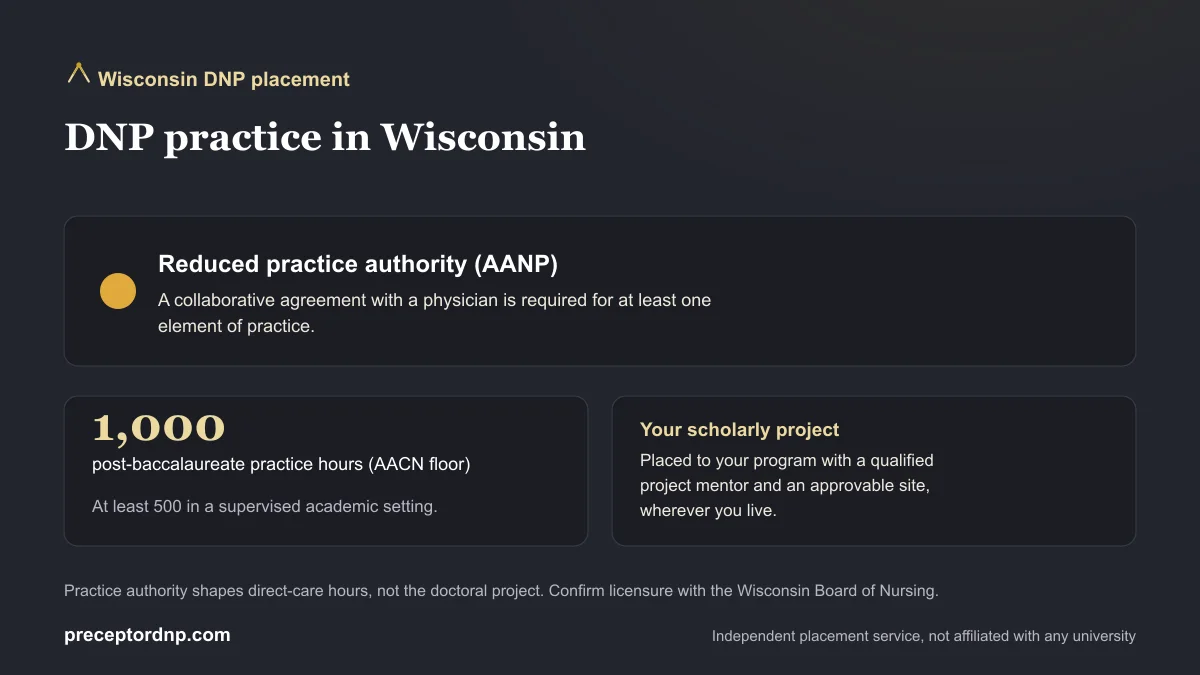
AACN guidance calls for at least 1,000 supervised post-baccalaureate practice hours, including at least 500 hours in a supervised academic setting. The total is cumulative and the doctoral remainder varies by program. A post-master's DNP student may apply qualifying prior graduate hours after program review. A BSN-to-DNP student generally completes population-focus clinical work alongside systems, leadership, and scholarly-project practice.
A Wisconsin plan may use one setting for direct care and another for quality, public health, informatics, care management, or leadership. Ask the program for a written gap analysis that identifies accepted prior hours, remaining outcomes, required credentials, and documentation rules. Site availability does not decide what counts. Organize the questions with the DNP clinical-hours guide, then obtain approval for each proposed activity before it begins.
AANP currently categorizes Wisconsin as a reduced practice state. Direct-care experiences therefore require careful review of the proposed preceptor's current license, prescriptive authority where relevant, population focus, and practice arrangement. Confirm the applicable requirements with the Wisconsin Board of Nursing and the student's program instead of relying on a general description of the facility or role.
Reduced practice status does not by itself govern an organizational quality project. An approved workflow change, staff intervention, or evaluation using permitted aggregate data is generally not a licensure-gated clinical rotation. Site policy, privacy, and academic review still apply. Separate any patient assessment, diagnosis, treatment, or prescribing from project work and secure the properly qualified clinical supervision for those tasks.
Many online DNP programs ask students to self-source mentors and sites, while some provide coordination, referrals, or placement support. Verify the exact division of responsibility. A Wisconsin packet should state the pathway, region, improvement theme, remaining hours, dates, mentor criteria, data needs, and all agreement forms. Ask an integrated network whether student approval is centralized and a community site who has authority to sign and release measures.
PreceptorDNP is independent and assists students at any university without guaranteeing a placement or program decision. We can research Wisconsin settings that fit the work, contact project mentors or population-matched clinical preceptors, and support the paperwork handoff. Review how matching works, then send the verified requirements through the match form or contact our desk.
It may, but network membership does not guarantee that each service, mentor, and activity will be approved. The program must separately confirm the project setting, direct-care population focus, credentials, supervision, and hours that count.
Choose a bounded workflow, measures the site already collects, and an intervention the current team can sustain. A focused referral, transition, screening, or safety process is often more feasible than work requiring new software, extensive analytics, or several locations.
The program reviews qualifying supervised graduate hours and decides what applies toward at least 1,000 cumulative post-baccalaureate hours. The exact total varies by program. Request a formal audit before committing to a project site or clinical schedule.
Usually not by itself. Reduced practice rules govern nurse practitioner patient care. Staff education and an approved systems change generally follow organizational and academic review, while any direct-care activity must meet current state licensure and program requirements.
No cost to request, and nothing is billed until a match is confirmed and your school signs off. We'll reply within one business day.
We do not guarantee placement. Final approval rests with your program.
