Wyoming DNP placement is a frontier planning problem as much as a mentor search. Long distances, small teams, weather, and limited formal improvement departments make a focused project, accessible local sponsor, realistic travel calendar, and verified practice-hour plan essential from the beginning.
Cheyenne, Casper, Gillette, Jackson, Rock Springs, and Laramie serve large surrounding areas with different referral patterns. Cheyenne Regional Medical Center, Banner Wyoming Medical Center, Campbell County Health, St. John's Health, Memorial Hospital of Sweetwater County, rural clinics, and county public health illustrate potential settings. A student should map where the target population receives care and where the relevant workflow is controlled before selecting a host.
Many communities depend on critical-access hospitals, small practices, public health, emergency transport, and telehealth connections across long distances. Winter conditions and mentor travel can affect implementation. Build onsite days, remote meetings, backup dates, and the location of data review into the project plan. Telehealth may support continuity, but it does not automatically satisfy a program's supervision or presence requirements.
The DNP scholarly project must move from an identified problem through intervention and evaluation. Wyoming topics might include emergency transfers, telehealth follow-up, maternal access, chronic-disease monitoring, infection prevention, older-adult safety, or rural workforce processes. A viable site can authorize a narrow change and provide measures for the full cycle. A location that offers observation but no implementation access is not the same kind of doctoral project site.
Keep the design light enough for a small team. Use an existing referral log, audit, registry, checklist, or aggregate outcome when possible. Ask how the host reviews quality improvement and whether privacy, compliance, leadership, or research review applies. The site and program must approve the population, intervention, data source, mentor, and schedule before work begins, and the proposal should include a smaller fallback if the preferred measure is unavailable.
A Wyoming project mentor should be close enough to daily operations to keep the change active. Program rules may allow a DNP-prepared nurse, physician, nurse executive, clinic director, quality leader, or health-system administrator. In a small hospital or clinic, one person may connect leadership, staff, and data. Confirm that the proposed mentor can approve practical adjustments, meet regularly, evaluate progress, and verify the required work.
For direct-care hours, a board-certified nurse practitioner or physician must practice with the population required by the student's focus. That person may not be the project mentor. If one clinician is proposed for both roles, ask the program to approve the credentials and duties separately. A remote expert may advise the project, but the primary practice mentor still needs sufficient access to the Wyoming site's workflow and measures.
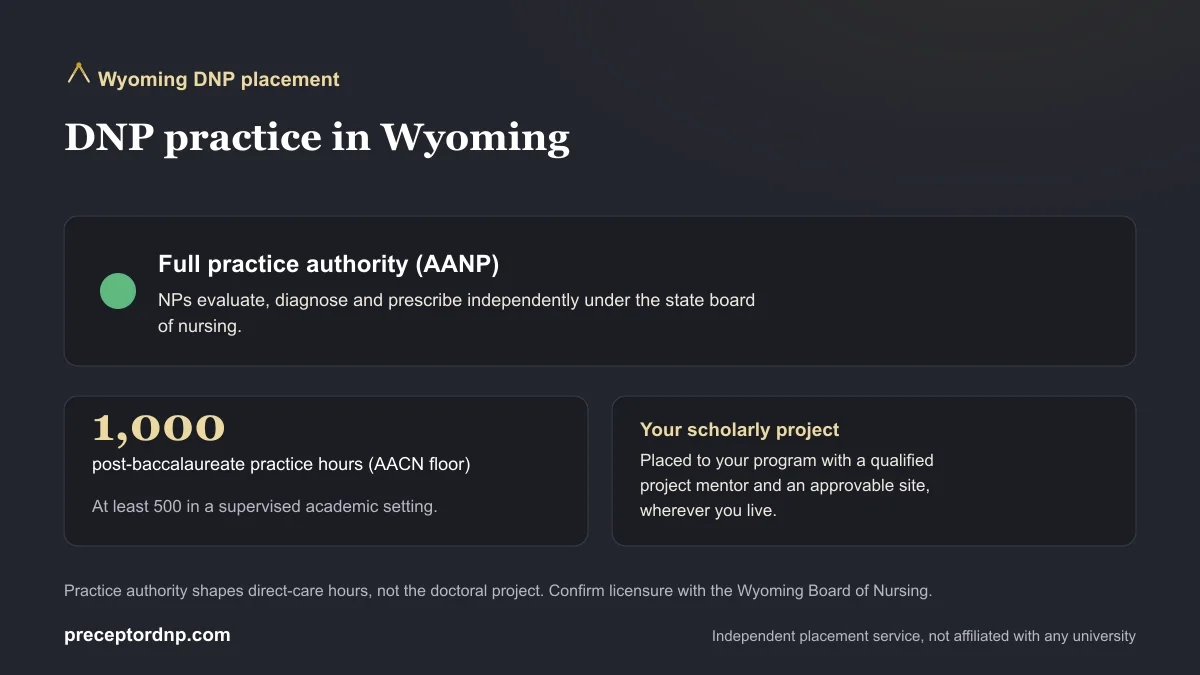
AACN guidance calls for at least 1,000 supervised post-baccalaureate practice hours, including at least 500 hours in a supervised academic setting. This is a cumulative minimum and the doctoral balance varies by program. A post-master's DNP student may apply qualifying prior graduate hours after program review. A BSN-to-DNP student usually completes population-focus clinical practice together with systems, leadership, and scholarly-project experiences.
Wyoming students may need different settings for direct care, project work, public health, quality, informatics, or leadership. Request a written audit showing accepted hours, remaining outcomes, mentor criteria, remote-activity rules, and required documentation. Do not ask one rural site to promise a total it cannot support. Review the cumulative hours framework, then confirm the exact activity plan with the program.
AANP currently categorizes Wyoming as a full practice state. This matters for nurse practitioner direct care, but students still need program-approved supervision, facility permission, and a preceptor whose active license and population focus fit the experience. Confirm current licensure and scope details with the Wyoming State Board of Nursing before a direct-care placement begins.
A quality-improvement project focused on an approved workflow or aggregate outcome is generally not a licensure-gated clinical rotation. It still follows organizational, privacy, community, and academic requirements. If the experience includes assessment, diagnosis, treatment, or prescribing, identify those activities separately and secure the appropriate licensed clinical preceptor and approvals.
Many online DNP programs use a self-source model, while some offer coordinator help, referrals, or placement assistance. Verify the support and final approval process. A Wyoming packet should state the project theme, region, travel range, remaining hours, dates, mentor criteria, onsite expectations, data needs, and program forms. Include an alternate measure or smaller intervention in case staff capacity, weather, or data access changes.
PreceptorDNP independently assists students at any university and cannot guarantee that a Wyoming organization or program will approve a match. We can research feasible settings, approach project mentors or population-matched clinical preceptors, and support document exchange. Review how matching works, then send confirmed requirements through the match form or contact our desk.
Yes, if it identifies a priority, can authorize a bounded intervention, has usable measures, and assigns an approved mentor. Design around the hospital's actual staffing and data rather than expecting the resources of a large referral system.
Only if the site and program approve the arrangement and the mentor can still reach local staff, decisions, and measures. A remote adviser can add expertise, but project implementation usually needs a sponsor with operational access at the host site.
Not necessarily. The expectation is at least 1,000 supervised post-baccalaureate hours cumulatively and the exact total varies by program. Qualifying prior graduate hours may count after formal review. Ask for the written balance before planning travel and sites.
It chiefly affects nurse practitioner direct care. An approved quality-improvement project generally follows organizational and academic review instead of licensure authority alone. Any patient-care task still requires current scope, appropriate supervision, and program approval.
No cost to request, and nothing is billed until a match is confirmed and your school signs off. We'll reply within one business day.
We do not guarantee placement. Final approval rests with your program.
