Our role for University of Maryland DNP students is specific: identify a mentor, preceptor, or practice site that fits the current requirements supplied by the student. The program reviews the proposal, and no match is represented as approved before that review is complete.
Treat this as an identity and accreditation snapshot, not as a statement of school policy. The official school website and the student's current course documents remain the sources for pathways, deadlines, hours, and placement rules.
As of the July 21, 2026 roster check, CCNE accreditation records include a DNP program at University of Maryland. Accreditation answers the inclusion question. Your current catalog and placement office must answer the separate questions about entry route, specialty, deadlines, and site approval.
Begin with the course number, term dates, required practice setting, mentor or preceptor credentials, location limits, and every form your program expects. If the course includes both a scholarly project and direct-care practice, separate those needs so each proposed person and site can be evaluated for the work they will actually supervise.
The scholarly project turns a practice question into an approved change and a measurable evaluation. That work needs more than an address. The site must offer the relevant population, operational access, and enough support to carry the project through. Hospitals, ambulatory practices, public health teams, long-term care settings, and community programs can fit when the project and program rules align.
Mentor selection follows the project, then the program's current qualification rules. Relevant experience may sit with a DNP-prepared nurse, physician, executive, quality professional, or another practice expert, yet no credential should be assumed acceptable at University of Maryland. We document the proposed mentor's role and let the program make that determination.
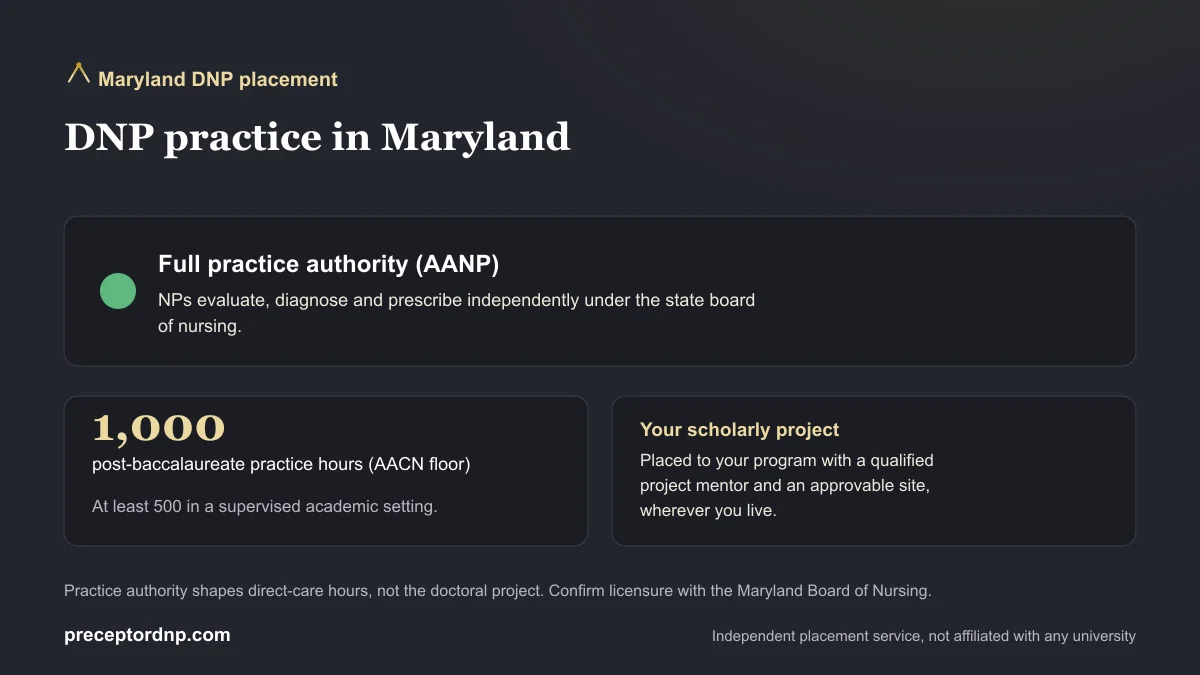
The national DNP framework starts with at least 1,000 supervised post-baccalaureate practice hours. A student's remaining hours cannot be calculated from that floor alone because programs differ on pathway design and qualifying prior master's work. Use University of Maryland's current degree audit and course plan to establish the approved balance before a search begins.
Separate the hours by purpose before selecting a person. A clinical population focus can require an eligible NP or physician, while a systems, leadership, or project experience can require a different mentor profile. Our DNP clinical hours guide covers the national framework, not an invented total for this school.
The directory places the school in Baltimore, Maryland, which gives the search a useful geographic starting point. It does not establish where a student may complete hours. Confirm state authorization and location rules, then screen each site for course fit, mentor eligibility, conflicts, and willingness to complete the required paperwork.
The DNP placement guide for Maryland describes the wider mix of project settings and supervised practice sites. Use it for search context, then apply the exact rules confirmed by the program.
We organize the candidate's setting, role, credentials, availability, and relationship to the project before submission. That gives University of Maryland a complete proposal to evaluate. It does not replace an affiliation agreement, compliance review, background requirement, state authorization check, or any other step the school requires.
Recheck every item against the documents for the student's actual term because catalog and placement instructions can change. The official source links below are the starting point. Our search follows the requirements supplied for this program and does not import another university's rules.
Bring the current course documents into the search from the first step. We need the dates, geography, setting, population or systems focus, project question, credential rules, and submission forms. See how placement works; the final decision always remains with the program.
PreceptorDNP is an independent service that works separately from University of Maryland. A request starts a search, not a guarantee of placement or approval. Use the matching form when your current program requirements are ready.
University of Maryland makes its own approval decisions. We identify and document a candidate around the current requirements you provide, then the program reviews the person, site, and paperwork.
AACN sets a floor of at least 1,000 supervised post-baccalaureate practice hours, but the total and treatment of prior qualifying hours varies by program. Confirm your current University of Maryland degree audit and handbook rather than relying on a generic number.
Yes, when the current course requirements call for both roles. We screen each candidate for the work that person will supervise and submit the match for program approval.
No. PreceptorDNP is an independent placement service. We do not represent University of Maryland, and we cannot guarantee that the school will approve a proposed mentor, preceptor, or site.
Sources · last updated July 2026
University of Maryland website · CCNE DNP program directory · AACN Doctor of Nursing Practice education
No cost to request, and nothing is billed until a match is confirmed and your school signs off. We'll reply within one business day.
We do not guarantee placement. Final approval rests with your program.
